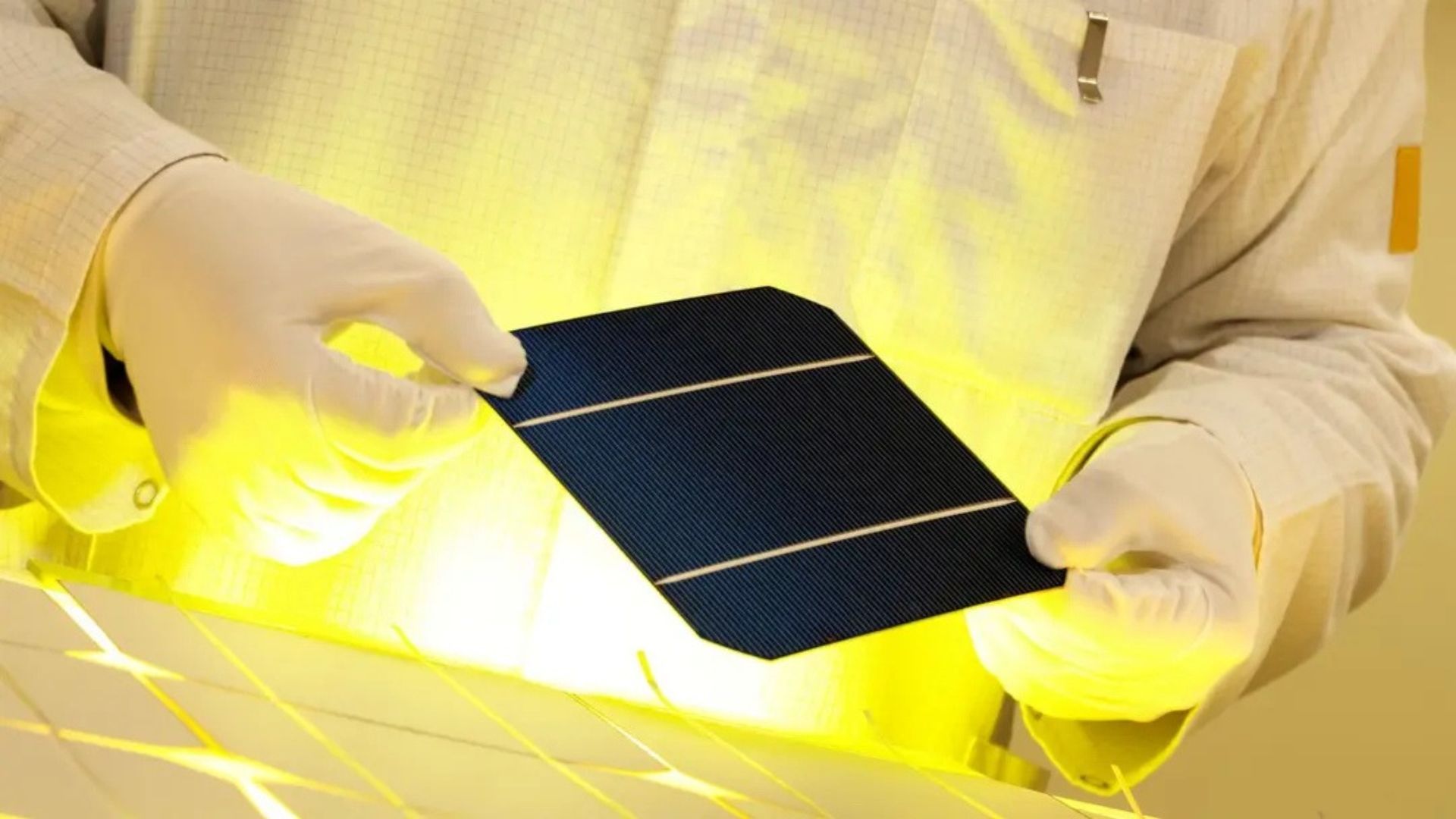
A joint research team led by Southeast University and Soochow University has found a way to stop the molecular battles in flexible perovskite solar cells. To convert rigid solar technology into flexible panels that can be rolled over backpacks or car roofs, researchers had to fix a major manufacturing flaw in flexible perovskite solar cells.
When printing these flexible devices, two layers must be applied at the same time. An ultra-thin fundamental transport layer called a self-assembled monolayer (SAM) and the light-harvesting perovskite crystals
When engineers tried to coat them together on flexible substrates, the SAM molecules and perovskite components bound together too tightly instead of assuming their proper positions. This chemical feud left uneven, defective layers that collapsed under operating heat and humidity.
The joint research team solved this chemical obstacle by introducing a tailor-made “uncoupling” molecule. Discovery acts as a nuclear arbiter. It prevents the two components from reacting prematurely and enables reliable large-scale production.
“A 25-square-centimeter flexible device retained 92.5 percent of its initial PCE of 22 percent after 1,044 hours of maximum power point tracking at 85 °C (185 °F) and 65 percent relative humidity,” the study paper states.
Fix the problem
Flexible substrates have uneven surface roughness and varying hydroxyl group densities, making traditional large-area printing techniques ineffective. Attempting a conventional co-deposition strategy improves surface wettability, but strong intermolecular interactions between transport layer molecules and perovskite components disrupt both substrate anchoring and crystal formation. These chemical conflicts ultimately leave current flexible solar modules far behind their rigid counterparts in terms of both efficiency and stability.
Researchers introduced a “decoupled co-deposition” strategy to improve large-area flexible perovskite solar panels.
The approach solves the challenge of uniformly printing transport layers and perovskite films onto flexible substrates. It provides a practical chemical solution to increase both the conversion efficiency and operational stability of flexible solar devices.
To correct the chemical interference, the research team added a decoupling modulator molecule containing ammonium ions, iodide ions and two sulfonate groups to the precursor solution.
This additive forms strong chelating bonds with the perovskite framework. It blocks harmful interactions between transport layer molecules and perovskite components. With the disorder removed, the transport molecules can quickly adhere to the flexible base while the new additive controls crystal growth and seals defects in the perovskite layer.
The technology works well in testing
This strategy optimizes both the transport and perovskite layers together, increasing efficiency and durability to record levels.
The results reached record levels. Small-area flexible cells achieved a third-party certified efficiency of 26.86 percent. Through scaling, record module efficiencies were achieved across the board: 22.31 percent for 5×5 cm² panels, 20.63 percent for 10×10 cm² panels and 20.15 percent for large 30×30 cm² panels.
The durability also held up under pressure. The flexible modules survived thermal shock cycles from freezing temperatures to extreme heat and met the stringent international stability standard IEC 63163.
“More importantly, this strategy enables the modules to pass the industry-standard IEC 63163 stability series certification, providing an important foundation for the industrial development of flexible perovskite photovoltaics,” the team explained.
This collaborative work provides a new chemical strategy to produce flexible, high-performance perovskite modules in China.
Future research will focus on refining uncoupling molecules, integrating tandem cell designs, and scaling production for roll-to-roll manufacturing. These developments support the modernization of renewable energy systems and help advance national CO2 reduction targets.
The results were published in the journal Science.
