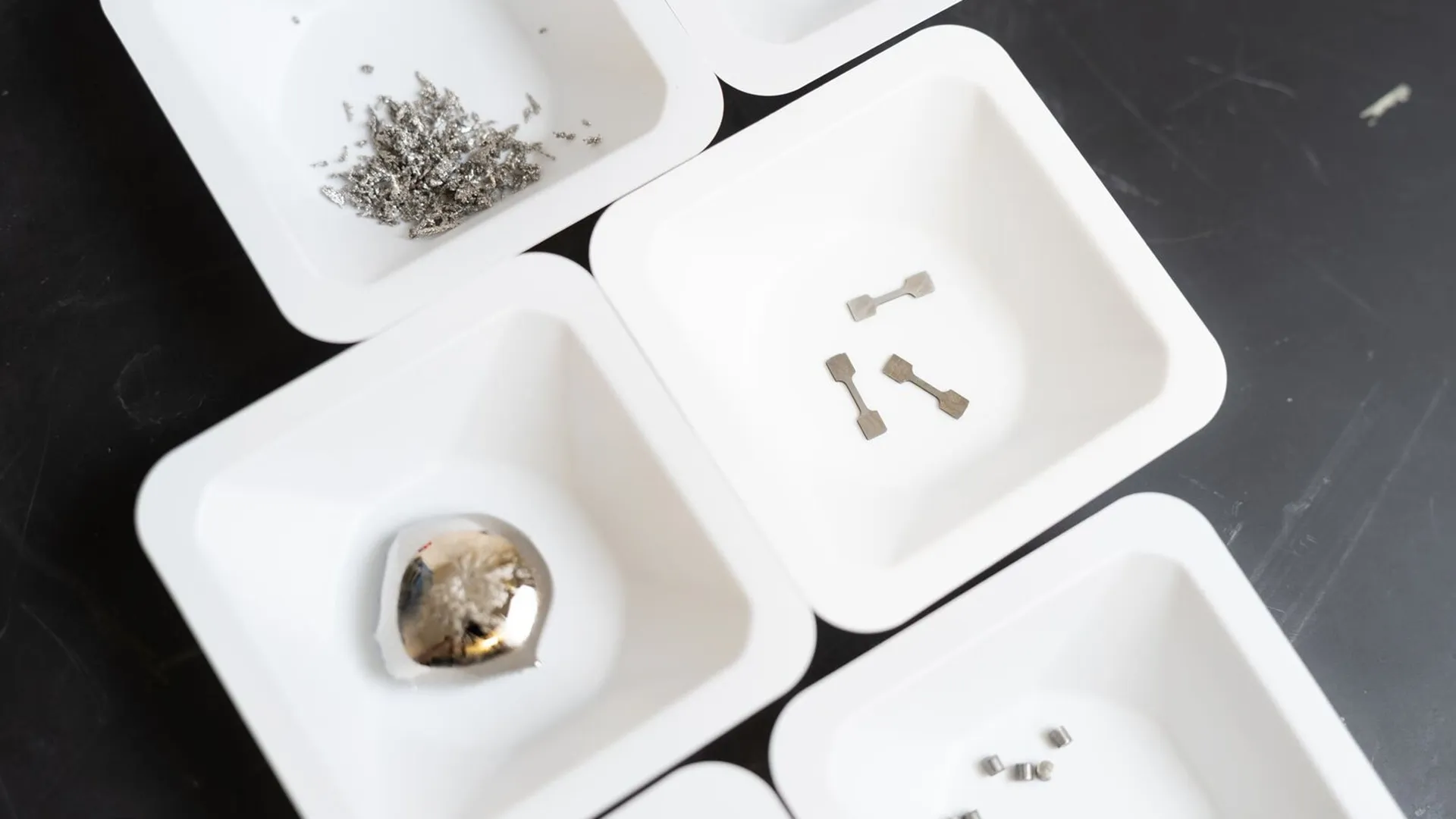
A team of US researchers has developed a novel metal alloy for nuclear fission reactors that can reportedly withstand stresses of up to 600 megapascals (MPa) at room temperature.
The experimental alloy, called V555, was developed at the Department of Energy’s (DOE) Pacific Northwest National Laboratory (PNNL). Scientists examined nearly 1,000 possible metal combinations to determine the most promising formula for the new alloy.
To quickly verify, simulate and optimize the materials, the scientists used a computational approach called Robust Alloy Design (RAD). It can identify materials that can withstand the extreme temperatures, radiation and mechanical stresses found in nuclear reactors.
PNNL said the alloy underwent initial testing at room temperature. “The work has become a way for the nuclear materials community to explore and evaluate a broader range of materials for future nuclear systems,” said Osman El Atwani, PhD, a materials scientist and study leader.
New reactor materials
Traditional coating materials include steels and zirconium-based alloys such as Zircaloy. However, according to El Atwani, new alloys made from several major elements could have better properties through changes in their metal composition.
To select different elements and create entirely new compositions, he and his team developed the eight-step RAD process. Potential materials are evaluated based on various requirements, such as radiation resistance and manufacturability.
Photo credit: Eddie Pablo / Pacific Northwest National Laboratory
Using the approach, the group initially identified around 724 alloy compositions with promising properties. They then turned to the RAD scoring system to narrow down the selection. The assessment tool evaluates alloys based on their suitability for nuclear reactors. The team ultimately selected V555 for initial laboratory testing to see whether the computational approach could work in practice.
“The common practice is to swap this element for that and this element for that,” revealed Mohan Nartu, PhD, a PNNL materials scientist who worked on the project. “Although this technically makes a new material, you haven’t changed the broth, so the soup is still old. You’ll still be somewhat limited.”
After choosing V555, the team made samples to test its structure and strength. To their surprise, initial tests at room temperature revealed an estimated yield strength of around 500 to 600 MPa, which refers to the stress a material can withstand before it begins to permanently deform.
While initial results showed the alloy’s strength, further testing is needed to confirm whether it can be used in nuclear reactors. The team also found that unused V555 material can be recycled to produce additional samples without compromising their quality. This could reduce material waste in experimental testing.
Photo credit: Eddie Pablo / Pacific Northwest National Laboratory
Researchers will now study how V555 withstands heat, radiation and other reactor conditions. They will also test additional compositions identified through the RAD process. The research was supported by DOE’s Office of Nuclear Energy through its Innovative Nuclear Materials program.
“We wanted to show that you can actually select elements from scratch if you have the right criteria in mind and systematically design a material for nuclear applications,” Nartu concluded in a press release.
The study was published in the scientific journal Materials & Design.
