Quantum computers could become far more powerful if scientists could connect them via networks so they could exchange information using light particles. However, there is a big catch.
The quantum connections that make this possible are very sensitive. Even small disturbances can destroy the entanglement between photons and bring communication between quantum devices to a standstill.
Now, in a new study, researchers at the University of Pennsylvania have shown a fascinating way to preserve a certain property of quantum light even after this connection has broken down.
Using a mathematical concept called topology, they transferred a characteristic pattern between photons and found that the pattern remained intact even when the photons lost their quantum connection (entanglement).
“It’s as if a dancer’s unique movement suddenly became part of a duet and persisted even when the dancers were separated,” said Liang Feng, lead study author and professor of materials science and engineering at the University of Pennsylvania.
Giving the photons a pattern that doesn’t disappear
The secret of the experiment lies in a structure called a quantum skyrmion. Unlike a traditional object, its defining characteristic is not its physical shape, but a pattern that encompasses two properties of light: its spin, which is related to polarization, and its orbital angular momentum, which describes how its wavefront twists.
“The light oscillates in different directions depending on where you look at it. It’s like sections of hair on your head grow in different directions,” said Haoqi Zhao, lead author of the study and a postdoctoral researcher at Yale
Together, these variations create a pattern that covers all possible polarization states a fixed number of times. Mathematicians describe this property with a topological number. The interesting thing is that disrupting individual parts of the pattern doesn’t necessarily change this number.
“Imagine a cowlick in a person’s hair. You can move individual strands without changing the overall pattern,” Zhao added.
To test whether this mathematical resilience could help quantum information survive disruptions, the team first needed a way to create and transmit these patterns using photons.
Building a tiny quantum light factory
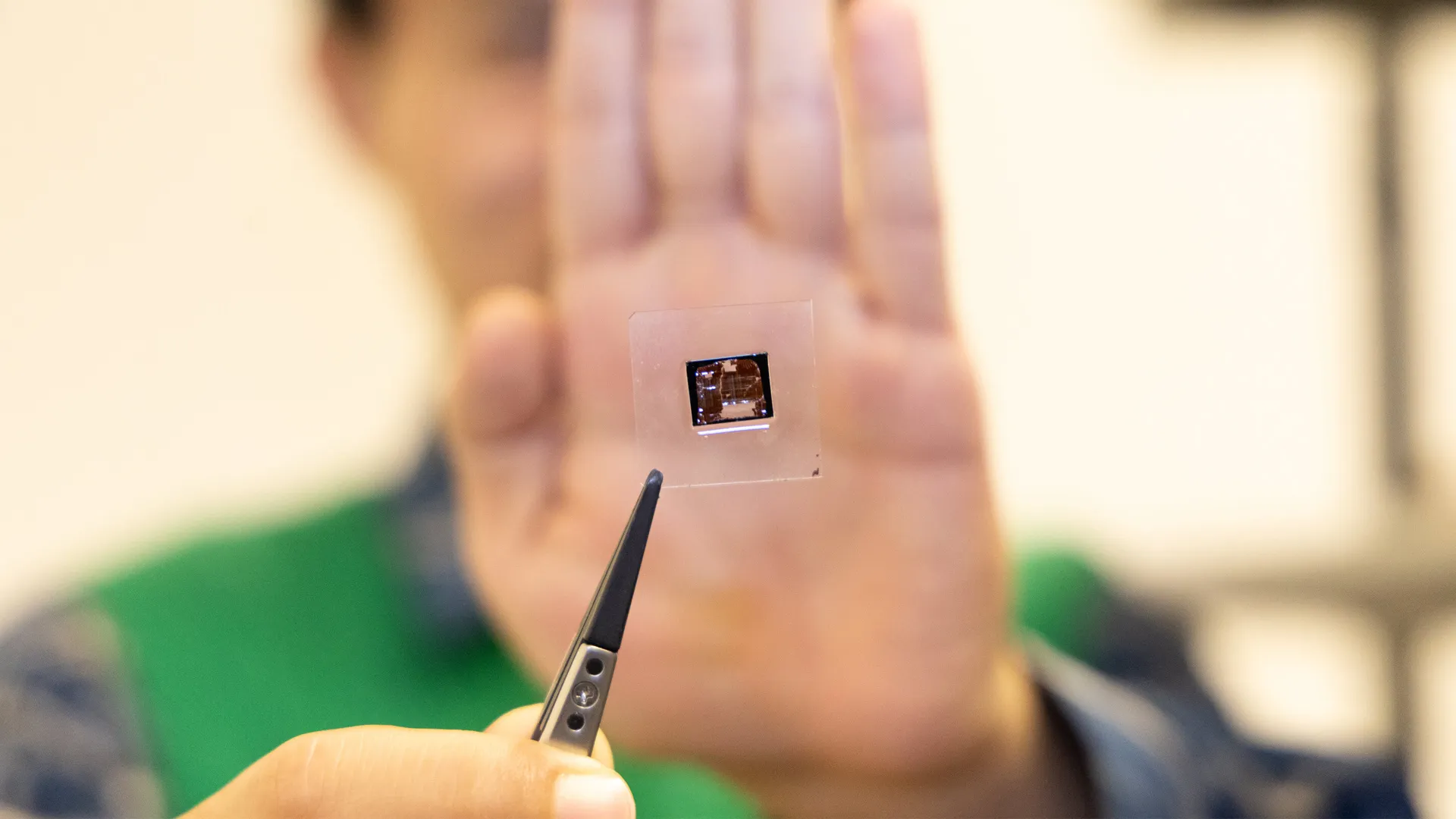
The researchers developed an integrated photonic chip made of silicon nitride, a material commonly used in photonic devices. Its components are designed to create entangled photons, direct them into different paths and imprint a skyrmion pattern on one of them.
The process began with a femtosecond laser pulse directed into two spiral waveguides on the chip. Through a process called spontaneous four-wave mixing, the light created pairs of photons that shared quantum entanglement. To put it simply, their quantum states were linked, even if the photons were subsequently separated.
A series of miniature interferometers then passed the photons through different parts of the chip. A photon entered specially designed microring resonators, where carefully arranged structures on their inner and outer edges produced different polarization and angular momentum components. Combining these components created the desired skyrmion pattern.
The researchers then carried out a measurement of the polarization and momentum of the first photon, a so-called Bell state measurement. This allowed the topological pattern encoded in this photon to be transformed into a quantum state that both photons have in common.
The team verified the resulting states using quantum state tomography, a technique that reconstructs a quantum system from measurements.
The original one-photon skyrmion had a measured topological number of 1.981, which was very close to the expected value of 2. The transferred two-photon states showed similarly high values, with an average quantum state fidelity of 89 percent, indicating how closely the experimentally created state matched the intended one.
The chip’s development involved nearly half a decade of refining techniques, with the team producing prototypes at Penn’s Singh Center for Nanotechnology.
“It’s a bit like building an entire factory in miniature. One part of the chip creates entangled photons, another directs them where they need to go, and another part creates the skyrmion pattern. The challenge was to make all the parts work together,” said Yichi Zhang, one of the study authors and a researcher at the University of Pennsylvania.
The surprising part came when the entanglement disappeared
As the system worked, the researchers deliberately introduced noise into the photons, including unwanted background light, to see how well the transmitted pattern resisted interference.
As the disturbances increased, the quantum state gradually deteriorated and the entanglement between photons eventually disappeared. Nevertheless, the topological number of the skyrmion remained largely unchanged. The pattern only broke down when the researchers introduced even stronger perturbations.
This was particularly surprising because “previous work suggested that these structures depended on entanglement. Our results show that the relationship is more complicated than we thought,” Zhao said.
The researchers also found evidence of these remaining correlations through a measure called quantum discord. In contrast to entanglement, quantum discord can detect certain quantum correlations that persist even when two particles are no longer entangled with each other.
Their persistence suggests that the topology may be linked to a broader range of quantum relationships than scientists previously thought.
The discovery could ultimately help protect quantum information from noise in future quantum networks. However, the experiment does not yet demonstrate a practical communication system that works without entanglement.
The study is published in the journal Natural physics.
