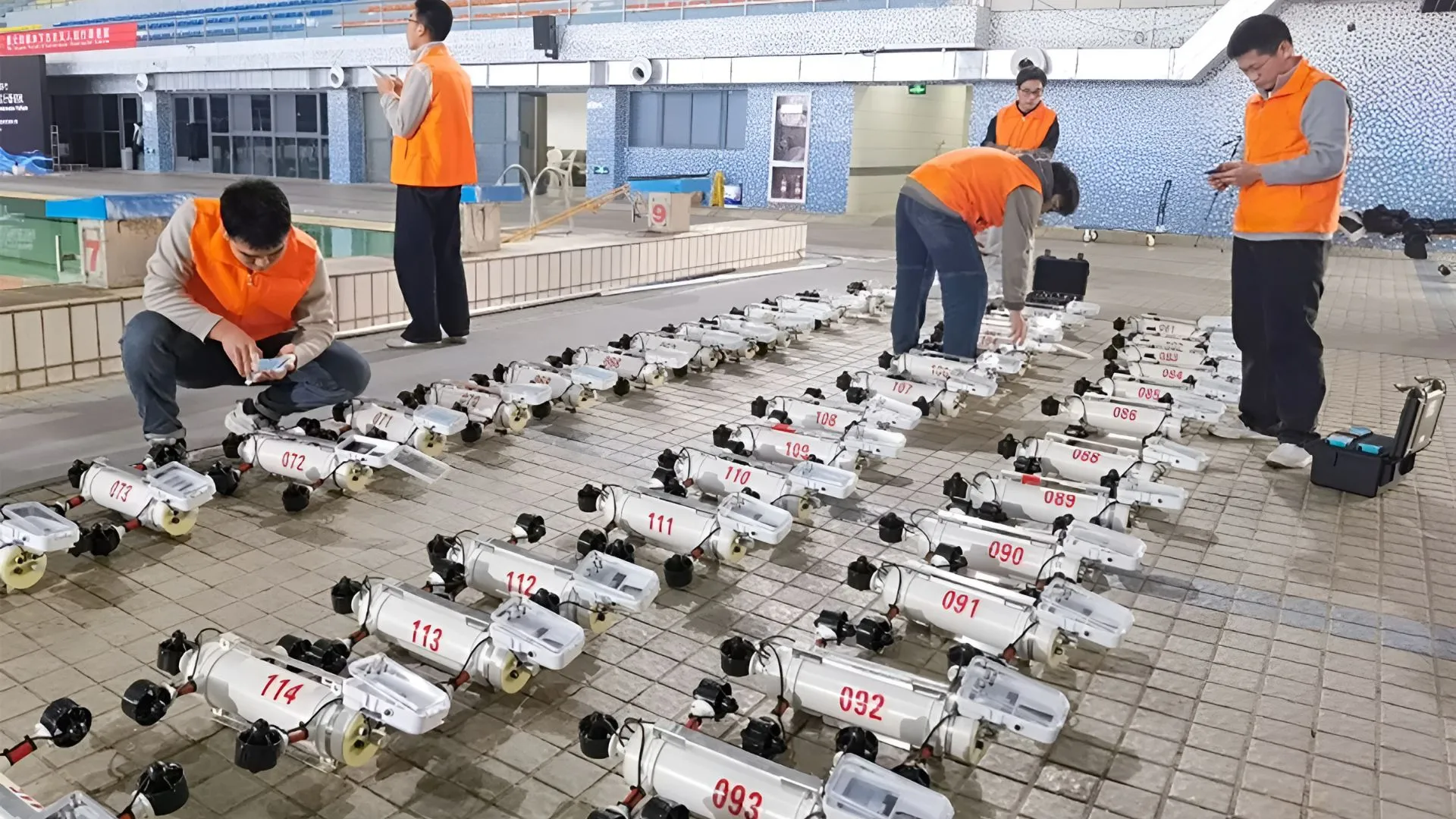
China has set a new world record for simultaneous autonomous underwater vehicles after 116 small drones navigated a swimming pool without human control.
Autonomous underwater vehicles from Northwestern Polytechnical University and Xian Tianhe Maritime Technologies took part in the experiment. Guinness World Records confirmed the achievement after officials monitored the demonstration on August 29.
The drones spent 34 minutes navigating a preset route over 1,640 feet of water. They traveled about 1,640 feet, moving in a coordinated manner through the basin.
116 drones navigate together
The vehicles, known as TH-618, acted as a coordinated swarm during the test. Operators deployed them one at a time before handing control over to their onboard autonomous systems.
Each drone used real-time data to stay on its assigned route. The system also allowed the vehicles to correct their course if disturbances took them off their planned course.
Coordinating dozens of underwater vehicles presents a more difficult problem than simply programming each drone to follow a route. Radio signals also behave differently underwater, making reliable communication a constant technical challenge.
Northwestern Polytechnic University said the swarm shows progress toward larger autonomous underwater systems. The university has spent more than two decades developing technologies for underwater sensing, acoustic communications and visual perception. Further scaling of the system would require each vehicle to maintain formation awareness despite limited underwater bandwidth and visibility.
Compact drones offer endurance
The TH-618 is approximately 24 inches long and 7.8 inches wide. Each vehicle weighs around 5.5 kilograms, making the individual drones small enough for swarm operations.
The vehicles can travel up to 18.6 miles and remain operational for more than eight hours. A camera-based navigation system helps them interpret their surroundings and adjust their movement.
The drones can also react if conditions disrupt their planned path. This capability is important underwater, where currents and other disturbances can gradually divert vehicles from their intended course.
According to Xian Tianhe Maritime Technologies, autonomous underwater vehicles can support civil and industrial work. Potential applications include detailed seabed surveys and oil and gas pipeline inspections.
Underwater schools are gaining ground
The record comes at a time when militaries are increasingly exploring unmanned systems for operations in the air, on land and at sea. An underwater drone attack on a submarine in a Black Sea port in December highlighted the increasing use of these systems in maritime operations.
Chinese researchers have also investigated military applications for coordinated underwater systems. A July article suggested deploying swarms of aircraft around disputed islands in the South China Sea.
The study appeared in Command Control & Simulation, a Chinese-language journal. Underwater drones have been discussed as a tool to close detection gaps.
Other countries have also tested coordinated underwater robots. A European Union-funded project previously demonstrated a swarm of 41 autonomous robots.
China’s new record is more than double that number. The larger formation highlights the challenge of scaling autonomous underwater navigation beyond small groups.
The pool test also provided a controlled environment to validate the swarm’s navigation system. Larger deployments would involve greater distances, greater environmental disturbances, and more difficult communications conditions.