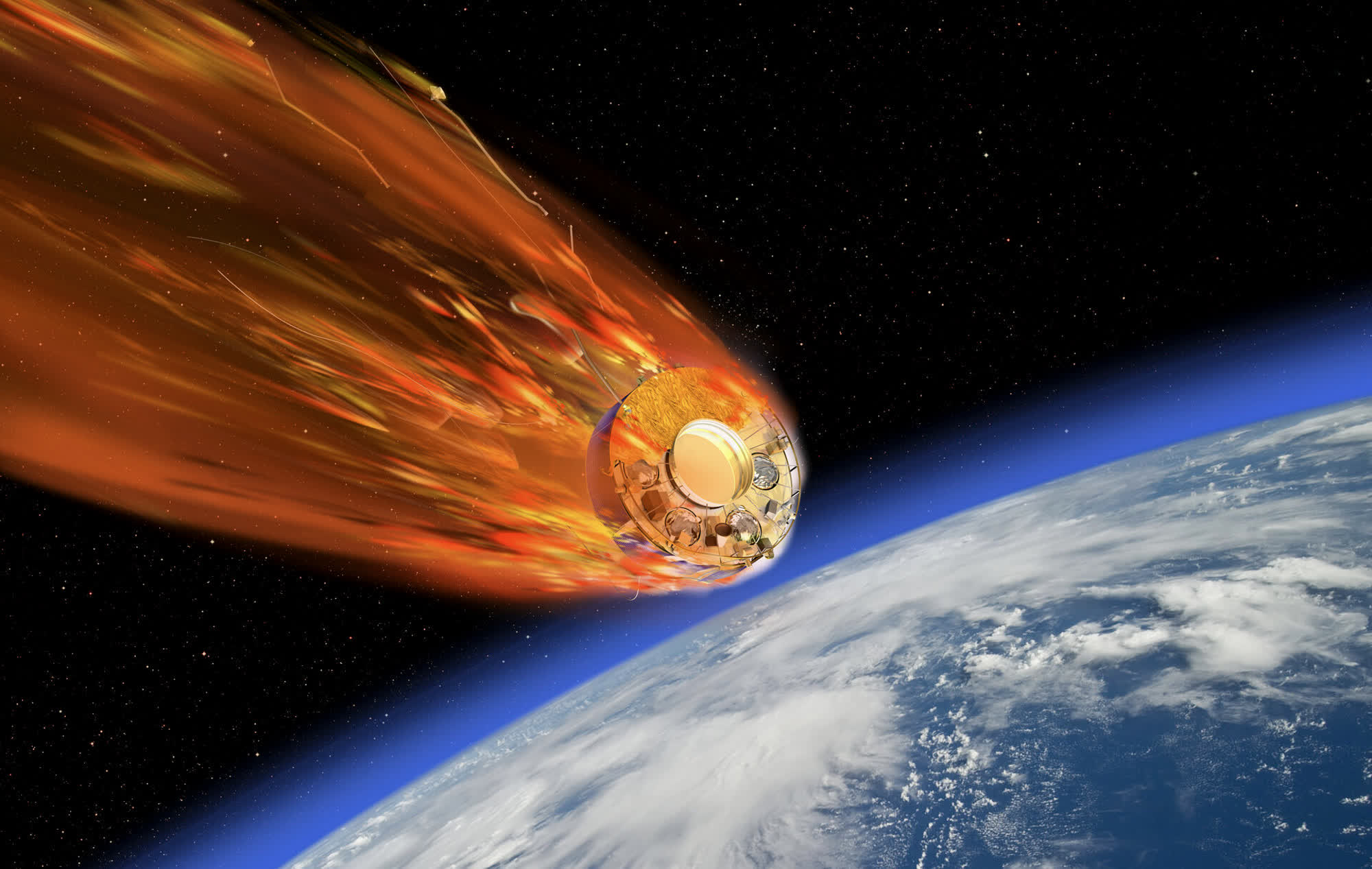
Don’t look it up: After spending more than 20 years in space, the Neil Gehrels Swift Observatory is now expected to experience a “catastrophic” re-entry into Earth’s atmosphere. Most of the telescope should burn up, but a few surviving pieces could eventually reach the ground and pose a danger to people.
The Swift Observatory could return to Earth as early as Friday, US officials said. The telescope is expected to suffer an uncontrolled re-entry after NASA and Katalyst Space Technologies tried – and failed – to correct the spacecraft’s orbit using a robotic device in September.
According to US Space Force forecasts, the Swift Observatory is expected to burn up in the atmosphere upon re-entry. Some components, including parts and mirrors made of tungsten, could survive the plunge into the atmosphere and eventually reach the ground.
The Space Force is tracking Swift’s orbit to determine where these components might end up. Parts of Africa, Australia, India, Southeast Asia, Central America and South America could potentially be affected. However, most likely the remaining debris will end up in the sea.
The aging telescope is going down with a bang, according to John Nousek, an astronomer at Pennsylvania State University who leads Swift’s control team.
“We knew before Swift launched that this day would come. At least in low Earth orbit, what goes up must come down,” Nousek said.
The Neil Gehrels Swift Observatory launched on November 20, 2004 aboard a Delta II rocket. Led by astrophysicist Neil Gehrels, the mission was tasked with studying extremely high-energy events called gamma-ray bursts. Eventually, the orbiting observatory was also used as a “general purpose telescope” for observing transient events in other parts of the electromagnetic spectrum.
Despite its disastrous end, Swift was an extremely successful mission. The main mission was only supposed to last two years, but the telescope remained operational for 21 years and 11 months. In recent years, the spacecraft’s orbit has been affected by the expansion of Earth’s atmosphere due to increasing solar activity.
NASA and Katalyst launched the Swift Boost Mission in July, sending a robotic probe to try to correct Swift’s deteriorating orbit. The mission failed and the probe returned to Earth in September 2026.
Like other legendary space observatories, including Hubble and the James Webb Space Telescope, Swift made important contributions to astrophysical research. The telescope observed more than 2,000 gamma-ray bursts, 1,400 exploding stars, as well as comets, asteroids and black holes.
