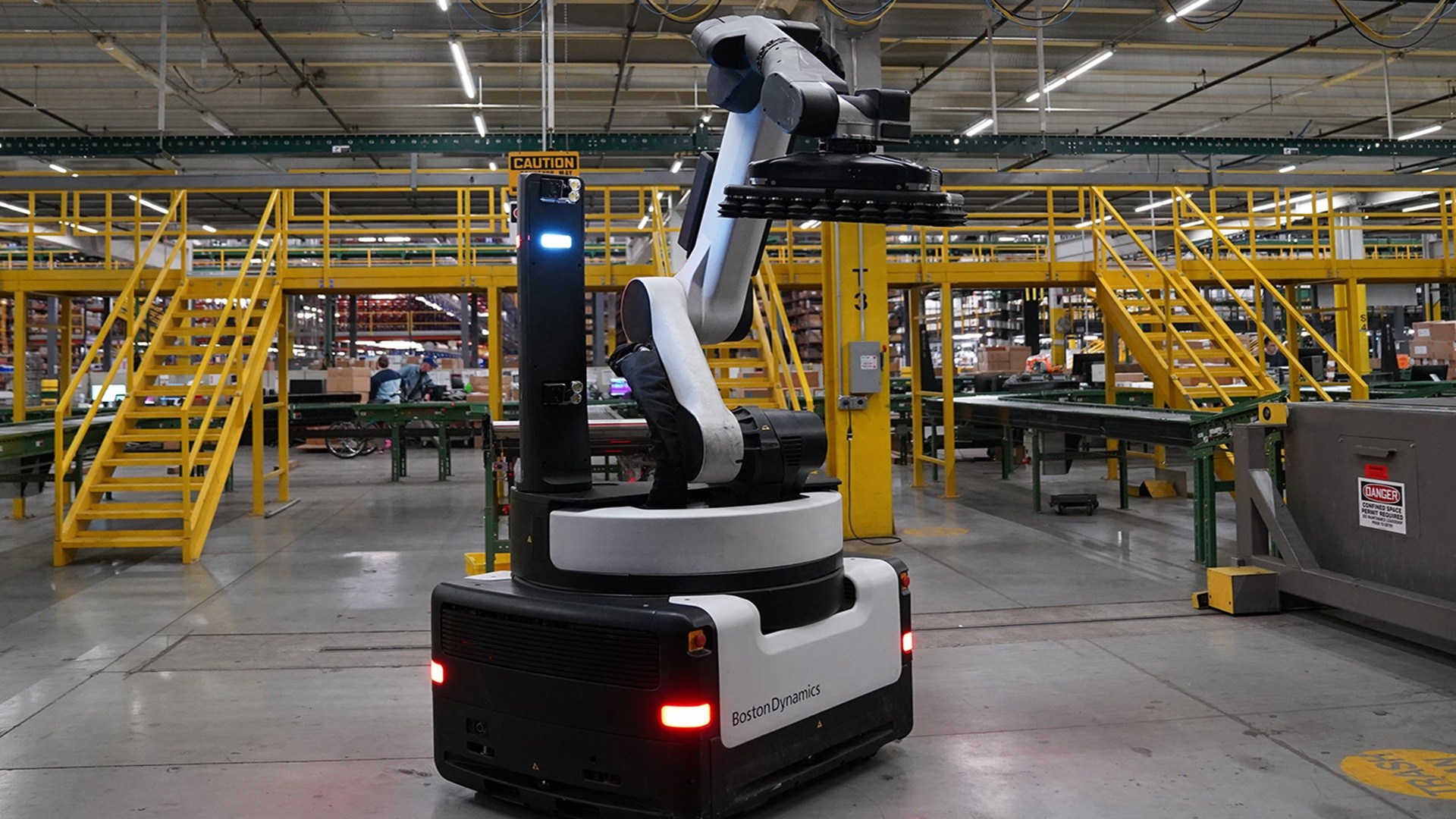
Hyundai-backed Boston Dynamics has unveiled Stretch Gen 2, a next-generation autonomous robot designed to unload trailers faster and reduce maintenance downtime in high-volume logistics operations.
Based on data from more than 100,000 hours of operation and tens of millions of boxes unloaded from its predecessor, the improved robot features a redesigned gripper, improved sensing, 81 percent less internal wiring and modular components that enable faster repairs.
The changes are aimed at preventing mechanical wear and electrical failures that could cause the robot to go offline. Boston Dynamics also redesigned its exterior panels to withstand falling boxes and repositioned the emergency stop button to reduce accidental safety stops.
“Our customers rely on Stretch to keep cargo moving, and every hour a robot sits idle is an hour of work piling up on the dock,” said Brian Donnelly, vice president and general manager of logistics robotics at Boston Dynamics. “In Gen 2, we focused on the things that actually take robots offline in the real world. We made it harder, made it easier to maintain, and ensured it continues to improve long after deployment.”
Faster repairs keep robots running
The redesigned robot also aims to make maintenance less time-consuming when components need to be replaced. According to Boston Dynamics, a complete backup drive change now takes about an hour, compared to a full day before.
The company has removed dynamic cables and complex wiring harnesses and replaced them with simpler architecture and standardized high-strength fasteners. These changes are intended to reduce the number of tools required for repairs and shorten the time technicians work on the machine.
Stretch Gen 2 also features built-in diagnostics and maintenance tools that enable customers’ maintenance teams to perform more routine maintenance. This could reduce reliance on external support and help keep robots operational in busy warehouses.
Software updates improve performance
Beyond the mechanical changes, Stretch Gen 2 runs on a redesigned onboard computing platform that supports continuous software improvements. According to Boston Dynamics, regular software releases will improve fall detection, motion planning, picking strategies and world modeling in deployed robot fleets.
These updates can result in performance improvements without requiring customers to replace or upgrade the robot’s physical hardware.
The robot can unload up to 1,000 boxes per hour. However, actual throughput depends on factors such as the weight of the boxes and how neatly or irregularly the packages are stacked in the trailers. A multipick function allows multiple boxes to be handled in a single picking cycle to achieve higher throughput rates.
Its battery is designed for two work shifts, and a quick charger can restore the charge to 90 percent in about 75 minutes. Thanks to the integrated lighting, the robot can also work in dark trailers where visibility may be limited.
Stretch has a pre-trained vision system that can identify most packages from day one of deployment without the need for additional programming.
Boston Dynamics has positioned Stretch as a solution to automate one of the more physically demanding tasks in logistics. Unloading trailers involves handling large quantities of packages in confined spaces, often in changing lighting conditions and with boxes stacked unpredictably.
The second-generation model builds on the company’s existing implementations with a greater focus on reliability, maintainability and sustainable performance in demanding warehouse environments.
