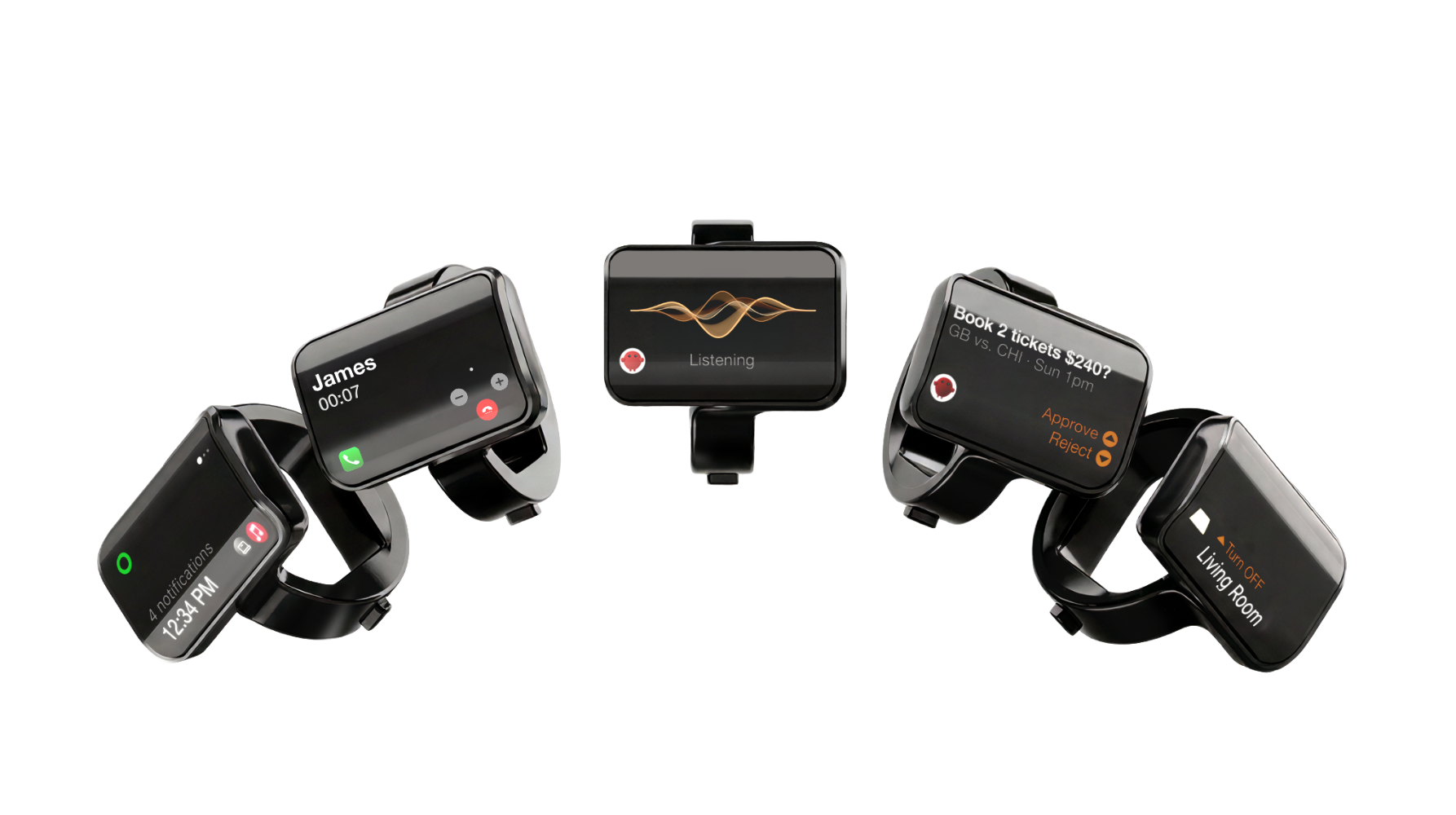
Artificial intelligence has made great progress in a very short time: it writes emails, answers questions, generates code, images, videos and much more. But as breathtaking as these advances are, deploying AI is still arduous. People have to pull out their smartphone, find the right app, and then enter a prompt before anything gets done.
To eliminate that friction, a startup called Aina Computers Inc., which just completed 15 months in “stealth mode,” is trying to bring its flagship product to market: an AI-native smart ring with an OLED display designed specifically to control autonomous AI agents.
Aina founder Apoorv Shankar told SiliconANGLE that hardware interface development has not kept pace with advances in AI. For people to access information, they need to browse smartphone applications or turn on a laptop.
Even the most basic tasks, like ordering an Uber, require someone to open an app, enter their destination, and click to confirm. To join a virtual meeting, the user still needs to search through their email to find the right link. In Shankar’s view, AI is trapped behind a software layer, meaning it cannot proactively support people when they need it.
Aina’s ring is intended to free the AI from these shackles and make access as easy as saying a command. The ring is made of titanium and features a colorful OLED display, a microphone and speaker, and an 18-hour battery. There’s also a mechanical “shifter” that can track thumb gestures in four directions. “We started developing Aina with the thesis that AI would evolve from following instructions to anticipating what we need,” Shankar explained.
The device is powered by Aina’s context-sensitive operating system software, designed to learn the ring bearer’s behavior over time to anticipate their needs. It can connect to the user’s devices such as their smartphone and computer, as well as any AI agents they use. Once operational, it attempts to anticipate what users need at any given time and displays the information they need on the ring’s display before they even ask for it.
“With proactive agents, this shift has already begun,” Shankar said. “Agents like Muse, Instinct and Dots will soon perform hundreds of our daily tasks, but we will still need to direct them via text or voice. But soon they will learn our patterns, build on our context and become proactive in almost every interaction, just waiting for our approval.”
Shankar founded Aina last year. The startup was originally a research laboratory for human-computer interaction. The 40-person team experimented with dozens of different hardware concepts, including a three-key adaptive Mac keyboard called Dune, before ultimately settling on the Ring as the ultimate interface for AI agents.
Aina’s $399 ring is available for pre-order now and will ship to customers in January. This is when people’s relationship with AI will fundamentally change, Shankar believes. When someone wears Aina’s ring, the way they interact with their AI agents generally involves simply saying “yes” or “no,” because they will quickly learn to anticipate what their users need at the moment they need it, he said.
Users can interact with the ring in three ways. The microphone is there to support voice interactions. The user simply presses and holds the center button to call an agent and instruct them to do something, or they can also simply use it to take a few quick notes. It will also be able to route phone calls, allowing people to have a conversation simply by holding their hand close to their ear.
The ring also supports hints supported by the context-sensitive operating system. Because it learns to anticipate the user’s needs, it can proactively order an Uber ride based on the time of day, their location and their schedule. All the user has to do is click or say “yes” to confirm and the ring will book the ride. Alternatively, if someone is late for an appointment, the ring will proactively create a message to let the person they are meeting know when they will arrive.
Shankar said the ring can also be used as a remote control, so someone watching TV can tell them to pause or rewind the show they are watching. It can adjust microphones and cameras during video calls, skip to the next song when someone is listening to music on their iPod, and so on.
“Every major shift in computing comes from the combination of software and hardware,” Shankar said. “The mouse and graphical user interface gave us personal computing. The touchscreen and app gave us mobile computing. Now with Aina, we are entering a new era where personalized computing is right at your fingertips.”
Images: Aina
Support our mission to keep content open and free by interacting with theCUBE community. Join theCUBE Alumni Trust Networkwhere technology leaders connect, share information and create opportunities.
- Over 15 million viewers of theCUBE videosto spark conversations about AI, cloud, cybersecurity and more
- Over 11.4k theCUBE alumni — Connect with more than 11,400 technology and business leaders shaping the future through a unique, trusted network
Founded by tech visionaries John Furrier and Dave Vellante, SiliconANGLE Media has built a dynamic ecosystem of industry-leading digital media brands, reaching over 15 million elite tech professionals. Our new proprietary theCUBE AI Video Cloud is a game-changer in audience engagement, leveraging the theCUBEai.com neural network to help technology companies make data-driven decisions and stay at the forefront of the industry conversation.
