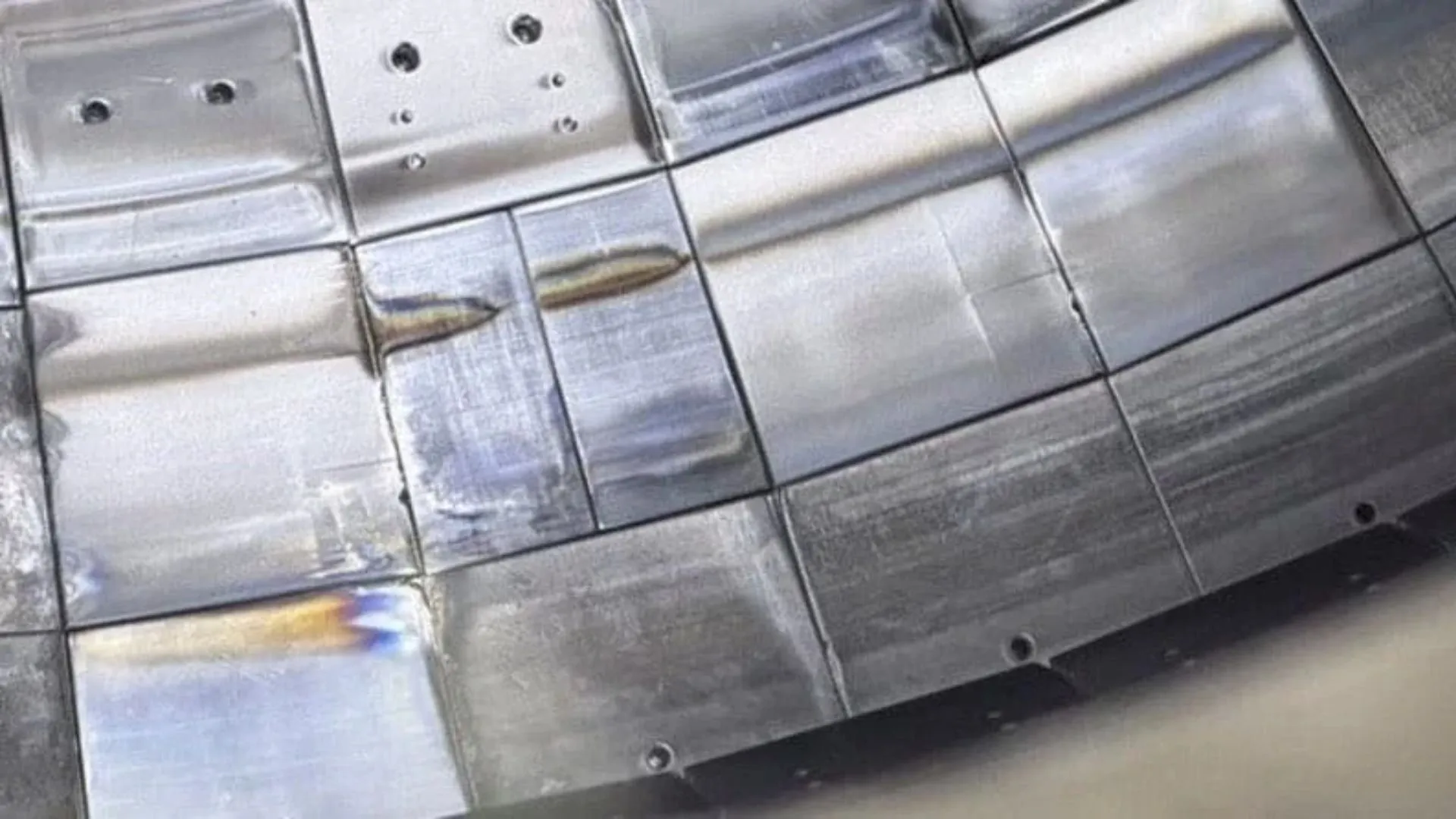
Full-size 3D printed tungsten tiles have survived the extreme heat in a large nuclear fusion test reactor and remained completely intact. The protective components survived 74 direct plasma discharges at the DIII-D National Fusion Facility in San Diego. During the tests, the tiles were exposed to harsh particle bombardment in the machine’s exhaust zone, the so-called divertor, for three days.
During high-performance runs, the tiles were exposed to direct plasma for about four minutes. They even survived an accidental fire test that melted a neighboring traditional tile and sprayed molten metal all over them. The printed surfaces held strong, proving that the material can withstand the intense heat flow and particle bombardment from plasma hotter than the center of the sun.
Tungsten is the first choice for lining future fusion power plants such as ITER. At 3,422 °C (6,191 °F), it has the highest melting point of any metal, more than twice that of steel. It is also exceptionally dense and weighs about as much as pure gold.
But tungsten has long frustrated engineers. Below 600 °C (1,112 °F), the metal becomes brittle and shatters like glass under physical stress. “However, most attempts to 3D print tungsten, almost all of which used lasers as a heat source for printing, turned out to be porous and full of cracks,” the team said.
With a high-speed electron beam
To overcome this hurdle, researchers turned to electron beam powder bed fusion (EB-PBF). This method uses a high-speed electron beam to melt tungsten powder layer by layer in a vacuum chamber.
The jet sweeps across the powder bed fast enough to keep the surrounding metal above 1,400°C (2,552°F) throughout the build. By keeping the construction envelope red-hot throughout the entire process, the system prevents cracks caused by thermal shock and brittle cooling during manufacturing.
While researchers proved the concept on small coin-sized samples in 2025, building reactor-capable components required industrial scale-up. The final tiles should be about 140 millimeters in diameter and 20 millimeters thick.
A joint team from North Carolina State University, Oak Ridge National Laboratory (ORNL) and Japanese precision manufacturer JEOL Ltd. The jump was achieved in just eight months. JEOL produced the full-size tiles on its large format printer in Akishima, Japan. ORNL provided expertise on fusion materials and project financing.
Elimination of a critical bottleneck
After printing, the tiles were sent to the state of North Carolina for finishing. Engineers formed the assembly fixtures using electrical discharge machining, an electrical wire cutting method that does not involve mechanical stress. A computer-controlled grinder then removed about 250 micrometers from the surface, creating a mirror-like surface tailored to the curved walls of the divertor. The tiles were mounted on copper alloy bases and bolted into the reactor for testing in July.
Scientists say the successful attempt removes a critical bottleneck on the path to commercial fusion energy. By demonstrating that large-scale additive manufacturing can produce robust, crack-free tungsten parts, the team showed that advanced 3D printing is no longer just an experimental curiosity, but a viable factory method for building the next generation of clean fusion reactors.
“The qualification of new materials and manufacturing methods requires fusion-relevant data,” concluded Dr. Florian Laggner, assistant professor and plasma physicist at the Department of Nuclear Engineering at North Carolina State.
“By exposing additively manufactured tungsten in DIII-D, we are generating data on survivability and erosion.”
