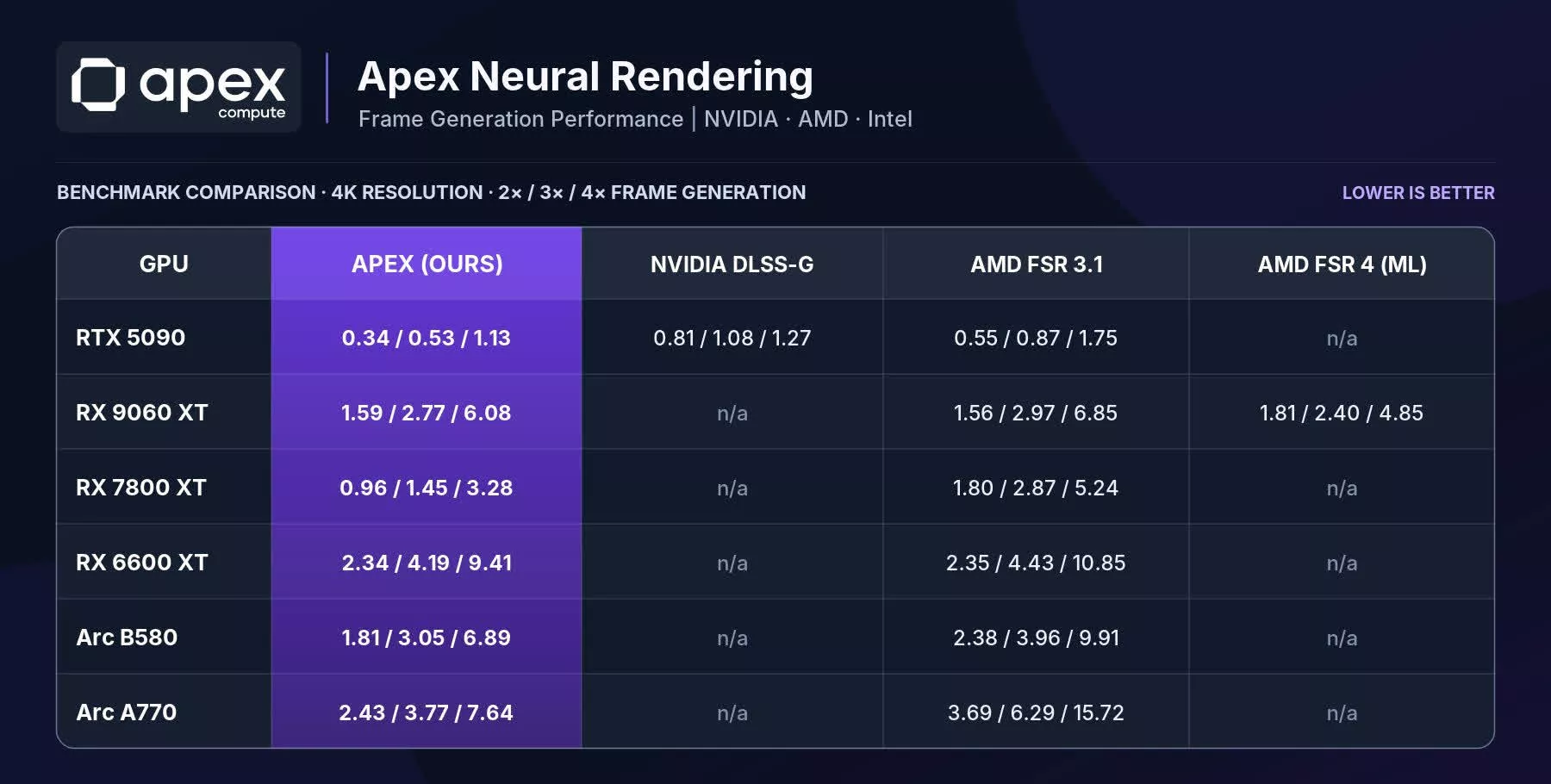
Short: Nvidia DLSS is widely considered the gold standard in frame generation, but the feature is officially limited to RTX 40 and 50 series GPUs. A new competitor boldly claims that its solution, which it plans to open source, is not only faster and better looking, but also supports every graphics architecture since the GeForce GTX 16 and Radeon RX 5000 series.
Users can now download an open beta to test Apex Compute’s claim that its neural rendering suite outperforms and dwarfs Nvidia’s DLSS frame generation. Components for super-resolution and beam reconstruction (noise reduction) are still in development.
Apex’s YouTube clips show that frame generation in The Last of Us Part II and Hogwarts Legacy produces less ghosting than DLSS. Internal benchmarks also show that dual frame generation on an RTX 5090 at 4K costs just 1.01 milliseconds per frame generated, compared to 1.26 ms with DLSS. Apex also claims to reduce VRAM usage by approximately 62% from 562MB with DLSS to 214MB.
Hardware support is also much more comprehensive with Apex. Nvidia says its AI-driven frame generation requires hardware first introduced with the RTX 40 series. Although Apex has not yet released its source code or fully explained its technology, the solution supports Nvidia GTX 16 and newer, AMD Radeon RX 5000 and newer, Intel Arc A and B series, Apple M1 and newer (via a separate Metal test kit), and the Steam Deck.
— Apex Compute (@apexcompute) November 11, 2026
Apex Neural Rendering is available via GitHub and the company’s website, and runs on OptiScaler, with separate packages for games that already have it installed and those that don’t.
To get started, launch the game once and close it, extract the archive, run the installer from the folder containing the game executable, restart the game and enable DLSS frame generation if available. The GitHub repository also includes a tool that losslessly captures frame generation inputs and renders them across competing solutions for direct comparisons.
Meanwhile, AI-powered coding has recently created another way for Radeon owners to access the full range of Nvidia DLSS features. The DLSS NR on AMD mod enables DLSS 5 neural rendering, super resolution, frame generation and ray reconstruction on AMD Radeon RX 6000 and newer GPUs in Windows 11 DirectX 12 games that already support DLSS, FSR or XeSS.
Modders have traditionally had to use OptiScaler to switch between the three upscalers, depending on their hardware and what the particular game supports. However, AMD recently extended FSR 4.1, which compares favorably to DLSS, to its Radeon RX 7000 and 6000 GPUs, reducing the need for modding.
