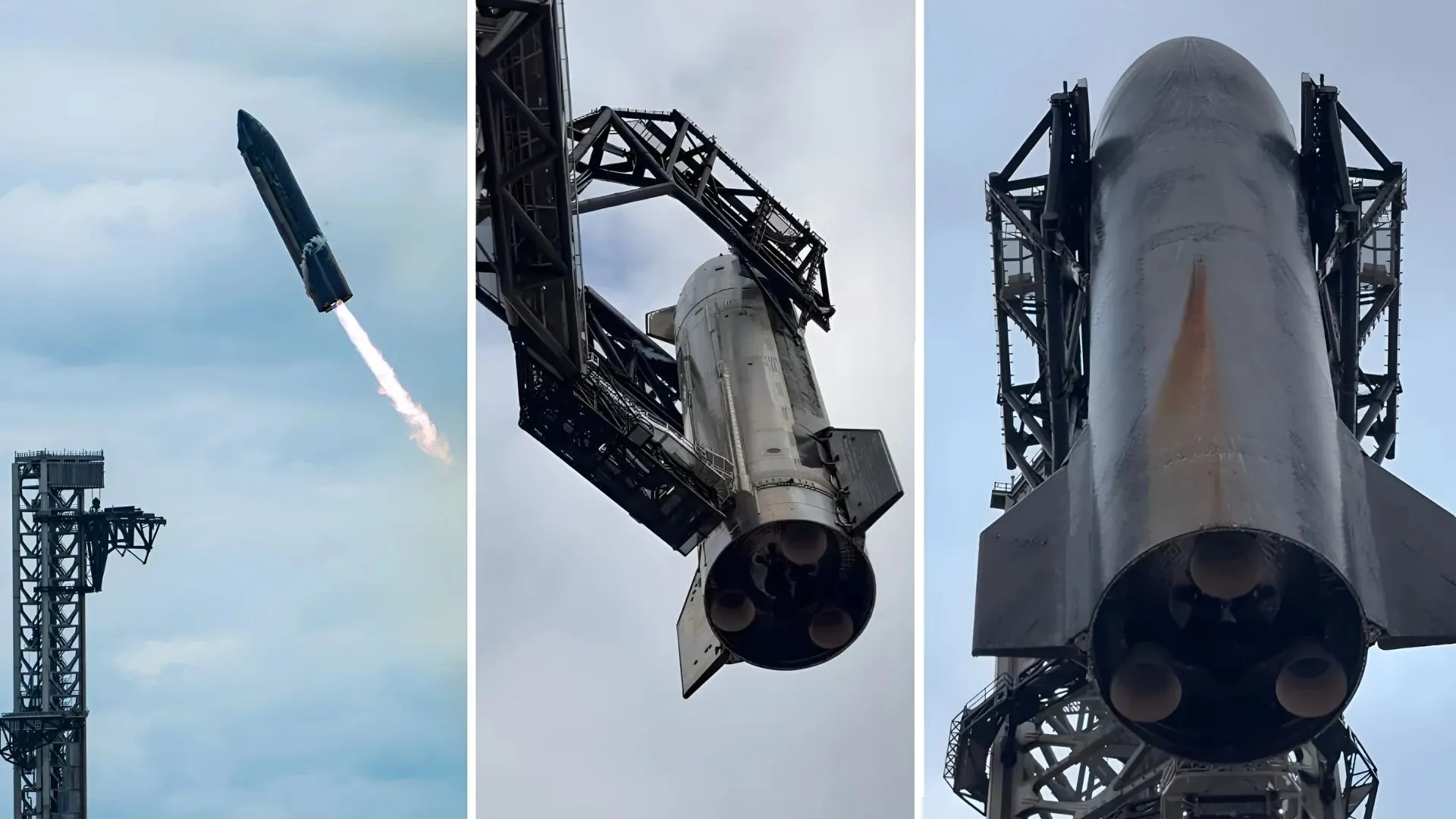
SpaceX has successfully intercepted its Starship spacecraft from the launch tower for the first time, marking an important milestone in the development of reusable rockets. The achievement came on Saturday, November 14, after the spacecraft completed its longest orbital flight to date. It returned to the starbase in South Texas and landed directly in the mechanical arms of the tower.
The recovery came after Starship’s 15th test flight, which began Friday evening. SpaceX had planned to recover both stages using its giant launch tower. However, the Super Heavy booster aborted its landing attempt after a low fuel warning. Instead it splashed in the Gulf of Mexico.
Ship 42, the rocket’s upper stage, has successfully completed its return. The spacecraft demonstrated that SpaceX could recover both types of vehicles independently. It also brought the company closer to its goal of making Starship fully reusable.
The spacecraft completes the return to orbit
During Flight 15, Ship 42 orbited the Earth 14 times in approximately 22 hours. The spacecraft reached an altitude of about 161 miles (260 kilometers). In addition, 26 next-generation Starlink V3 satellites were launched into low Earth orbit.
After completing its orbital mission, Starship fired an engine to begin descent. When entering the Earth’s atmosphere, the space probe was then exposed to extreme temperatures. Its speed reached approximately 17,000 miles per hour before air resistance slowed it.
Ship 42 then re-ignited three engines to control its final descent. The spacecraft maneuvered into a vertical position and approached the starbase’s launch tower. Two giant mechanical arms, also called chopsticks, then secured the vehicle.
SpaceX employees gathered outside to watch the historic landing. The company’s webcast captured the moment Ship 42 settled into the tower. SpaceX commentator Dan Huot called the success a major breakthrough in space travel.
“That was the missing link,” Huot said during the broadcast. He also described the recovery as a key technical achievement for the company.
Why catching is important
SpaceX has already demonstrated its ability to capture Super Heavy boosters. The company successfully performed this maneuver on three previous Starship flights. However, recovering the upper stage represents a much greater technical challenge.
The ship travels further and faster than its booster during flight. It must also withstand the intense heating that accompanies re-orbit. To successfully guide the spacecraft back into the tower, precise control is required throughout the descent.
Restoring both phases could significantly reduce the time between spacecraft missions. SpaceX wants to inspect, overhaul and restart its vehicles much more quickly. This approach would bring missile operations closer to commercial aircraft turnaround times.
However, some technical challenges still remain. Starship’s heat shield still needs further development before SpaceX can reuse it with minimal remanufacturing. Its black hexagonal tiles protect the spacecraft from extreme temperatures upon re-entry into the atmosphere.
Greater ambitions for Starship
The recovery milestone could also support SpaceX’s growing satellite ambitions. The use of Starlink V3 represents another important part of Flight 15. SpaceX ultimately plans to build a constellation with 100,000 satellites.
Elon Musk has also discussed a separate project called Starmind. The proposed network would include one million satellites supporting orbital data center infrastructure. Such ambitious deployment plans would require an exceptionally high launch frequency.
Starship could ultimately support these operations alongside SpaceX’s lunar and Mars ambitions. NASA also expects the spacecraft to play a critical role in future lunar exploration.
SpaceX has yet to recover both Starship stages during the same mission. Nevertheless, the capture of Ship 42 shows that the upper stage can return directly to its launch tower. The company will likely try the maneuver again on an upcoming flight.
