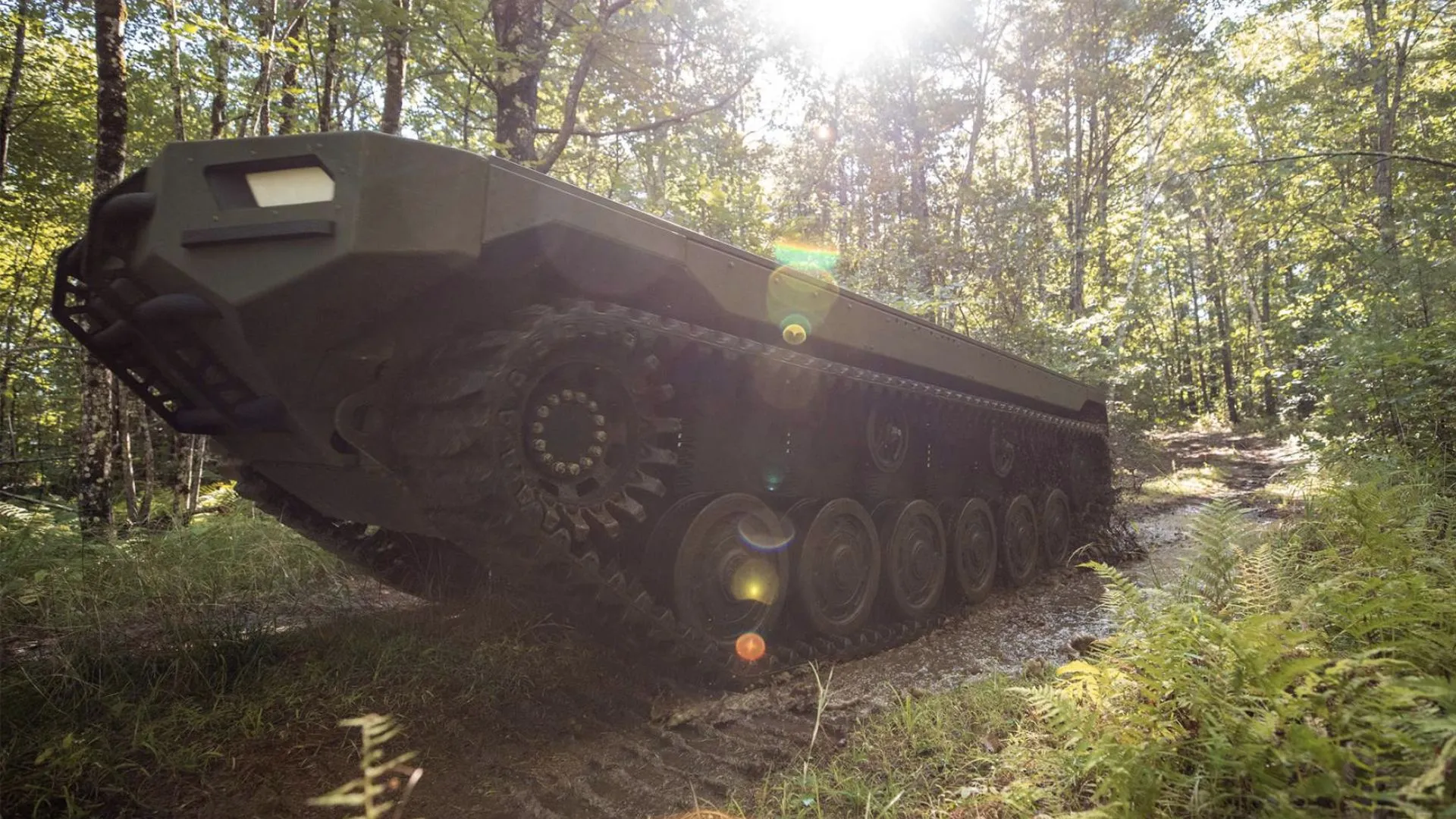
The US Marine Corps will expand its unmanned warfare capabilities. The US Marine Corps Warfighting Laboratory (MCWL) at Quantico is now purchasing two RIPSAW M3 robotic ground vehicles from Textron Systems and its subsidiary Howe & Howe.
Rather than serving as traditional operational vehicles, the platforms will initially act as experimental and integration testbeds, allowing Marines to evaluate different payloads, sensors and mission configurations.
Robotic ground vehicles set standards for speed and agility
“Textron Systems’ M3 robotic ground vehicles set the standard for speed, agility and flexibility across multiple missions,” said Sara Willett, vice president of programs.
“Combining the M3’s proven performance and reliability with the MCWL mission to advance future operational concepts and capabilities will enable the Marine Corps to advance unmanned force design and battlefield deployment.”
Textron said the M3 vehicles will serve as experimental and integration testbeds, providing Marines with the ability to integrate various payloads and sensors, demonstrate mission sets and inform additional robotics requirements.
The M3 robotic vehicle has a modular open system architecture
Leveraging Textron Systems’ more than sixty years of experience in air, land and sea unmanned multi-domain technologies, the M3 vehicle features a Modular Open Systems Architecture (MOSA) to provide the warfighter with increased agility and functionality in even the most complex battlefield environments.
According to a press release, the vehicle offers a payload capacity of more than 5,000 pounds, a flat deck to support a variety of payloads and operating speeds of over 30 miles per hour to support missions in complex terrain around the world.
“For over two decades, Howe and Howe, Inc. has developed high-performance, multi-domain off-road platforms with extreme use and durability in mind,” said Senior Vice President Michael Howe.
“The M3 will be an excellent fit for the Marine Corps and its demanding environmental requirements. Howe and Howe Inc. is not only proud to deliver the RIPSAW M3 vehicle, but is also pleased to work closely with the Marine Corps to develop technologies that will continue to meet their specific needs.”
With more than three million operational hours of unmanned experience across air, land and sea domains, Textron Systems claims it continues to expand its autonomous technology to support current and future mission sets.
The acquisition reflects the growing importance of robotic and autonomous technologies in modern warfare. Militaries around the world are increasingly exploring unmanned systems to improve mission flexibility, reduce risks to personnel and expand their ability to conduct missions in challenging environments.
Through the RIPSAW M3 program, the Marine Corps will have the opportunity to experiment with various robotic capabilities and evaluate how unmanned ground vehicles can support its evolving mission requirements.
The vehicles will allow Marines to integrate various mission payloads and sensors, demonstrate potential mission applications and identify additional requirements for future robotic systems. Lessons learned from these activities are expected to help shape the Marine Corps’ broader approach to unmanned force design and battlefield integration.
By using the RIPSAW M3 as a test platform, the Marine Corps can evaluate how different payloads and sensor systems perform in different mission scenarios. This will help identify practical applications for robotic ground vehicles and provide insights into the technologies required for their future integration.
