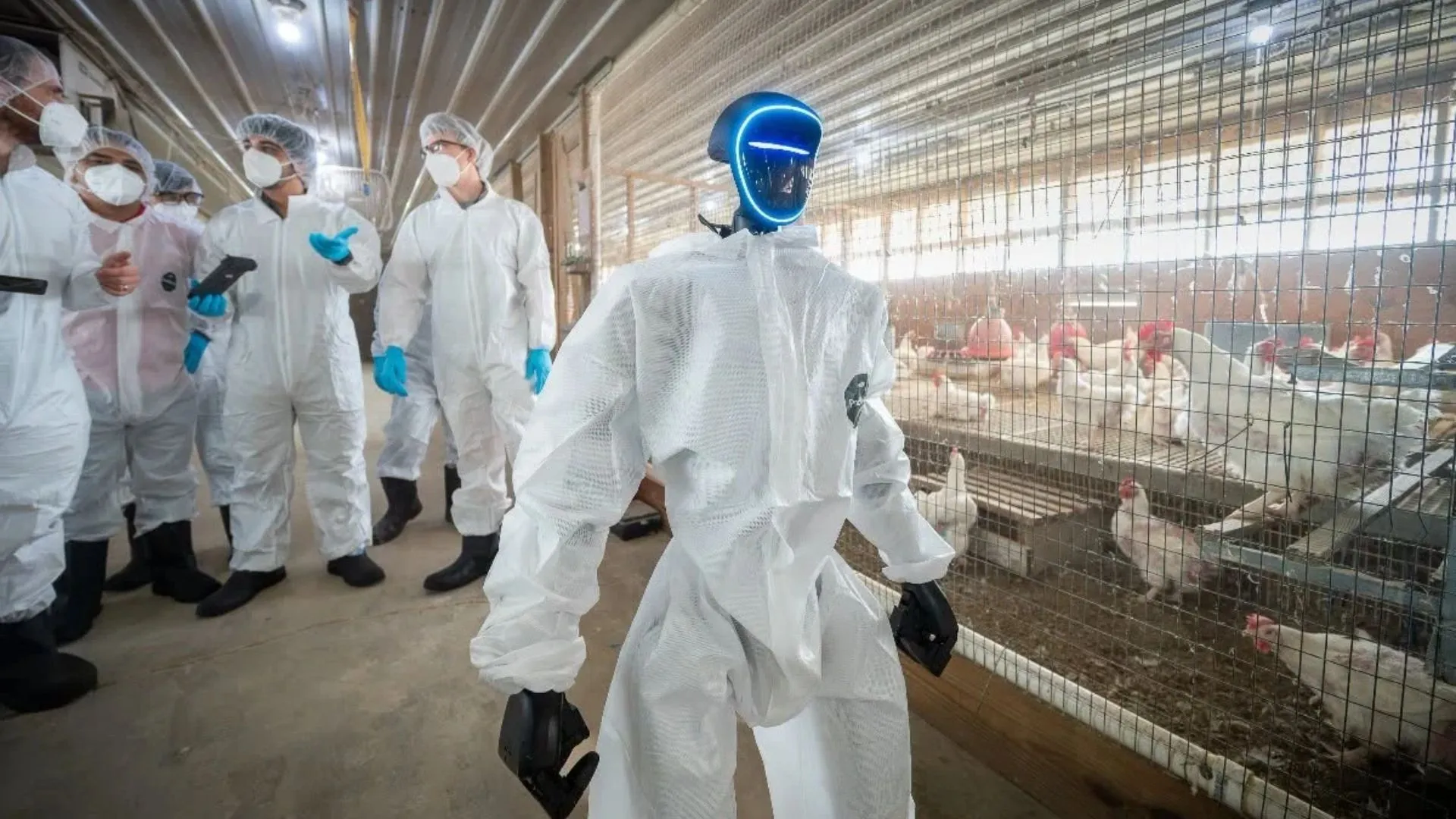
Humanoid robots are taking on an unusual new task: collecting eggs on poultry farms.
Researchers at North Carolina State University are developing Howl, a 4-foot-tall robot that detects and collects eggs laid on the floor of cage-free poultry houses.
The project, using Unitree G1 robots as its base, aims to address labor shortages while improving bird welfare and productivity.
The egg-collecting robot is part of a broader effort by the university’s Artificial Intelligence and Robotics Laboratory to bring advanced automation to commercial poultry farming.
AI powered egg harvester
The 4-foot-tall robot called Howl, which is essentially a Unitree G1 humanoid, detects and retrieves eggs left outside nest boxes in cage-free poultry houses. The project is part of a broader effort to use automation, machine learning and computer vision to address labor shortages, reduce egg losses and improve animal welfare.
The switch to cage-free egg production presents poultry farmers with new challenges. Unlike traditional cage systems where eggs roll onto conveyor belts for collection, cage-free coops require some eggs to be manually collected from the floor. In some environments, these ground eggs can represent 2 to 15 percent of total production.
For a farm with around 100,000 birds, this could mean up to 15,000 eggs needing to be collected each day. The process is labor-intensive and delays in egg collection can affect product quality. Howl is being developed to automate this task using artificial intelligence and robotic manipulation. The robot is supposed to identify eggs on the ground, approach them and pick them up with its robotic hands.
In order to train the humanoid to perform these movements, its control and reaction systems must be developed largely from scratch. Researchers use virtual reality (VR) manipulation to demonstrate tasks and program robot movements. The training also includes machine learning techniques, including reinforcement learning and imitation learning, to help the robot learn how to handle eggs.
The team is currently refining Howl’s programming and training. Egg detection and collection simulations are expected to be completed before practical demonstrations begin. The researchers want the robot to take on these tasks in early 2027.
Smarter poultry farming
Beyond robotic egg collection, the university is developing AI tools to help poultry producers make better use of operational data and scientific information.
A project called Poultry Talk is a RAG (Retrieval-Augmented Generation) platform designed to act as a specialized AI assistant for the poultry industry. It combines a large language model with a curated database of poultry science documents, including peer-reviewed research and publicly available agricultural extension publications.
Users can ask questions on topics such as poultry nutrition, disease diagnosis and prevention, housing, animal welfare, production management and precision agriculture. Instead of relying on generic Internet information, the system pulls relevant material from its dedicated knowledge base to generate more targeted answers. The platform has a working demonstration that is shared with poultry professionals for feedback and development.
Another project focuses on monitoring the health of individual birds using computer vision and AI. Researchers are installing stationary two- and three-dimensional cameras at a poultry research facility, where computer vision models analyze individual birds and assess their physical condition.
The system evaluates characteristics such as feather condition, plumage density and body weight to create individual health assessments. By tracking these indicators, the technology aims to detect early signs of illness or stress that might otherwise go unnoticed in large herds.
The data collected could also support precision feeding systems, allowing farmers to tailor nutrition and management conditions to the needs of individual birds, rather than treating an entire flock as a uniform population.
Together, the projects show how humanoid robotics, computer vision and specialized AI platforms could bring more automation and data-driven decision-making to poultry production. The longer-term goal is to reduce reliance on manual labor while improving egg collection, flock monitoring and the efficiency of commercial farms.
