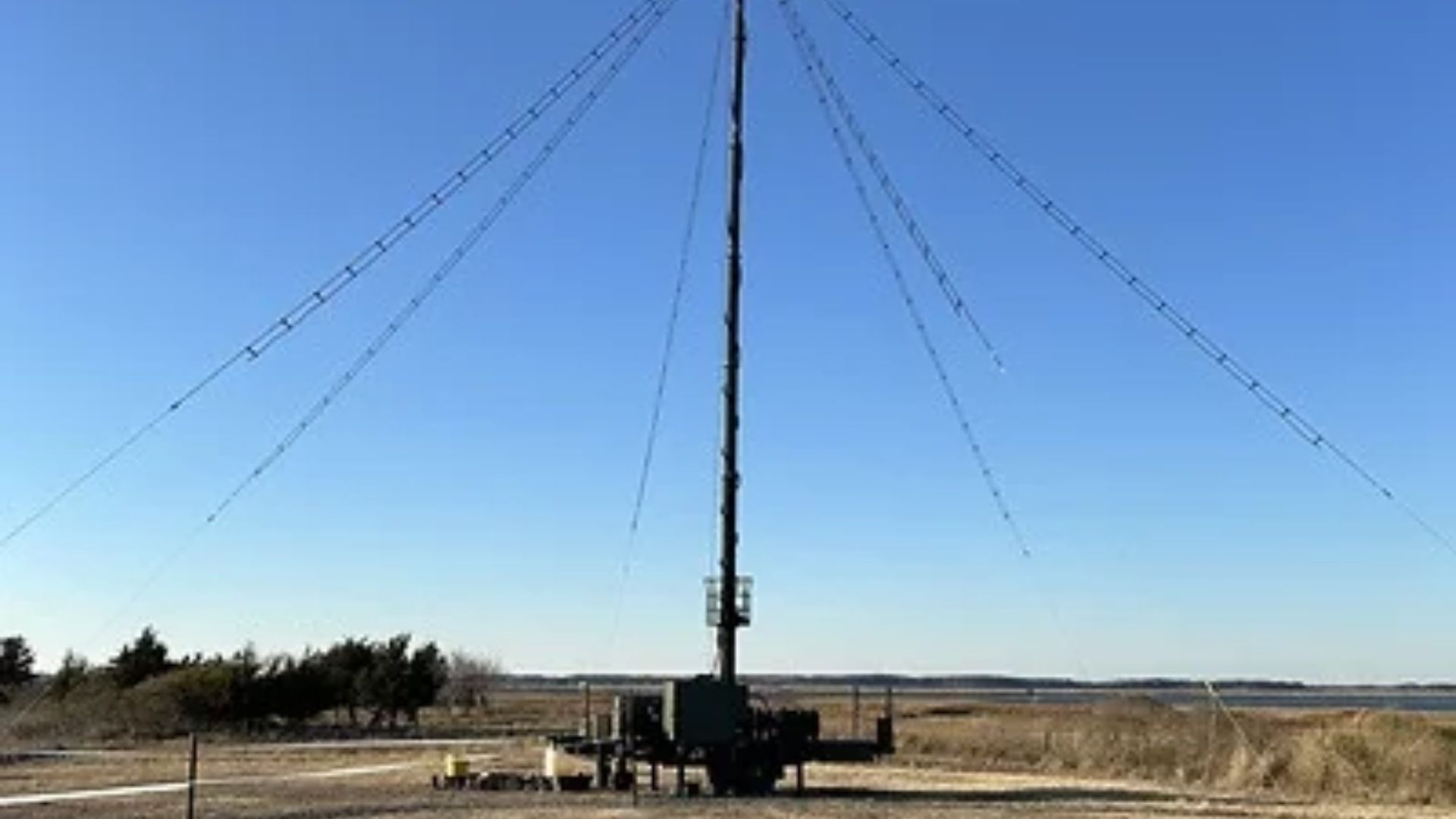
Defense contractor Leidos has been awarded a $40.8 million contract by the US Marine Corps to build and maintain 14 Medium Range Air Defense Radar (MRADR) systems, taking the mobile air surveillance program from early prototyping to operational use.
Scheduled to be completed by August 2028, the new sensors are designed to provide expeditionary units with continuous 360-degree aerial reconnaissance while keeping their electromagnetic footprint low enough to avoid detection by the enemy.
Conventional military radars emit powerful radio frequency pulses that act like a beacon for enemy electronic reconnaissance and anti-radiation missiles, forcing frontline units to turn off their sensors to survive.
To operate in contested coastal areas and island chains as part of the Marine Corps’ Expeditionary Advanced Base Operations concept, Marines need persistent surveillance that tracks incoming threats without revealing their firing positions.
How MRADR tracks threats without sharing its location
As announced in a press release from Leidos on November 18, 2026, MRADR builds directly on lessons learned from the company’s Marine Expeditionary Long Range Persistent Sensor (MELPS). Rather than relying on high-power active transmissions that can be easily triangulated by peer adversaries, the architecture combines digitized antennas, sensitive receivers and advanced digital signal processing to maintain a continuous 360-degree aerial view with minimal electromagnetic emissions.
The mobile sensor was developed by Leidos subsidiary Dynetics, which operates primary radar engineering and manufacturing facilities in Huntsville, Alabama, and Woodlake, California. It is designed to detect, track and classify low-flying cruise missiles, manned aircraft, rockets and unmanned aerial systems.
In addition to delivering 14 new units, the $40.8 million contract includes an option to upgrade both four MRADR prototypes built under a $32 million grant in 2023 and previously deployed MELPS hardware to a common operating standard.
“Marines require air defense capabilities that can keep pace with an increasingly complex operational environment,” Matt Becker, vice president of Leidos Defense Sensors, said in the company release. “This award allows us to help the Marine Corps work toward a significant increase in survivable air surveillance capabilities that support the warfighter wherever the mission takes them.”
Integration into the Marines’ layered air defense network
In operational use, MRADR is designed to be integrated directly into the Marine Corps’ broader command and control and air defense architecture, rather than functioning as a standalone sensor.
According to reports, the mobile radar can be mounted on tactical platforms such as the Amphibious Combat Vehicle chassis and coupled with existing sensors such as the Northrop Grumman AN/TPS-80 Ground/Air Task-Oriented Radar (G/ATOR).
By feeding target tracks into fire control networks, MRADR can detect interceptors such as the Medium Range Intercept Capability (MRIC), which combines naval command systems with Tamir interceptors adopted from Israel’s Iron Dome, allowing distributed naval batteries to combat aerial threats while minimizing active emissions from higher signature radars.
Expansion of Leidos’ low-signature sensor portfolio
The Marine Corps production order adds momentum to Leidos’ broader push into low-intercept drone detection and counter-drone as part of its NorthStar 2030 corporate strategy. In addition to MRADR, the Reston, Virginia-based contractor is developing the Army Long Range Persistent Surveillance (ALPS) sensor for continental missile defense initiatives and the Multifunction X-Band Radar (MXR) for mobile unmanned aircraft defense missions.
