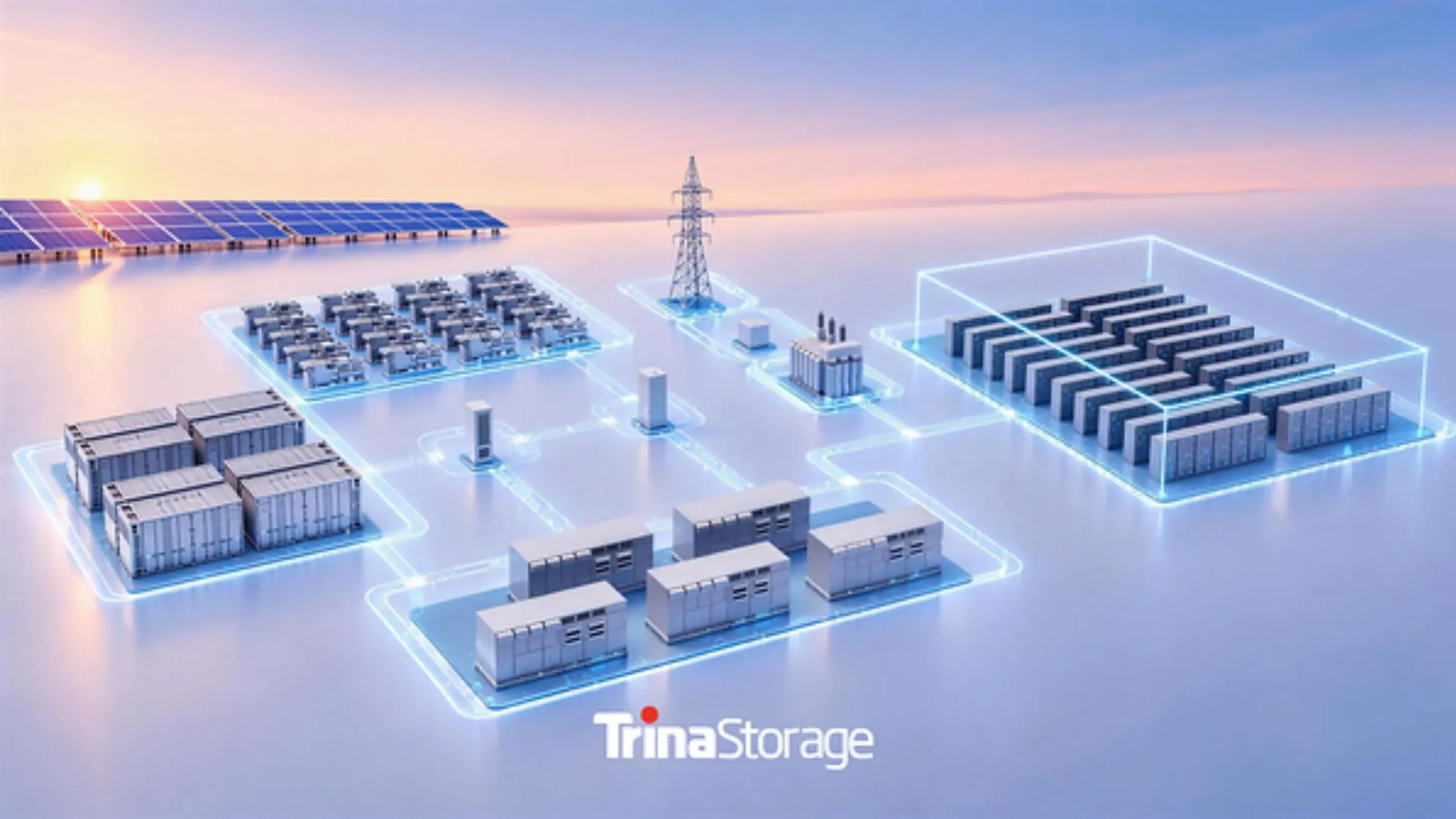
As artificial intelligence continues to drive unprecedented power demand, a Chinese energy storage provider, Trina Storage, has introduced a hybrid power solution that combines gas generation and battery storage to help data centers ensure reliable on-site power when grid capacity is unavailable or delayed.
The company introduced its Elementa Hybrid Genset at RE+ 2026 in Las Vegas, positioning the system as a modular power plant capable of supporting projects ranging from 5 megawatts (MW) to 1 gigawatt (GW). The launch follows a preview of the technology at the World Power data center in September.
The new platform integrates gas-powered piston engines supplied by qualified partners with Trina Storage’s Elementa DC battery storage system (BESS) and Electra AC platform. A hybrid system controller coordinates the various power sources in real time, allowing the system to respond to rapidly changing power requirements.
According to the company, the solution is designed for AI data center developers facing delayed network connections, limited transmission capacity, or locations with limited or no access to the power grid.
Designed for fluctuating AI workloads
The launch comes at a time when AI infrastructure is pushing conventional energy systems to their limits. Large language models and AI training clusters can lead to sudden spikes in electricity demand that traditional gas generators cannot always meet quickly enough.
While gas generators provide a continuous power output, they require time to ramp up production. Battery energy storage systems, on the other hand, can respond almost immediately, but are not designed to provide power during extended outages.
The Elementa Hybrid Genset combines the strengths of both technologies by allowing the battery system to accommodate rapid fluctuations in demand while gas generators gradually increase output to handle sustained loads. This coordinated approach aims to improve energy stability without relying solely on the grid.
The system is based on three main components: gas generation units with a rated capacity of up to 2.5 MW each, Trina Storage’s battery storage platform with reference configurations based on 5 MW/10 MW building blocks, and a hybrid controller that can scale plants from 5 MW to 1 GW depending on project requirements.
Three-layer control strategy
In order to be able to manage multiple power sources at the same time, the company has equipped the platform with three central control technologies.
The first, Load Transient Sensing, predicts changes in power demand and allows the battery system to respond before slower gas generators can adjust their output.
The second, Hybrid Power Coordination, dynamically balances power production between batteries and generators. In the event of sudden spikes in demand, the battery supplies electricity immediately before handing over a larger portion of the load to gas generation when demand is stable.
A third capability, Fault Isolation and Resilient Power Supply, is intended to identify faulty equipment while allowing remaining generators and battery systems to continue to power critical loads and help restore power across the site.
The platform supports four deployment scenarios: traditional grid-connected installations with backup power generation, grid-constrained sites, bridge-to-grid projects awaiting connection to the utility grid, and fully off-grid installations. If necessary, solar photovoltaic generation can also be integrated. Two system architectures, Load Sensing and Double Conversion, allow operators to prioritize either cost and efficiency or improved electrical isolation and power quality, depending on application requirements.
The Chinese company said it continues to validate the platform through simulation, hardware-in-the-loop testing and integrated testing with generation, conversion and battery devices. Networking capabilities, hybrid control strategies and certification activities are still under development, with final performance dependent on project-specific configurations.
“AI data centers have high power demands, especially when network capacity is limited or workload fluctuates rapidly,” said Eric Cao, vice president of Trina North American PV and BESS Business. “Elementa Hybrid Genset brings together gas generation, battery storage and hybrid control in a system architecture designed to coordinate these resources according to project requirements.”
