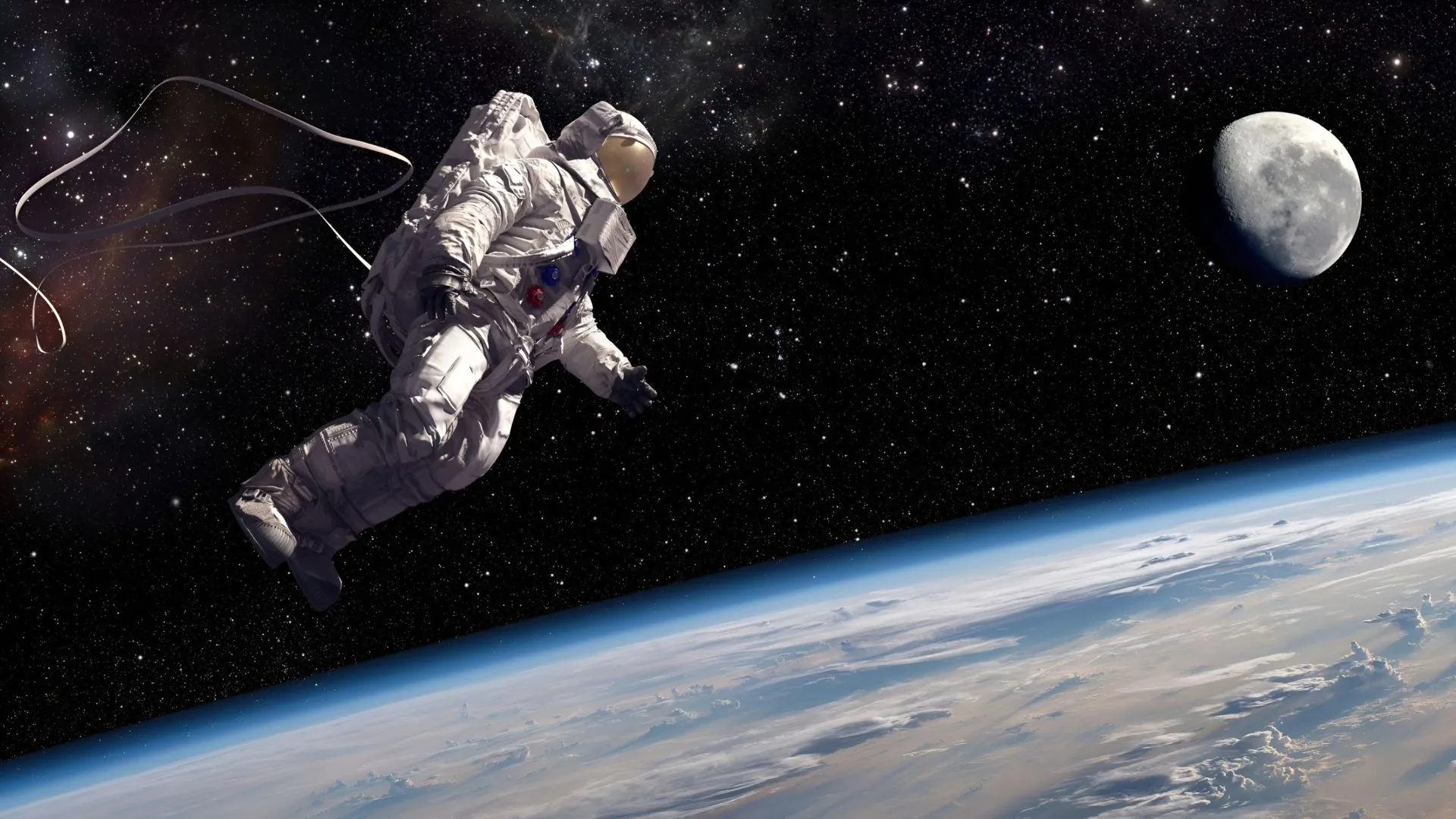
Space debris can impact spacecraft at speeds of over 16,000 mph and pose a serious threat to astronauts during spacewalks. Atomic-6 is studying whether its satellite shielding technology could provide additional protection against these high-speed impacts.
The company’s Space Armor® composite shield was recently tested at Texas A&M University’s Hypervelocity Impact Laboratory. A simulated torso behind the material showed no visible damage after a projectile struck at a speed of about 26,100 miles per hour.
A comparison with a solid aluminum plate gave a different result. Fragments were embedded in the simulated torso, illustrating another danger associated with a high-speed impact.
Testing at extreme speeds
Engineers fired a 3-millimeter aluminum ball at two shielding configurations. The projectile traveled at about 7.2 kilometers per second, which corresponds to a speed of 16,100 miles per hour.
Atomic-6 first placed a hexagonal Space Armor® Lite tile in front of a transparent ballistic torso. Georgia-based Ballistic Dummy Lab provided the model, which included simulated soft tissue and skeletal structures.
During the post-impact inspection, no visible punctures or damage to the upper body were found. The composite tile also showed no obvious cracks or bulges along its backing. For comparison, the engineers replaced a 4 millimeter thick solid aluminum plate. Both configurations maintained identical impact angles, clearances and mounting arrangements.
The aluminum plate created fragments that became lodged in the simulated hull. This demonstrated a phenomenon known as back spalling. Spalling occurs when an incoming projectile causes material to break off the back of a shield. These fragments can fly towards the person or equipment behind them.
Atomic-6 selected the thickness of the aluminum plate using NASA’s ballistic limit equations. Engineers use these calculations to estimate whether the shield can withstand projectiles of a certain size and speed.
The experiment did not compare complete spacesuits or traditional Whipple shields. The latter use separate bumper and rear panels to distribute incoming dirt.
Could astronauts wear it?
Space Armor® was originally developed to protect satellites from micrometeoroids and orbital debris (MMOD). Atomic-6 is now investigating whether its modular composite tiles could also protect astronauts during spacewalks.
The Space Armor® Lite tile weighs approximately 31 pounds per square meter (14 kilograms per square meter). Its potential use in spacesuits requires significant additional technical effort.
Chris Hadfield, a former commander of the International Space Station and a member of the Atomic 6 Advisory Committee, called the early results encouraging. He noted that orbital debris remains a persistent problem during spacewalks.
Trevor Smith, CEO of Atomic-6, also sees astronaut protection as a possible expansion of the technology. The company originally developed Space Armor® to protect spacecraft from fast-moving debris.
Before the material can be incorporated into the development of spacesuits, there are still significant challenges to overcome. The researchers used a stationary ballistic torso without a functioning spacesuit, pressurized clothing or life support equipment.
As a result, the experiment cannot determine whether the material prevents injury or maintains suit pressure during an actual impact. Its performance under real space conditions also remains unknown.
Atomic-6 plans further experiments with curved shields and different impact angles. These configurations were intended to better represent an astronaut’s chest or shoulder.
Engineers must also examine fastening systems, mobility and pressurization. Thermo-vacuum testing is required to evaluate a potential spacesuit application.
Space Armor® recently completed its first spaceflight aboard Portal Space Systems’ Starburst-1 spacecraft. A SpaceX Falcon 9 rocket carried it during the Bandwagon-5 rideshare mission last month.
This flight marked a milestone for satellite shielding technology. Its potential role in astronaut protection will depend on the results of further testing.
