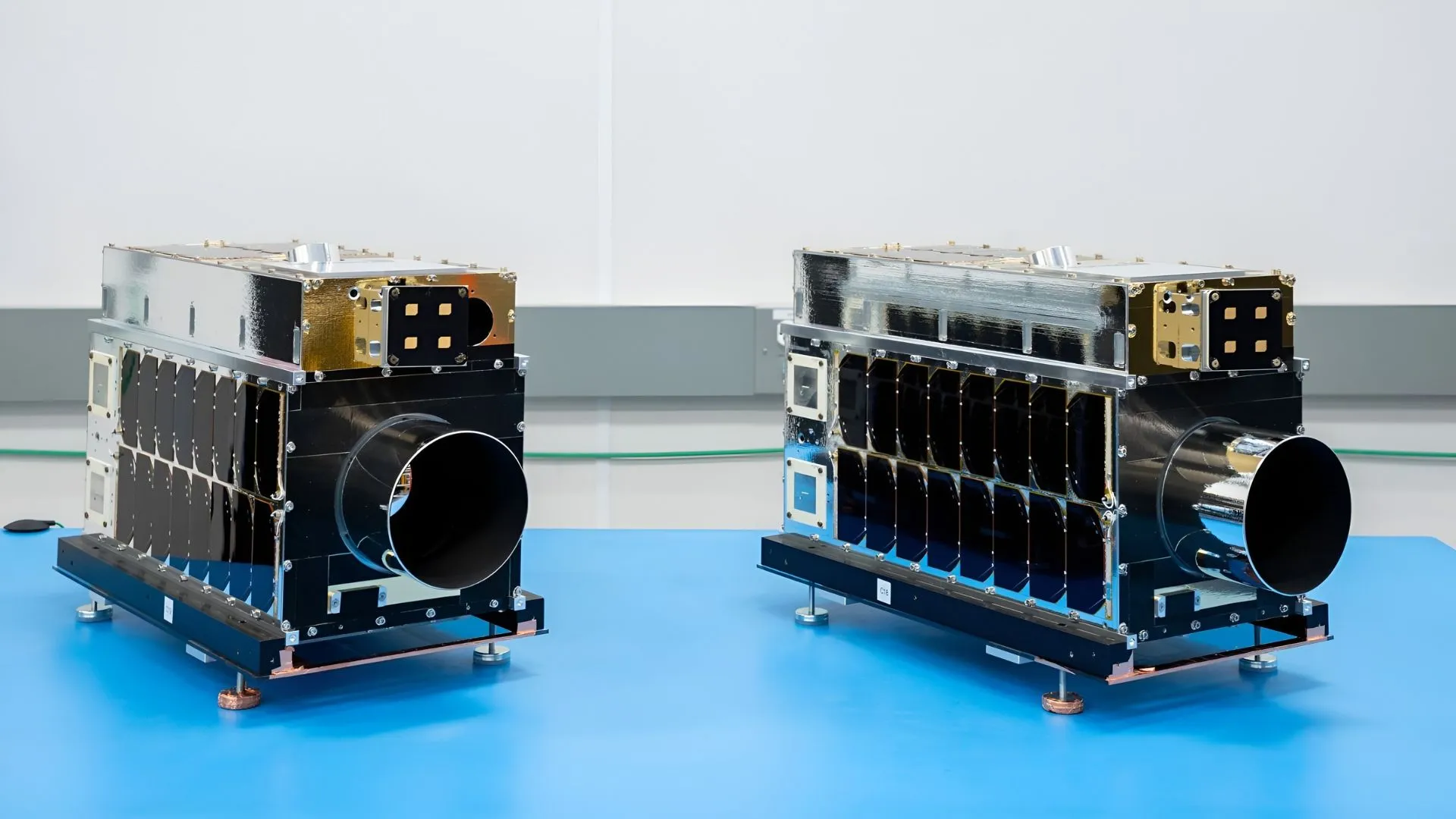
Two tiny satellites have joined an orbital fleet designed to measure greenhouse gas emissions from hundreds of kilometers above Earth.
The 33-pound spacecraft launched Oct. 1 aboard SpaceX’s Transporter 18 mission from Vandenberg Space Force Base in California. Their arrival brings the number of satellites developed for GHGSat to 13.
The space probes are equipped with sensors that can measure emissions from certain facilities on the ground. Through precise attitude control, these instruments remain focused on their targets as the satellites race around the Earth.
Precision packed into 33 pounds
The satellites use the NEMO spacecraft platform, which has supported eleven previous GHGSat missions. Its compact design places great emphasis on precise alignment without creating a lot of bulk.
The spacecraft operates about 310 miles above Earth. At this altitude, even small changes in alignment can affect an instrument’s view of the ground.
Robert E. Zee, CEO of SFL Missions, said the company’s small satellites can provide the attitude stability and pointing performance required for the mission. This capability has been central to the partnership since the 2016 GHGSat Pathfinder mission. Engineers needed the spacecraft to track specific targets with enough precision to provide reliable emissions measurements.
The design also provides additional capacity for multiple spacecraft systems. Power generation, data storage and communications all contain built-in margins. These reserves can support longer missions and allow the spacecraft to collect more data. Previous satellites using the platform have reportedly exceeded their expected collection capacity.
Thirteen satellites and counting
The recent launch also shows how a common spacecraft architecture can support a growing constellation. GHGSat has been working with SFL Missions for more than a decade. The two new satellites were integrated and tested at SFL’s facility in Vaughan, Ontario.
Stephane Germain, CEO of GHGSat, said the new spacecraft is another step in expanding the company’s emissions monitoring network. “Our ability to scale so quickly is a direct reflection of the caliber of partners like SFL,” Germain said.
The production pipeline extends well beyond the recent launch. SFL currently has 32 additional spacecraft in development at its Ontario site.
Hunting missions from orbit
Space-based emissions monitoring depends on both accurate targeting and sensitive detection hardware.
The satellites can observe individual systems from orbit and collect measurements that help identify greenhouse gas sources. These observations can support monitoring in industries with significant emissions.
The system has applications in oil and gas, power generation, mining and waste management. Agriculture also represents a potential area of application for satellite-based emissions data. According to SFL, the legacy of its spacecraft now extends to a total of almost 500 years in orbit. Its platforms range from 6.6-pound nanosatellites to 1,102-pound small satellites.
The technical challenge remains remarkably compact. A spacecraft weighing just 33 pounds must control its orientation precisely enough to point an instrument at a target on Earth.
This combination of low mass and high pointing accuracy is what makes the latest satellites so remarkable. The same architecture can now support another round of measurements from orbit as the constellation expands.