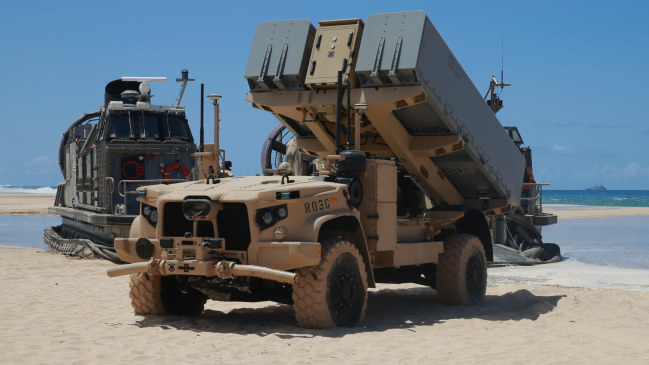
The The U.S. military is preparing to deploy its NMESIS anti-ship missile system to Yonaguni, Japan’s westernmost inhabited island and the closest Japanese territory to Taiwan, during a major joint exercise later this month.
The move will bring the mobile coastal weapon closer to Taiwan than its previous deployment to Japan and comes as Washington and Tokyo are expanding their operational capabilities on islands stretching toward the Taiwan Strait.
The deployment is part of Keen Sword, the biennial exercise between the U.S. and Japan, scheduled to take place Oct. 19-29. NMESIS will operate alongside Japanese and US forces in Yonaguni, while the exercise will also introduce the US Marine Corps’ MADIS short-range air defense system to the island.
NMESIS moves closer to Taiwan
Yonaguni is about 62 miles east of Taiwan. That puts it significantly closer to Taiwan than Ishigaki, where U.S. Marines deployed NMESIS during the Resolute Dragon exercise in 2025, when it was about 150 miles from Taiwan. the South China Morning Post reported.
The Navy-Marine Expeditionary Ship Interdiction System (NMESIS) is a ground-based anti-ship weapon designed for mobile operations in coastal and island environments. The Marine Corps describes it as a highly mobile and rapidly deployable sea denial and coastal defense system.
The system uses a remotely controlled launcher mounted on an unmanned vehicle and features naval attack missiles capable of attacking ships at ranges of more than 115 miles. This range gives a Yonaguni-based launch vehicle the ability to threaten ships operating in a large area around the island and toward Taiwan.
The U.S. has already demonstrated the concept elsewhere in the region, deploying the NMESIS during the Balikatan exercises in the Philippines’ Batanes Islands, another location near Taiwan, and during the Japanese-U.S. exercises in Ishigaki last year.
The island becomes a military hub
Keen Sword will also establish a joint coordination center at Yonaguni Garrison, where Japanese and U.S. forces will conduct island defense exercises and coordinate with equipment stationed at other locations. The exercise is intended to improve the way the two militaries operate on Japan’s southwestern island chain.
The US Marines will also station MADIS in Yonaguni for the first time. The system is designed to provide short-range protection against drones, helicopters and low-flying aircraft, adding an air defense layer in addition to NMESIS’s anti-ship capability. The Marine Corps’ 12th Marine Littoral Regiment officially received both systems in June.
In addition, Japan has also increased its own military presence on Yonaguni. The island has hosted a Ground Self-Defense Force garrison since 2016, while Tokyo plans to add additional air defense capabilities in the coming years.
Such developments make Yonaguni increasingly relevant to the broader concept of distributed forces across the first island chain, stretching from Japan through Taiwan and the Philippines. The U.S. National Defense Strategy 2026 specifically calls for strengthening defensive defenses along the First Island Chain and closer cooperation with regional allies.