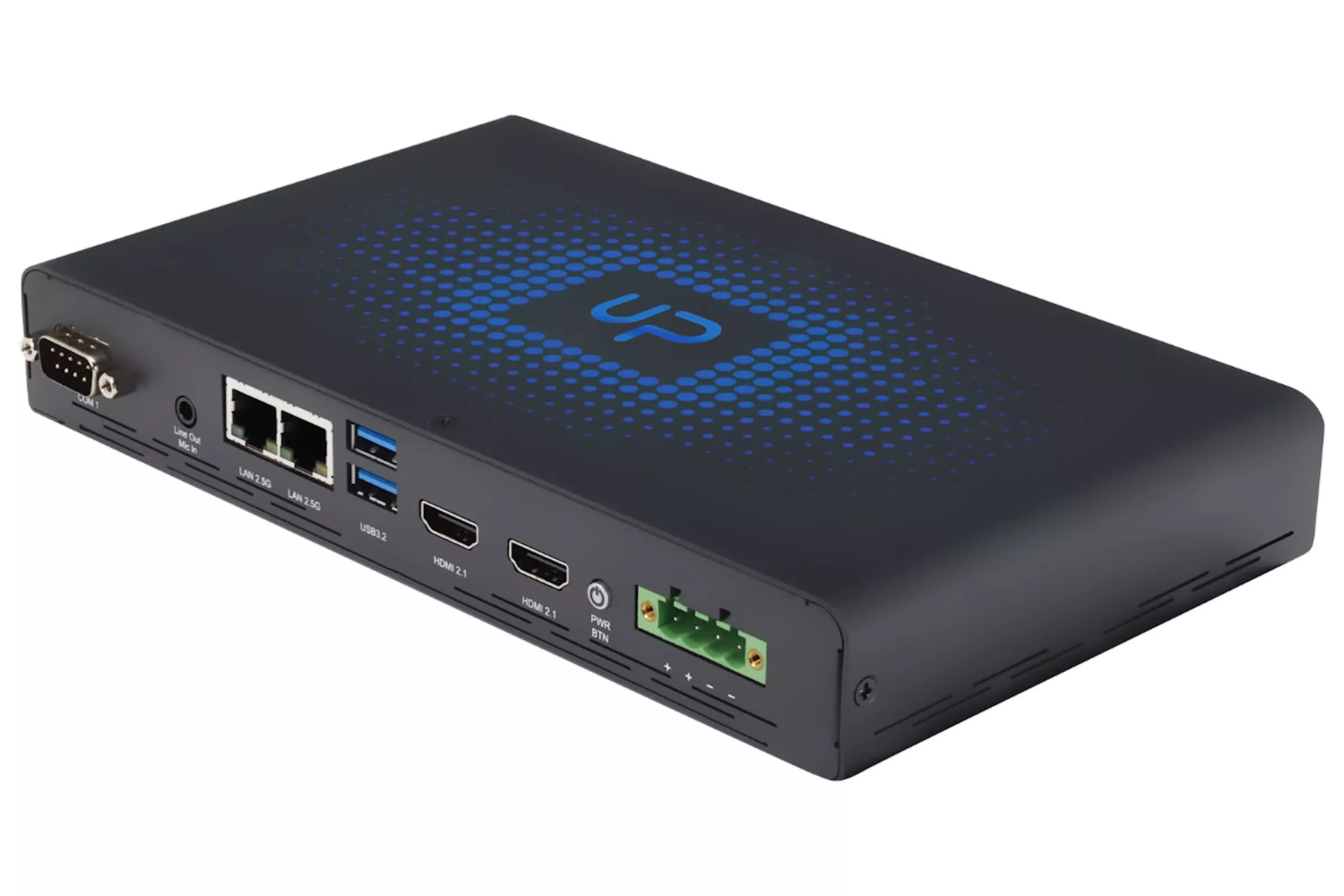
First look: Aaeon has introduced a compact industrial PC that uses Frore Systems’ AirJet cooling instead of a traditional fan and heat sink. The Up Xtreme PTL Edge Air is aimed at embedded systems that require strong processing power without the noise, vibration or larger case sizes associated with traditional active cooling.
The system can be configured with an Intel Core Ultra X7 358H, Core Ultra 7 356H or Core Ultra 5 325 processor. The design shows how newer cooling methods could give industrial PCs more space for faster processors and graphics hardware in space-constrained environments.
The top configuration includes integrated Intel Arc B390 graphics cards with 12 Xe cores, giving the small machine more graphics power than many embedded PCs used in kiosks, robotics and edge systems.
The most important change concerns the cooling design. AirJet uses ultrasonic membranes to create airflow without a traditional rotating fan. According to Aaeon, the system runs at less than 21 dBA, making it nearly silent during normal operation. The company also claims that this approach allowed it to make the device “35% thinner and 43% lighter” than a cofenclos-like system with a standard heatsink and fan.
This cooling configuration is critical when a computer is frequently built into another product. A larger cooling assembly can limit a system’s installation options, particularly in thin kiosks, mobile medical devices, and autonomous mobile robots. Aaeon said the PC is intended for “integration into space-constrained applications such as ultra-thin kiosk builds, close-spaced AMR enclosures and compact mobile healthcare units.”
By not using a conventional fan, vibrations are also reduced. This can be useful in systems that are located near cameras, sensors, robot controllers or actuators. In such environments, vibration can be more than just a comfort issue. This can affect sensor readings, camera stability or the performance of devices mounted in the same housing.
Aaeon has equipped the PTL Edge Air with the kind of connectivity you’d expect from an industrial computer, not a consumer mini PC. It includes USB Type-A and USB Type-C ports, LAN, and audio and video outputs. It also has two serial ports that support RS-232, RS-422 and RS-485, standards still widely used in industrial automation and specialty equipment.
The PC also has a 40-pin GPIO connector. This gives integrators a direct way to connect sensors, switches, controllers and other hardware. Aaeon says the system can support up to four displays simultaneously, which could be useful in control rooms, digital signage systems or surveillance facilities.
Memory support reaches 128GB across two DDR5 SODIMM slots with speeds of up to 7,200 MT/s. The system has two M.2 2280 slots for SSDs and one M.2 2230 slot for a WLAN card. This gives customers leeway to configure the system for local storage, wireless networks or edge applications that need to store data close to where it is collected.
The thinner design comes with compromises. According to Aaeon, the AirJet cooling system increases power consumption by 6% and reduces operating temperature to -10°C to 45°C. The temperature range may be suitable for indoor use, but is narrower than that supported by some rugged industrial systems.
The Up Xtreme PTL Edge Air can run Windows IoT Enterprise or Ubuntu 24.04 LTS. Aaeon has not released pricing, which is common for embedded systems sold through direct sales channels and configured for specific projects.