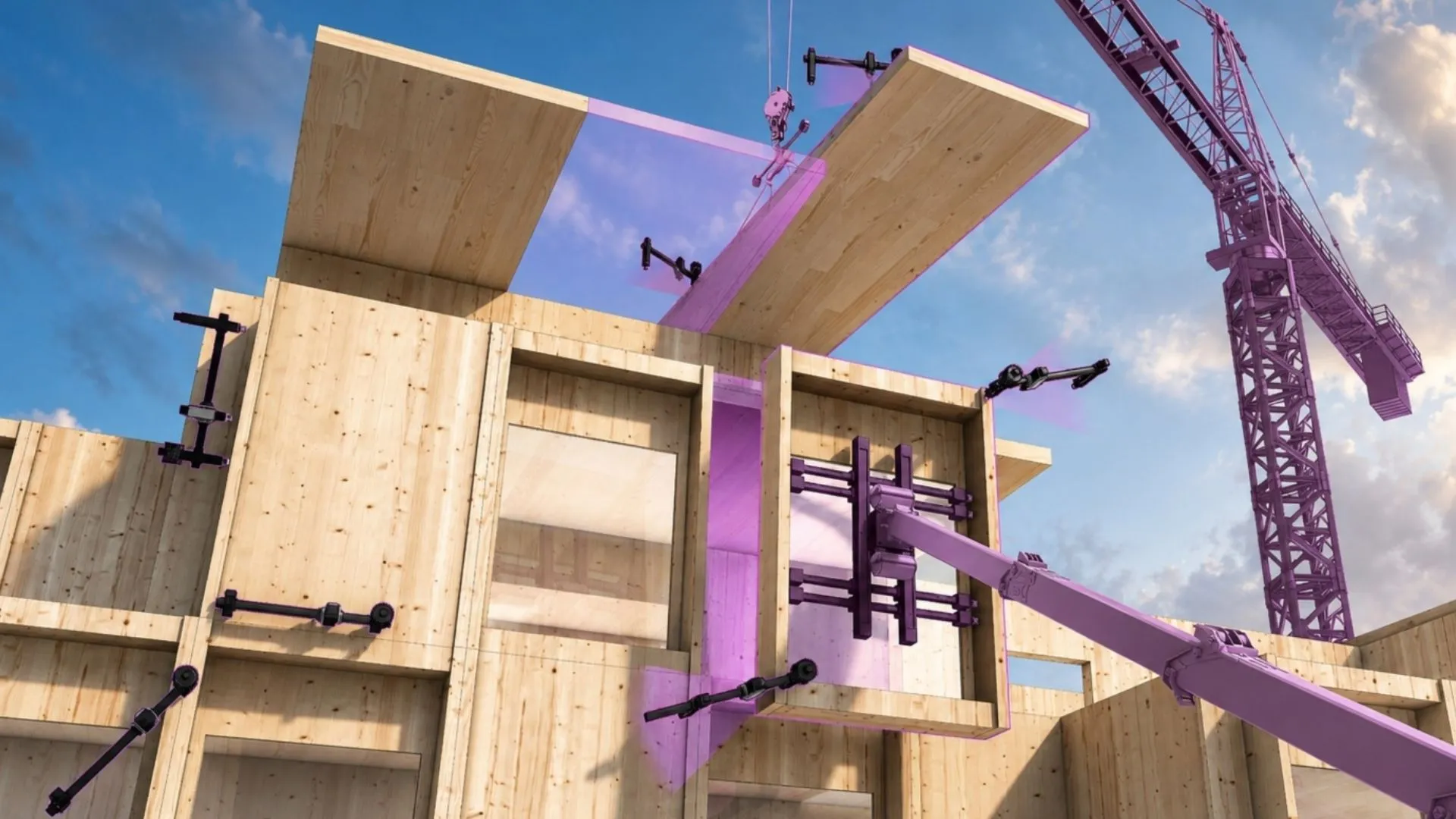
Researchers at the University of Stuttgart in Germany are developing two autonomous robotic systems that aim to make construction faster, more productive and less wasteful. The SCALAR and COBRAS projects will explore how teams of robots and construction equipment can assemble buildings with less human intervention while supporting more sustainable construction methods.
Both projects were funded by the European Innovation Council’s EIC Pathfinder Challenge and received approximately 4 million euros (approximately $9 million) each. The three-year projects will be coordinated by the university’s Institute for Computational Design and Construction (ICD) and are scheduled to begin in November 2026.
The research focuses on two different approaches to robot building: autonomous machines that assemble prefabricated wooden modules and swarms of smaller robots that build reusable lightweight structures.
SCALAR brings autonomous machines to timber construction
The aim of the SCALAR project is to improve modular timber construction, in which components are manufactured off-site and assembled on site. The approach can reduce on-site construction time, while wood provides a renewable alternative to some traditional building materials.
According to the University of Stuttgart, SCALAR will develop a wooden construction system with universal connections and digital design processes, as well as a multi-scale robotics platform that can autonomously assemble wooden modules.
The system distributes the construction tasks to different machines. Retrofitted cranes transport components and roughly position them, while mobile robots carry out more precise assembly work. Before construction begins, the researchers want to simulate the assembly process in a virtual environment. A digital control system then coordinates the processes in real time and helps maintain safety on site.
An important part of the project will also be the development of sensors that work reliably even in dust, dirt and difficult lighting conditions on the construction site. SCALAR is intended for both new buildings and renovation projects of existing buildings. The Institute for System Dynamics at the University of Stuttgart as well as the Austrian Technical University and the crane manufacturers Liebherr and Jekko are also involved.
COBRAS uses swarms of robots to build reusable structures
While SCALAR focuses on coordinating different types of construction equipment, COBRAS will investigate how teams can assemble space-frame structures from identical, electrically powered mobile robots.
Space frames use interconnected components to create lightweight structures that span large areas using relatively little material. Thanks to the modular design, components can also be dismantled and reused. However, assembling the many individual parts can be labor-intensive, which hinders wider acceptance.
COBRAS wants to meet this challenge through swarm intelligence. Instead of relying on a central controller to control each robot, the machines coordinate their actions autonomously and dynamically as a group.
Using identical robots could make it easier to scale the system: construction teams could add or remove robots depending on the size of the project. If a machine needs maintenance, the remaining robots could continue working instead of bringing the entire assembly process to a halt.
The project will also utilize digital design methods to reduce material consumption while improving structural performance. Researchers plan to develop modular components specifically suitable for assembly and disassembly by robots, allowing structures to be taken apart, reused and adapted to different locations or requirements.
The Institute for Civil Engineering and Structural Design at the University of Stuttgart, the Reconfigurable Robotics Lab at EPFL in Switzerland and the research laboratory for artificial intelligence IRIDIA at the Université Libre de Bruxelles are taking part in COBRAS.
Integration of robotics into the entire construction process
Both projects reflect the University of Stuttgart’s approach to combining architecture, engineering, materials, digital planning and robotics, rather than viewing automation as a standalone technology. The researchers expect this integrated approach to improve construction productivity while supporting resource efficiency and circular construction practices.
However, SCALAR and COBRAS remain research projects whose autonomous systems still need to be developed and tested. Their planned three-year programs will examine whether coordinated construction equipment and adaptable robot swarms can make complex assembly processes more efficient while allowing components to be reused instead of thrown away.