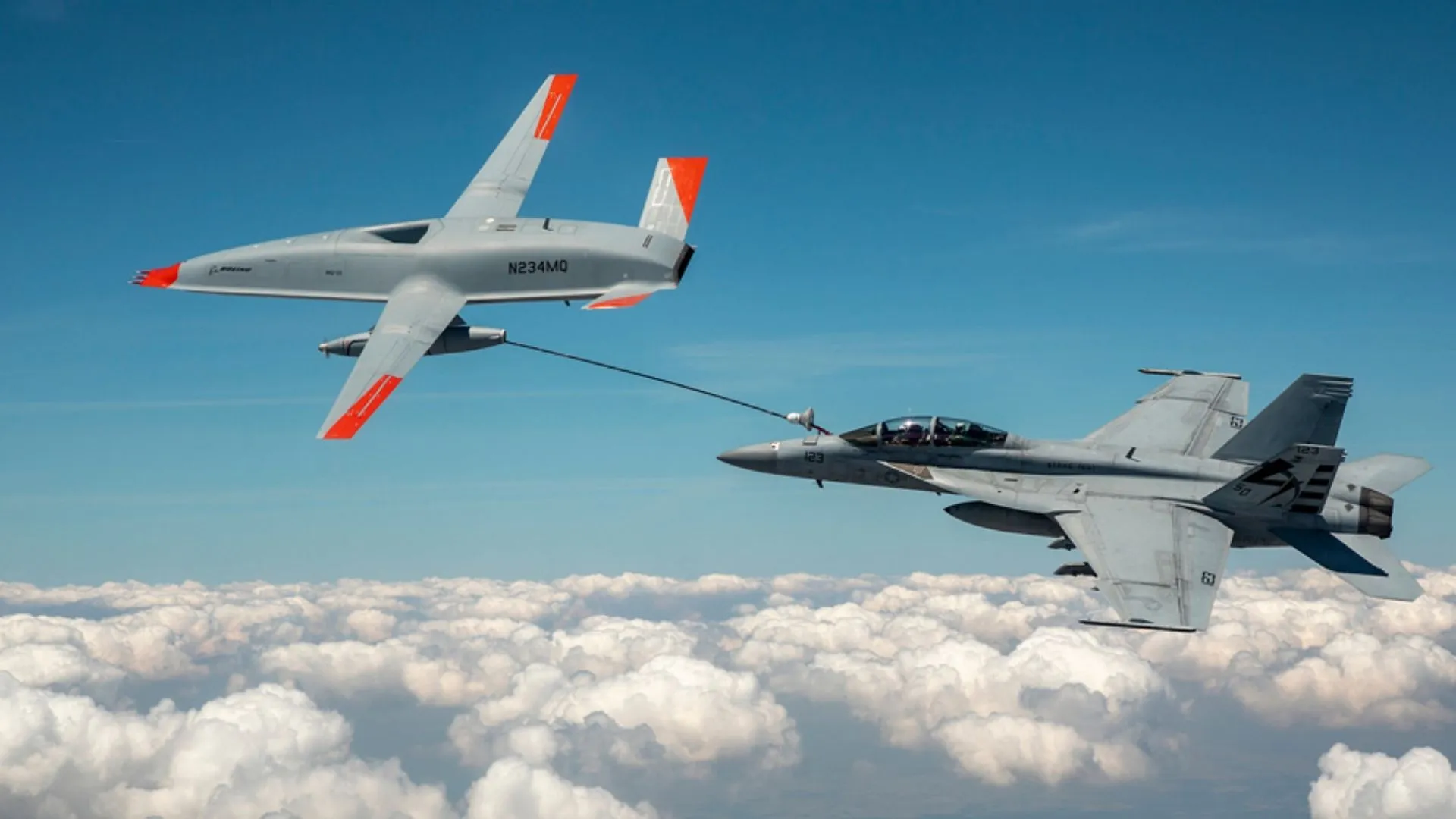
Boeing has demonstrated software that allows pilots in manned aircraft to coordinate with unmanned aircraft over a military communications network and is moving forward with plans to integrate that capability into the U.S. Navy’s MQ-25A Stingray aerial refueling drone.
The Manned Unmanned Teaming (MUM-T) software was tested during the Emerald Flag military exercise at Eglin Air Force Base, Florida. Boeing installed the software on a Beechcraft 1900D and an E90 King Air, allowing test pilots to use Link 16 to demonstrate command and control communications between the two aircraft in the air.
The MQ-25A itself was not involved in the test. Instead, it demonstrated a communications capability that Boeing plans to integrate into the unmanned tanker after further testing and evaluation.
Software aims to connect manned and unmanned aircraft
Boeing said the software leverages open command and control messaging over Link 16, a tactical data network commonly used by U.S. and allied militaries to share information between compatible platforms.
The system is designed to support manned and unmanned teams across multiple aircraft types rather than being tied to a single airframe. Boeing developed the software in collaboration with the US Navy, relying on teams working on the Phantom Works, MQ-25, F/A-18 and F-22 programs.
The company plans to initially roll out the feature on the MQ-25A Stingray and F/A-18 Super Hornet once testing and evaluation is complete. The intended result is that crews aboard manned aircraft can control or coordinate with the unmanned tanker to help it respond to changing refueling requirements during a mission.
“Integrating this software into the MQ-25A will allow manned platforms to control aircraft and turn the tanker into a force multiplier, streamlining refueling operations and extending mission range,” said Kayla Stice, MQ-25 Advanced Design program manager at Boeing.
The demonstration marks progress toward that capability, but Boeing says more test flights are needed before the software can be integrated into the operational aircraft.
MQ-25A could free fighters for attack missions
The MQ-25A Stingray is being developed for carrier-based aerial refueling of the Navy’s carrier squadrons. By taking over much of the refueling work currently performed by the F/A-18E/F Super Hornets, the unmanned aircraft is intended to allow more fighters to focus on their primary attack missions while extending the reach of carrier operations.
The Navy calls the Stingray an important step toward integrating unmanned aircraft into carrier operations. Its responsibilities include both providing fuel and helping to establish the infrastructure and procedures necessary to operate unmanned aircraft alongside manned combat aircraft at sea.
The MUM-T software could add another layer to this integration by allowing pilots in compatible aircraft to coordinate with the tanker over an existing military data network. Boeing said the capability is intended to improve tanker responsiveness, reduce logistical friction and support coordinated strike operations.
Mark Dunn, head of Boeing’s MQ-25 Avionics integrated product team, said embedding the software into the Stingray would enable autonomous coordination with manned platforms and increase the carrier strike group’s operational speed.
Production is progressing while testing continues
The software demonstration comes as the MQ-25A program advances toward production. In September, the U.S. Navy awarded Boeing a $562 million contract for the first low-cost initial production lot, which included three aircraft and advance procurement of components for three additional aircraft. According to the US Navy, the first deliveries of the first batch are scheduled to begin in 2029.
The Stingray made its first flight as an operational MQ-25A in April 2026, demonstrating autonomous taxi, takeoff, flight and landing under the supervision of Navy and Boeing test teams.
The new MUM-T software remains a separate feature in development. Further flight testing will need to validate it before Boeing can integrate it into the MQ-25A’s operational software.
If successful, the integration would help the Navy move beyond operating unmanned tankers as remotely monitored assets to closer coordination between manned combat aircraft and autonomous support aircraft. This could add flexibility to aerial refueling during carrier operations, although the extent of control and missions supported will depend on the ultimate capability tested and deployed.