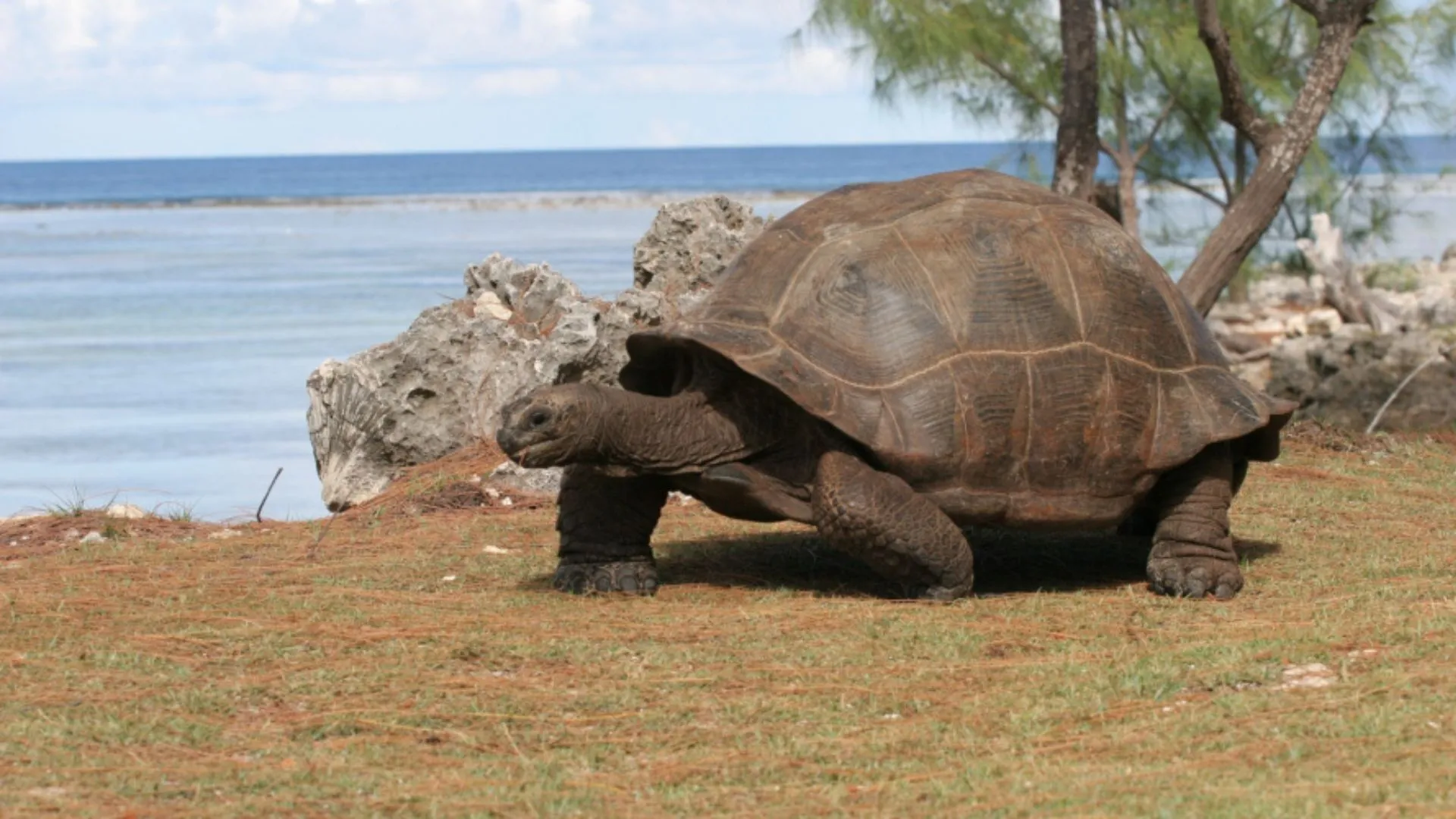
Up to 183,000 giant tortoises are thriving in the Seychelles, according to a new survey.
The Aldabra giant tortoise (Aldabrachelys gigantea) are considered an endangered species. A survey conducted by the Seychelles Islands Foundation (SIF) and the University of Exeter found that the identified population is the “highest number ever recorded for this species”. The discovery is a major victory for conservation efforts across the Indian Ocean.
Population increase
Today’s population stands in sharp contrast to the late 19th century, when hunting and habitat exploitation drove the reptiles to near extinction. It left fewer than 1,000 survivors on the isolated coral ring.
Rapid intervention reversed their decline after Aldabra was declared a strict nature reserve in 1981 and a UNESCO World Heritage Site in 1982. Strong legal protections combined with the successful eradication of invasive feral goats in 2012 ultimately paved the way for this historic recovery.
“The monitoring data in this study was collected year after year by SIF staff who live and work on the atoll. More than 180,000 giant tortoises roaming freely on our atoll are evidence of what a long-term commitment to conservation can achieve. This is wonderful news for Seychelles, for the world and for everyone who has worked to protect Aldabra,” said Dr. Frauke Fleischer-Dogley, CEO of SIF.
A basis for the future
However, determining the population size was not easy. It required almost five years of dedicated field monitoring by SIF researchers alongside statistical experts from the University of Exeter. The actual counting process proved to be a complex challenge.
Aldabra’s landscape consists of sharp corals and dense, tangled vegetation. Turtles regularly seek shade under dense bushes, disappear into mangroves, or seek shelter from the scorching equatorial sun. Previous surveys were based purely on personnel numbers.
As a result, older estimates, such as the long-cited figure of 100,000 from the late 1990s, likely missed tens of thousands of hidden animals.
To address this problem, the researchers used Bayesian hierarchical distance sampling. It is an advanced statistical method that models missing data. The technique mathematically corrects for invisible reptiles in a variety of habitats, from open “turtlegrass” grassland to impenetrable bushland. Rather than a sudden increase, the new estimate shows that the population has always been strong, thriving and secure.
Despite the encouraging news, scientists stress that caution remains necessary as the island’s fragile ecosystem faces serious environmental threats. Sea level rise risks flooding low-lying habitats, and worsening droughts threaten to dry up food and shade. Additionally, invasive rats and cats continue to prey on endangered turtle eggs and hatchlings. Taken together, these threats underscore the need for ongoing protective measures.
“By modeling both what we didn’t see and what we did, we have established the most reliable baseline yet for this iconic Seychelles species and created a benchmark we can use to track the population over decades,” said Dr. Nancy Bunbury, one of the study’s co-authors.
Plans to eradicate the remaining invasive mammals are already underway. But for now, Aldabra Atoll offers a rare story of hope: a landscape where nature recovered from near collapse and giant tortoises reclaimed their habitat.
The study results were published in the specialist journal Ecology and evolution