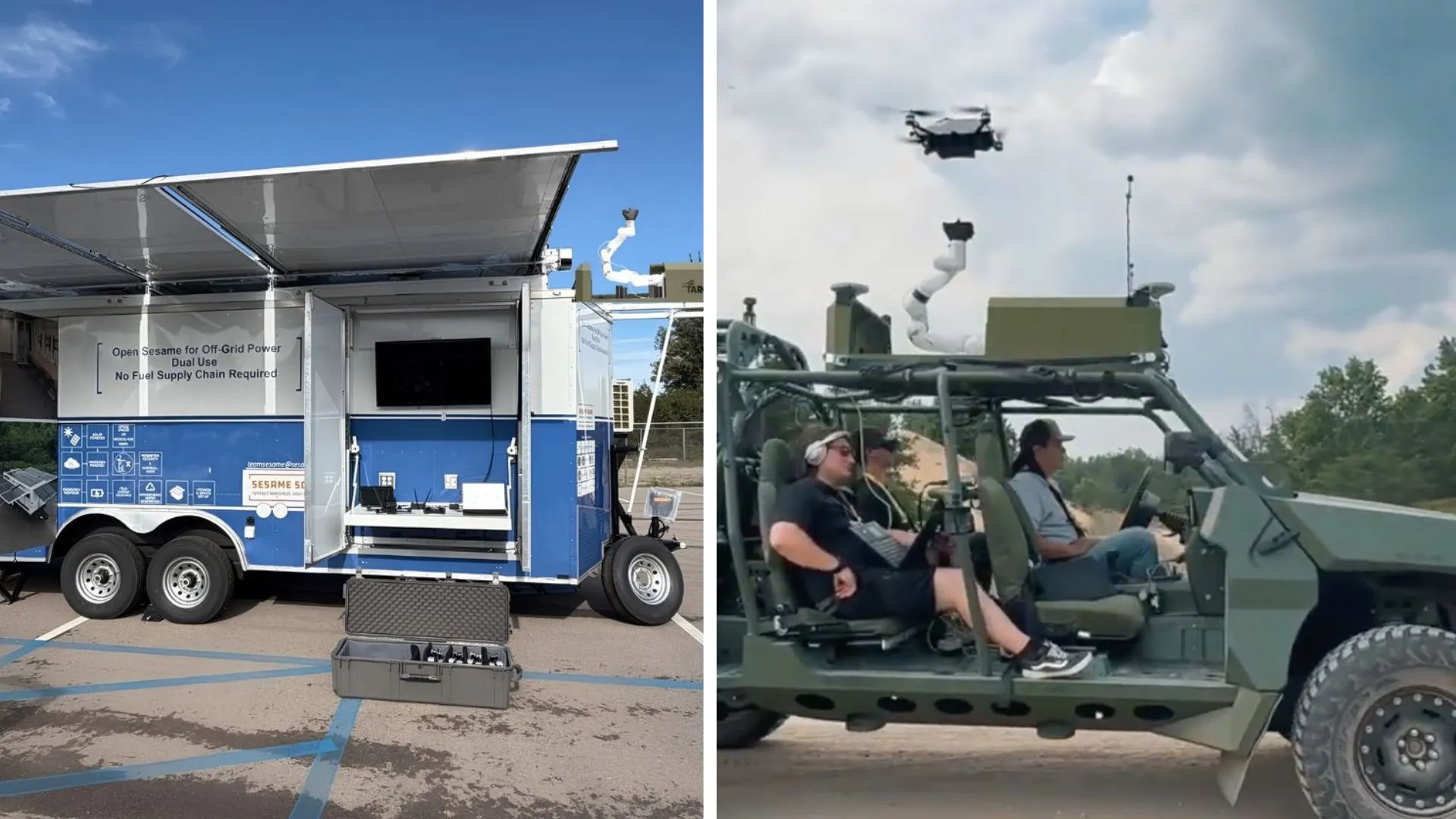
A new system has been introduced that integrates renewable energy, autonomous robotics and unmanned aircraft to support continuous drone operations without conventional fuel resupply.
Sesame Solar, Target Arm and AG3 Labs launch the Persistent Drone Operations Nanogrid, the first integrated solution that combines Sesame Solar’s self-generating mobile power, Target Arm’s robotic arm and drone magazines for autonomous drone launch and recovery, and AG3 Labs’ fragile unmanned aircraft into a single system for training and expeditionary operations.
Continuous drone operation without fuel refills
This solution enables continuous drone operation without fuel refills. Operators can remotely monitor the nanogrid’s energy performance and control the robotic arm and drones.
“Mobile power is a critical fifth supply need, along with food, water, ammunition and fuel. When a forward expeditionary team cannot power their drones or their batteries fail due to heat or cold, warfighters lose one of their most valuable assets,” said Lauren Flanagan, CEO and co-founder of Sesame Solar.
“Together with Target Arm and AG3 Labs, we have developed a comprehensive solution that eliminates the fuel supply chain while keeping drones in the air for longer periods of time.”
The launch comes at a time when federal policy is resolutely focused on domestic production. Executive Order 14307 directs agencies to expand UAS production in the U.S. and reduce reliance on foreign-made drones, and the Defense Department moved this year to widely equip units with small, U.S.-made drones. As a domestically manufactured solution, the Persistent Drone Operations Nanogrid meets these requirements while providing a comprehensive solution that improves operational readiness and supply chain security.
A drone is only as good as its next load. The US Army has documented this gap, pointing out that there is no standard procedure for providing emergency power to a drone launch team. In remote, contested or harsh environments, an autonomous solution that can transport, charge and safely store, launch, recover and recharge drones over a wide temperature range with minimal detection signatures can save lives while improving mission outcomes, a press release said.
“Every system we build at Target Arm starts with the same question: Will it get someone home safely?” said Jeffrey A. McChesney, CEO and founder of Target Arm.
“Launch and recovery are two of the most exposed moments of a drone mission – someone is standing in the open waiting for a plane. Ralar takes a person out of that moment. What makes our system even more unique is that drones can be launched from a moving vehicle or boat, so fighter jets never have to stop to complete their mission.”
The solution integrates Target Arm’s Ralar system, an autonomous robotic arm launch and recovery system that allows drones to deploy, recover, charge and restart pilotless in the field and while in flight. TargetArm’s drone magazines work with the Ralar system to move drones through missions autonomously, ensuring consistent, 24/7 coverage.
It also features AG3 Labs’ SPADE platform, a Group 1 UAS that reconfigures for the mission and supports ISR, communications relays and, for defense users, kinetic payloads. SPADE can be flown one-to-one or controlled one-to-many as an autonomous swarm, supporting training, first responder, law enforcement, military and special operations missions.
Available as a standalone solution or in a series of two to twelve nanogrids, the Persistent Drone Operations Nanogrid forms a turnkey MIL-STD mobile microgrid that can also charge portable batteries and other expeditionary equipment for forward flight.
“Operators shouldn’t need a different drone for every mission – they need an airframe that they can reconfigure in the field and deploy in bulk,” said Nick Smock, co-founder/head of growth at AG3Labs.
“Put that on top of a system that boots, recovers and recharges itself, and you have sustained performance without adding a single person to the team.”