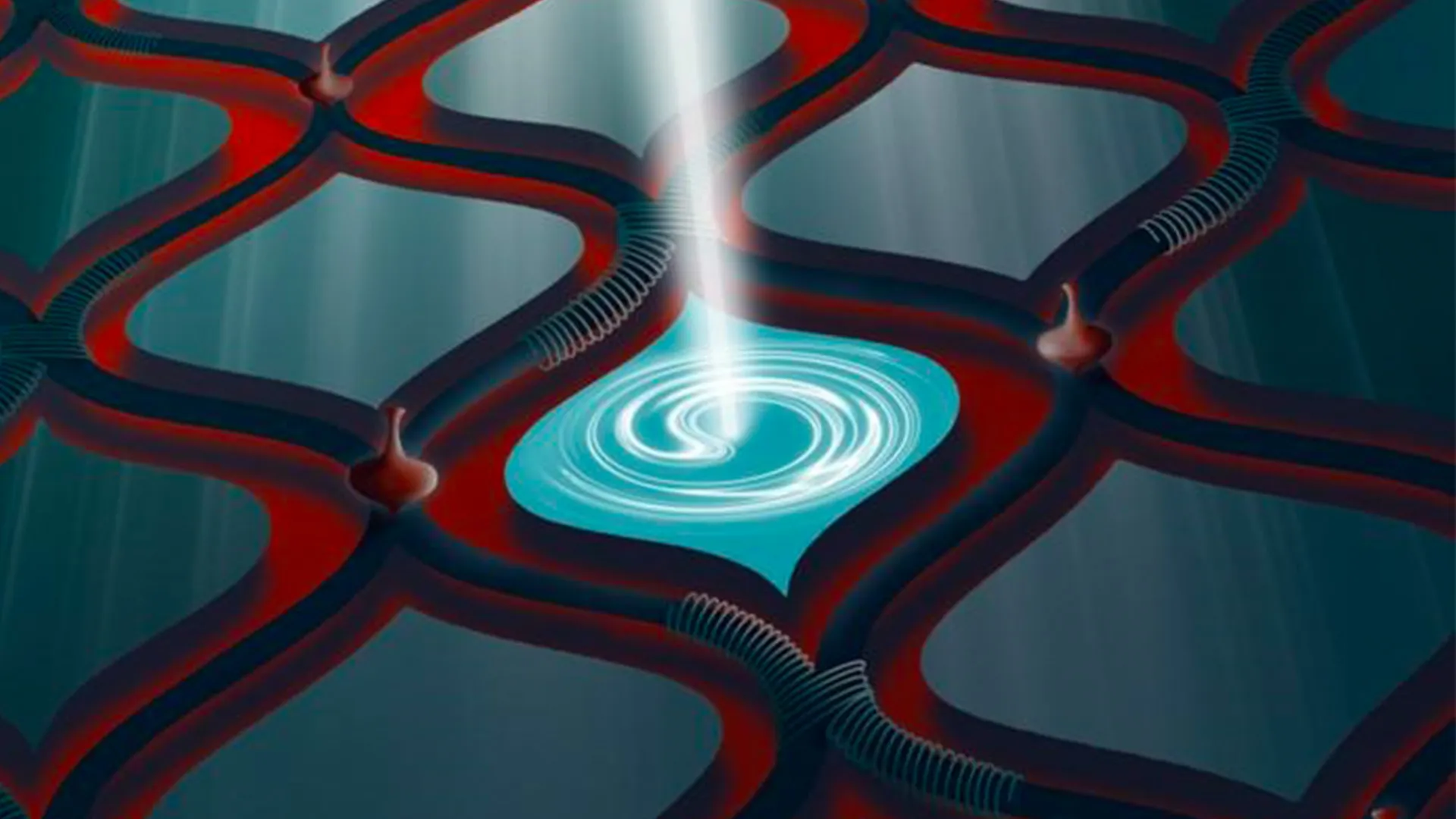
Quantum particles can move between two locations through a process called tunneling. However, what if a particle suddenly stopped moving due to a magnetic field that it never directly interacted with?
Physicists at the University of Oxford have recreated this counterintuitive behavior with a hybrid quantum computer and demonstrated the Aharonov-Bohm effect in a simulated quantum system.
The Aharonov-Bohm effect occurs when a particle moving around a region of magnetic flux experiences a change in its quantum phase, even though it never passes through the magnetic field itself.
In the Oxford University experiment, this effect resulted in the particle’s possible paths canceling each other out and its tunneling between two locations being completely suppressed.
These findings could help scientists simulate fundamental interactions that are increasingly difficult to model with traditional computers.
Building a quantum loop from trapped ions
In everyday physics, a charged particle responds to the electric and magnetic fields it encounters. However, quantum mechanics allows for something more subtle.
A particle can experience a measurable phase change as it moves around a region of magnetic flux, even if it never enters the region where the magnetic field exists. Physicists Yakir Aharonov and David Bohm predicted this effect in 1959, and experiments with real electrons later confirmed it.
The Oxford researchers are now studying how the same phenomenon behaves in lattice gauge theories, mathematical frameworks used to describe interactions between matter and fields in particle physics. In these theories, matter occupies points on a grid, while gauge fields connect these points.
The larger these systems become, the more difficult it becomes to calculate their behavior on conventional computers. Quantum simulation offers an alternative: Researchers build a physical system that follows the same basic rules as the model they want to study and then observe its behavior.
Starting in 2022, the study authors developed an experiment to simulate a lattice gauge theory, a framework for studying the interaction of matter with gauge fields.
Their hybrid system combined two components with different roles. Qubits, or quantum bits, encoded in the internal electronic states of trapped ions, represented the calibration fields. Quantum oscillators, which corresponded to the oscillations of the ions, represented matter.
The researchers connected two oscillators, which represent matter in two locations, using two qubits that represent the fields between them. Together, these components formed a loop, an elementary building block of the theory. The team used digital operations to prepare and measure the system, while analog quantum development allowed them to simulate the interactions.
The magnetic flux that canceled the motion of a particle
The researchers created the two qubits in an entangled state, in which their quantum properties are linked in a way that has no classical equivalent. In the simulation, this state represented the magnetic flux flowing through the loop.
Encoding the flux this way was initially a practical workaround. The hardware could not provide the interaction required to introduce the flow as a fixed background. But the approach also allowed researchers to study something more interesting: a gauge field that could evolve along with the matter it interacted with.
“For us, the exciting step was to encode the magnetic flux in a gauge field that is itself dynamic. Instead of matter evolving in a fixed background, matter and gauge field become part of the same quantum dynamics,” said Sebastian Saner, lead researcher and postdoctoral researcher at the University of Oxford.
The researchers then observed a tunneling effect of the matter particles between the two locations around the loop. Without magnetic flux, the particle could tunnel freely. When the researchers introduced a flow, the two possible paths destructively interfered, aborting the tunneling process and leaving the system in its initial state.
“We observe Aharonov-Bohm interference with dynamic calibration fields that encode the magnetic flux, thus demonstrating the interplay between charge and flux.”
Extending quantum simulations to fundamental interactions
The experiment offers a way to study how matter and magnetic fields interact in quantum systems. With further development, similar simulations could help researchers study more complex interactions that are difficult to model with traditional computers.
In a related study, a University of Maryland team led by Professor Norbert Linke used a hybrid quantum system to simulate the Yukawa potential, an interaction relevant to nuclear and particle physics.
Taken together, the studies show how hybrid quantum architectures could help scientists explore the fundamental forces and interactions that shape the physical world.
The study is published in the journal Natural physics.