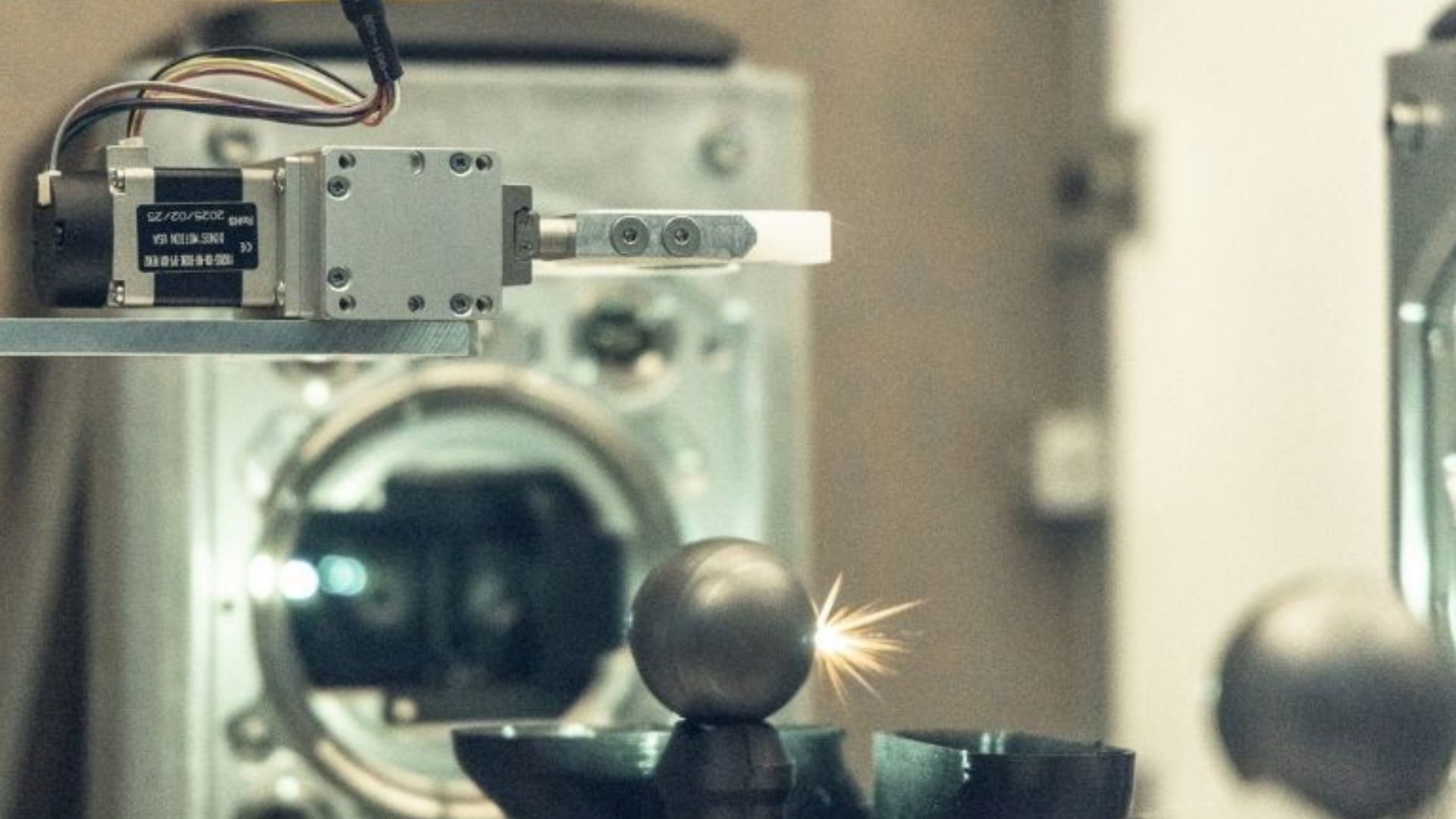
Kairos Power has commissioned an automated inspection and laser marking system for its nuclear fuel pebbles, adding a new quality control capability as the company prepares for upcoming reactor hardware tests and future deployment of its Hermes-2 demonstration plant.
The customized system is in operation at the company’s Manufacturing Development Campus in Albuquerque, New Mexico. It measures individual fuel pebbles against manufacturing specifications, records their properties, and engraves each one with a unique tracking code.
Kairos Power is targeting 70,000 inspected pebbles for upcoming test platforms, including its second Engineering Test Unit (ETU). The company says the same inspection and tracking capability will support the future Hermes 2 facility in Oak Ridge, Tennessee.
The milestone addresses a practical challenge in the development of silica-based nuclear reactors: maintaining consistent manufacturing quality while tracking individual fuel assemblies during testing and operation.
The automatic inspection checks every fuel pebble
Kairos Power is developing a fluoride salt-cooled high-temperature reactor technology that uses spherical fuel assemblies, commonly referred to as pebbles. Before the pebbles reach testing platforms or are prepared for transportation, they undergo a series of quality checks on the new automated line.
The system measures the diameter, geometry and density of each pebble in real time to confirm that it meets manufacturing specifications. High-precision lasers then scan the external surface in the micrometer range to assess its structural integrity.
By automating these checks, the company can process pebbles while capturing standardized measurements for individual data sets. The resulting data can help engineers identify manufacturing deviations and improve subsequent production campaigns.
Instead of relying solely on batch-level records, the system links inspection results to each pebble, providing more detailed information about the fuel assemblies participating in the tests.
Laser codes create individual fuel records
After inspection, each pebble is transported to an infrared laser engraving station. According to the company, the system etches three redundant data matrix codes, similar to QR codes, into the graphite surface with markings approximately half a millimeter deep.
Each code links the pebble to an individual data set that includes its dimensions, density measurements, production batch and inspection status. Additional markings around the codes allow optical systems to identify different types of pebbles when a data matrix is damaged.
This traceability could become increasingly important as Kairos Power expands its fuel development and testing activities. By linking physical fuel elements to manufacturing and inspection data, engineers can track individual pebbles through downstream handling and testing.
The company also expects the markings will help distinguish different types of pebbles, improve measurement of fuel consumption, and strengthen material stewardship during reactor operation.
“By automating our quality control and laser engraving processes internally, we are building the foundational capabilities and traceability needed to support our iterative approach to fuel development,” said Kirby Boone, lead engineer on Kairos Power’s fuels team.
Boone added that the system will generate data to inform future manufacturing and handling systems, from Hermes 2 to the company’s planned commercial fleet.
Supporting Hermes 2 and future fuel production
The automated line is currently processing pebbles for upcoming hardware demonstrations, with a near-term goal of 70,000 inspected fuel assemblies for test platforms, which include the second ETU.
The system will also support Hermes 2, the company’s planned demonstration facility in Oak Ridge. Kairos Power develops the inspection infrastructure internally so that the company can use lessons learned from each production campaign to refine manufacturing processes and prepare for larger-scale fuel production.
