Orbiting 250 miles above the planet, NASA astronaut Anil Menon celebrated his 50th birthday in a way few ever could. He received a special delivery package.
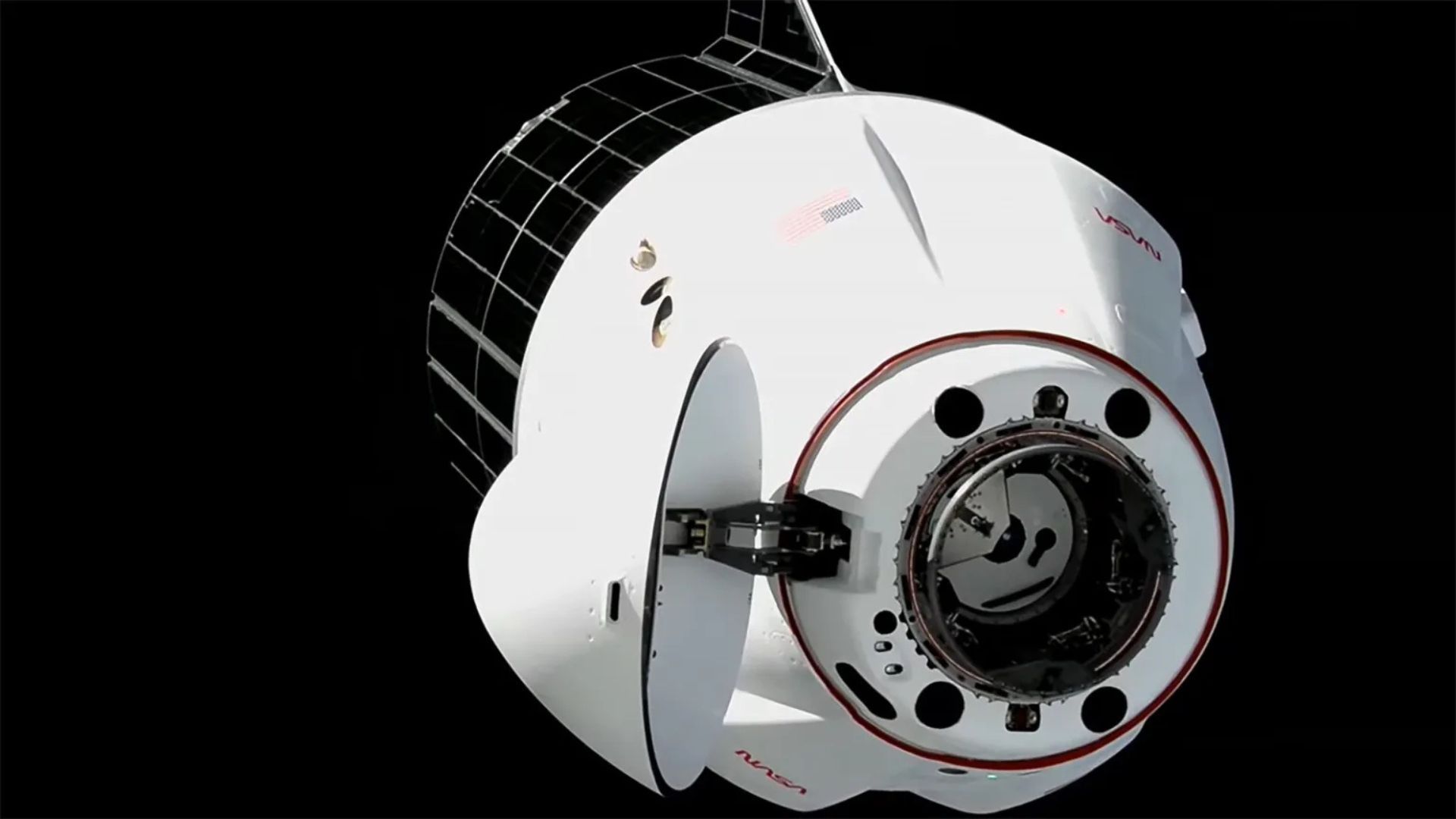
After a 51-hour orbital pursuit that began with a stunning predawn launch, SpaceX’s Dragon cargo spacecraft successfully docked with the International Space Station’s Harmony module on October 15.
The mission was designated Commercial Resupply Services CRS-35. It brought over 6,300 pounds of vital supplies, state-of-the-art scientific experiments, and a surprise birthday delivery for Menon, who was the primary crew member overseeing the automated rendezvous.
Menon launched to the ISS on the Soyuz MS-29 in July for an eight-month stay. Therefore, he was in the middle of his extended mission when CRS-35 arrived.
Chasing the train station
The journey began two days earlier at Cape Canaveral Space Force Station in Florida, where a Falcon 9 rocket roared to life and rose into the morning sky.
The rocket was launched around dawn, illuminating the upper atmosphere and creating a glowing “space jellyfish” with its expanding exhaust plumes on spectators along the east coast of the United States.
Flying at a high speed of 17,500 miles per hour, Dragon performed a series of precise engine firings to catch up with the station as both spacecraft raced over South Africa. Docking went smoothly.
Dragon autonomously attached itself to the space-facing zenith port of the station’s Harmony module and provided fresh supplies to the newly arrived Crew 13 astronauts who took over station operations earlier this month.
The Dragon spacecraft delivers a variety of operational equipment and advanced scientific experiments in support of the orbital laboratory. Its primary payload includes the eighth and final set of International Space Station Roll-Out Solar Arrays (IROSAs) to complete the expansion of the station’s power grid, along with maintenance components for the Canadarm2 robotic arm and replacement hardware for the station’s toilet systems.
Research and upgrades to the ISS
In the scientific area, the shipment includes materials to create 3D printed artificial retinas to treat vision loss on Earth, as well as 3D heart tissue models to improve drug testing.
On Earth, gravity causes cells to settle and deform. In microgravity, cells grow into 3D structures similar to those in the human body, allowing scientists to cultivate far more realistic heart tissues and brain organoids.
In addition, researchers will study brain organoids to identify potential therapies for neurodegenerative diseases such as Alzheimer’s, Parkinson’s and multiple sclerosis. It also contains experimental materials to observe how a new type of glass forms without the influence of gravity.
The arrival marks a transitional moment for the orbital laboratory. As the Crew 13 team unpacks fresh food and scientific instruments, the outgoing Crew 12 members are ready to share stories from their nearly eight-month stay in space.
SpaceX’s Cargo Dragon is a key element for international space operations because of its ability to return to Earth. It features a protective heat shield and parachute system that allow for a safe landing.
Dragon will remain tied to the station for about a month. Astronauts will load their pressurized cabin with completed research, waste and spent hardware before the spacecraft descends and splashes down into the ocean for a powered re-entry.
