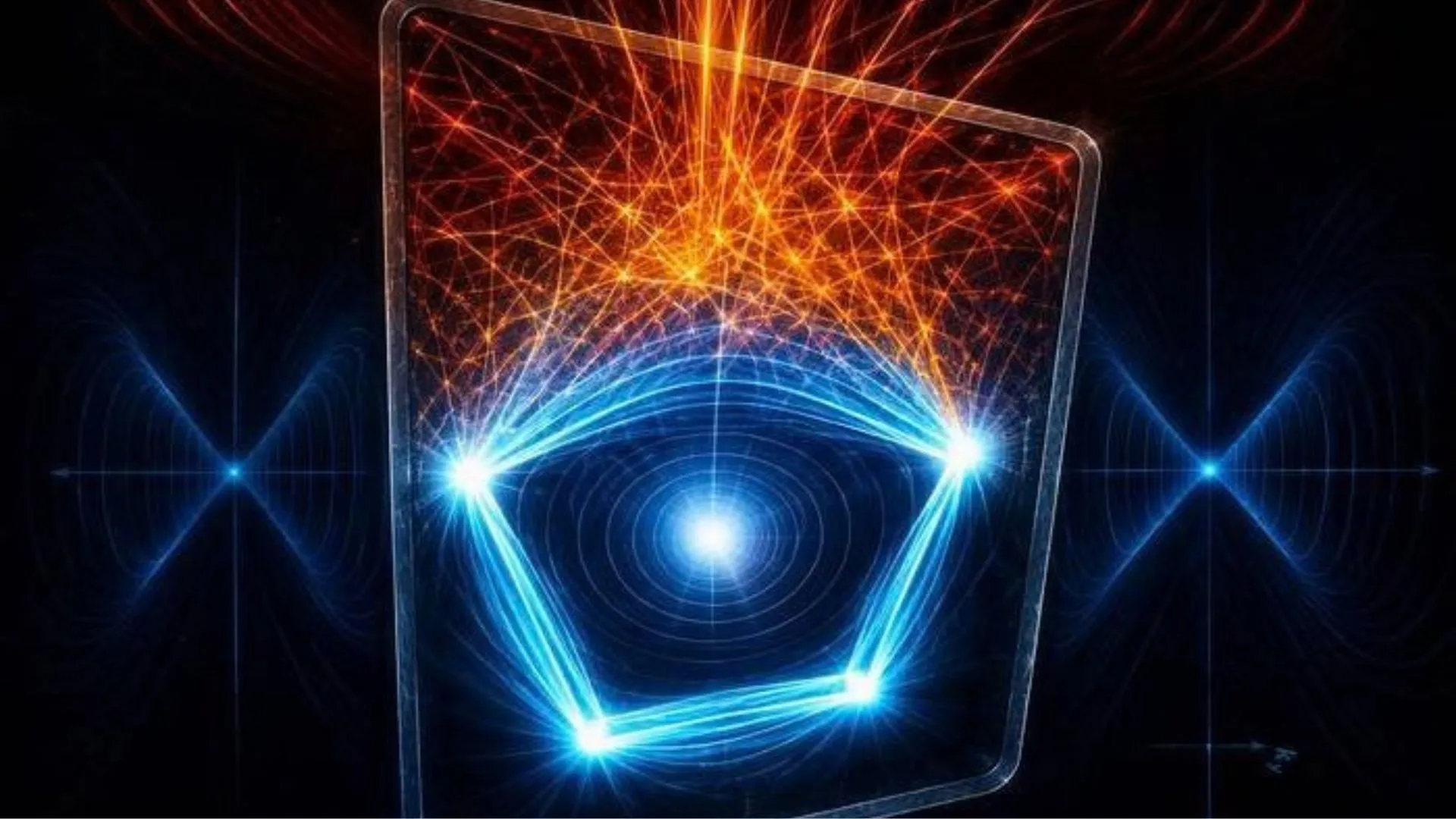
Scientists have found a way to prevent the chaotic scattering of light and sound waves in complex, oddly shaped spaces.
Shout into an irregularly shaped room and your voice will collapse into a chaotic mess of echoes. The incoming wave hits a sloping wall, bounces off at an angle and quickly becomes completely unpredictable. Physicists call this nonlinear mess a “dynamic billiards.” It is the bane of optical engineers and acoustic designers. Now scientists have found a way to stop the madness.
Researchers at the Advanced Science Research Center at the CUNY Graduate Center (CUNY ASRC) have found that passing waves through a special class of synthetic media forces them to completely abandon chaotic scattering. Instead of fragmenting, the waves organize themselves naturally into repeating geometric loops.
The discovery could change the way engineers direct light onto computer chips, route wireless signals and build biological sensors.
“This work shows how geometry and a material’s properties can work together to produce wave behavior that is both surprising and useful,” said Andrea Alù, the study’s principal investigator.
“By understanding how waves organize in these hyperbolic media, we can begin to explore new approaches to controlling energy, information and communication signals in complex environments,” Alù added.
The geometry of order
The research team wanted to investigate how combining these non-standard reflection properties with an asymmetric cavity changes wave dynamics.
In everyday materials, reflection follows a simple rule: the angle of incidence is equal to the angle of reflection. Throw light into an oddly shaped box and those reflections quickly get messy.
Standard materials send reflective waves outward at equal angles, creating unpredictable chaotic patterns in irregular containers.
Hyperbolic materials overcome this limitation by restricting wave propagation along narrow, highly directional paths and altering reflection behavior on inclined surfaces. In these special cavities, waves gradually organize into stable, scale-invariant closed loops, as broken mirror symmetry and shrinking wavelengths collapse chaotic scattering into structured trajectories.
This unique propagation results in wave trajectories with directional rotation, or handedness, which dictates whether paths rotate clockwise or counterclockwise.
Researchers experimentally validated this self-organizing behavior by controlling vibrations within an engineered mechanical metamaterial.
“The most exciting aspect of these results is that they connect a simple geometric idea with a variety of wave phenomena,” said Enrico Renzi, a graduate student in Alù’s lab. “We can observe how the waves organize themselves, and we can link that organization to properties such as stability and handedness. This gives us a framework for designing wave behavior rather than simply observing it.”
Sea roots
The physics behind this tabletop development has surprising roots in deep-sea oceanography.
In the ocean, underwater waves propagate through layers of water of different densities. When these internal waves hit underwater slopes, they reflect in unusual ways, often forming closed trajectories that concentrate energy beneath the surface.
The CUNY team translated this fluid dynamics concept into a solid-state platform using a mechanical metamaterial—a custom-made structure with miniature columns that conduct elastic vibrations.
The use could extend beyond mechanical vibrations. The same mathematical framework applies to 2D materials such as hexagonal boron nitride and molybdenum trioxide, which contain hybrid light-matter excitations called hyperbolic phonon polaritons.
The researchers’ goal is to use wave attractors to construct low-loss nanophotonic circuits, construct highly sensitive biosensors, manipulate microscopic particles using light, and create wave-based analog computing systems.
The study was published in the scientific journal Natural physics.