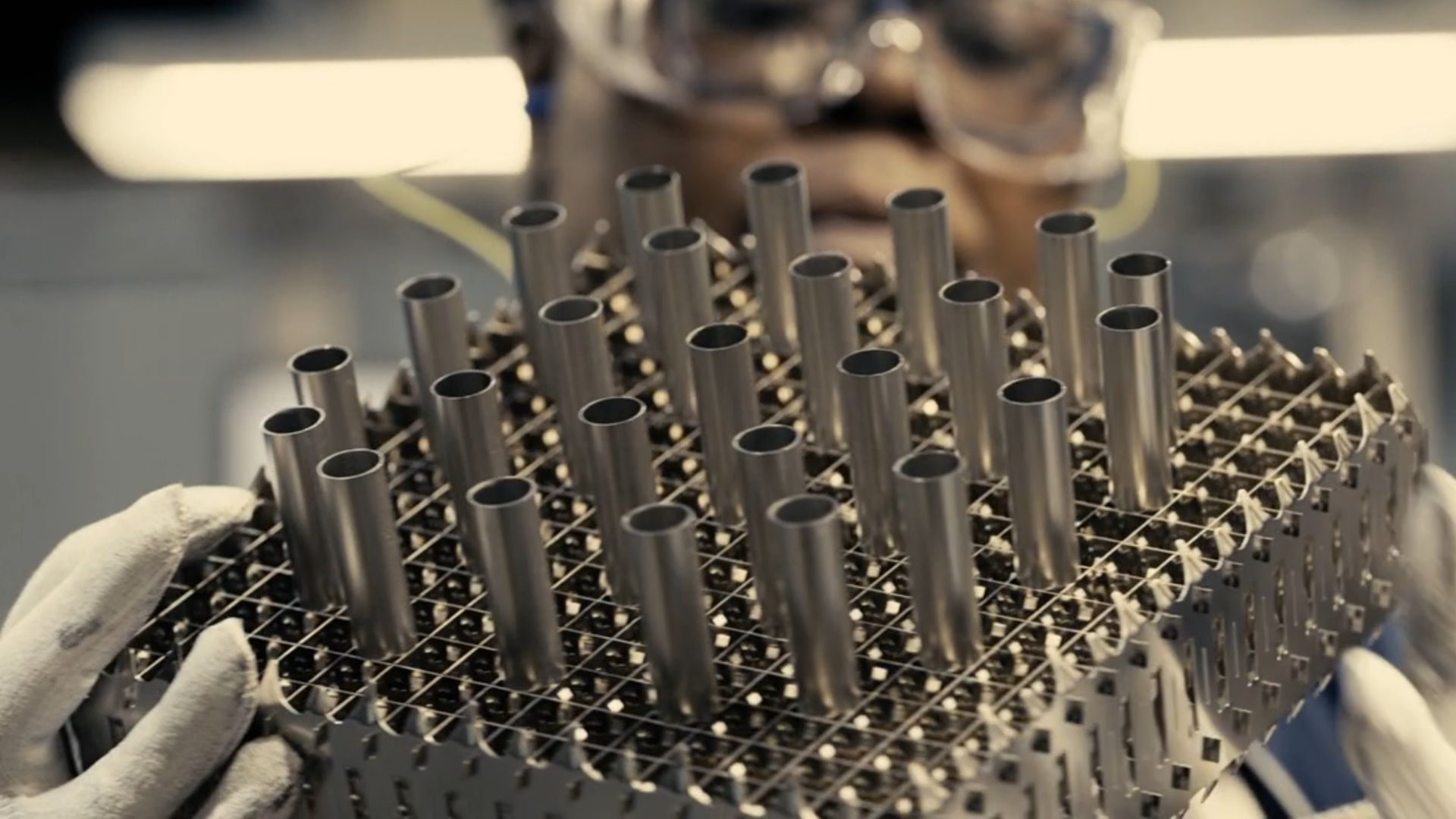
Westinghouse Electric Company is spending about $1 billion to build a new nuclear fuel production plant in South Carolina. The project is underway at the existing Columbia Fuel Fabrication Facility in Hopkins and is expected to be operational in 2030. It is the first fleet-scale nuclear fuel plant built in the United States in more than 50 years.
The site will mass produce a special type of fuel called Low Enriched Uranium Plus (LEU+). Conventional commercial fuel operates below these levels, but LEU+ increases uranium enrichment to 5% to 8%.
This higher concentration changes the economics of operating a commercial reactor. Because the core carries more energy, power plants can extend the intervals between required refueling stops. Longer operating times reduce daily costs for operators while providing the grid with constant baseload power.
To support the operational fleet
“The Columbia LEU+ Fuel plant is our largest single investment in support of the operational fleet and represents a transformative milestone for our company and the industry,” said Dan Sumner, President and Chief Executive Officer of Westinghouse.
“By scaling our LEU+ fuel production capabilities, we are strengthening our commitment to helping our customers produce more nuclear energy while creating new opportunities in South Carolina.”
The production boost supports the United States’ UPRISE initiative. As part of this program, energy suppliers want to increase the total electricity output of existing reactors through so-called plant expansions. The higher-energy LEU+ fuel will provide the thermal margin needed to expand electricity generation across the country without having to build new reactor vessels.
The Columbia facility will also provide finished fuel for current commercial fleets and deliver assemblies for Westinghouse AP1000 reactors worldwide. While the more comprehensive Columbia facility has produced pellets, rods and complete assemblies since 1968, the mass production of LEU+ marks a technological shift.
The fuel was first loaded commercially into an American reactor in 2025, and this new factory is intended to move the technology from use at a single plant to widespread commercial use.
Advanced microreactor testing
In addition to this manufacturing project, Westinghouse has also advanced testing of its eVinci microreactor platform. During high-temperature runs in September, engineers collected new empirical data to evaluate core behavior under extreme heat.
The eVinci core reached nuclear criticality at 1,225°F. In reactor physics, criticality is the threshold above which a chain reaction of nuclear fission becomes completely self-sustaining. By testing at this equilibrium, engineers can closely observe how reactor physics and core conditions interact. As the test continued, the team recorded a subcritical reactivity measurement at a maximum core temperature of 1,852°F.
Engineers use the physical measurements collected during core heating to test the accuracy of their mathematical reactor models. When engineering teams identify where physical results differ from computer models, they can correct their simulation software before committing to final prototype hardware.
Taken together, the two developments lead to a remarkable path. The new South Carolina facility will increase fuel production and operational life of large commercial power reactors, while the eVinci trials provide experimental data to refine software for high-temperature microreactor systems.
