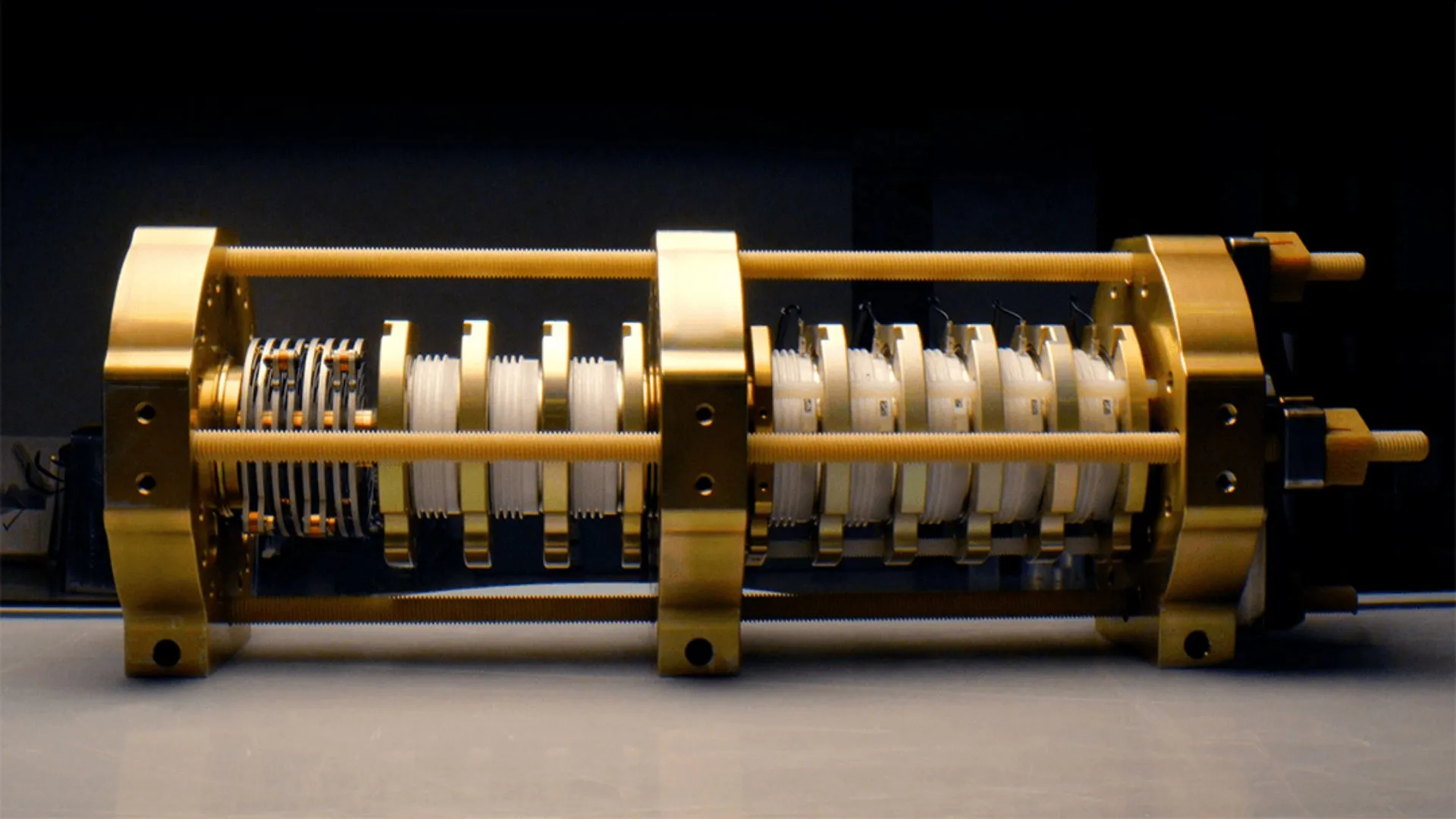
Nuclear fusion promises virtually unlimited clean energy, but building a minister on Earth requires extreme electronics. In this regard, the American fusion developer Helion has taken a big step towards solving this bottleneck.
The Washington-based company has reached a tentative agreement with the U.S. Department of Commerce for up to $175 million in federal financing. The grant supported by the CHIPS Act is matched by $50 million from private investors.
Together, the $225 million package will fund domestic facilities and production lines to help build the specialized modules needed to operate commercial fusion reactors.
Use of high power pulsed electrical systems
Helion’s approach is based on high-performance pulsed electrical systems. These circuits have to repeatedly capture, switch and release enormous current surges in fractions of a second. The robust semiconductors required for these tasks are currently only manufactured abroad.
By manufacturing in the U.S., Helion hopes to eliminate supply chain risks overseas. The new designs are designed to run at higher voltages, stay cooler under load and function reliably for years.
“Building fusion power plants at scale requires us to accelerate technologies like semiconductors that are critical to making fusion possible,” said David Kirtley, CEO of Helion. He noted that the new funds will help produce chips that meet the exact efficiency and performance standards the company needs.
Protect public funds
The investment will be split between two main centers. Everett, Washington, will receive more than $100 million to build research facilities and energy module production lines. The project focuses on advanced packaging techniques that bundle multiple chips into compact units.
Another $80 million goes to Burlington, Vermont. In collaboration with an industrial partner, Helion will develop specialized tools and production machines to support mass production. The rest of the funds will go toward automated assembly systems.
In an unusual agreement to protect public funds, the federal government will take an equity stake in Helion. Under the tentative agreement, the Commerce Department will receive $175 million in non-voting shares tied to the company’s most recent Series G valuation.
U.S. officials say domestic chip factories could also bring broader benefits. Bill Frauenhofer, acting director of the Department of Commerce, noted that breakthroughs in high-power switching will benefit national power grids and defense applications.
Push for commercial nuclear fusion
The funding comes amid an intensive push toward commercialization. Helion recently closed a $500 million investment round and reported plasma temperatures of 150 million degrees Celsius. Earlier this year, Washington state regulators issued key radiation and air permits and gave Helion permission to build the generator building for its flagship plant, called Orion.
Electricity is generated by fusing light atomic nuclei such as deuterium and helium, releasing enormous energy without creating long-lived radioactive waste. While Helion has not yet released peer-reviewed results confirming net power generation, the company faces an ambitious commercial deadline: to deliver 50 megawatts of power to Microsoft data centers by 2028.
“Injecting American-made fusion energy into the grid could fundamentally change U.S. strategy from addressing energy shortages to harnessing abundant clean energy, developing new industries, strengthening national security and improving the quality of life for all Americans,” Helion concluded in a press release.
