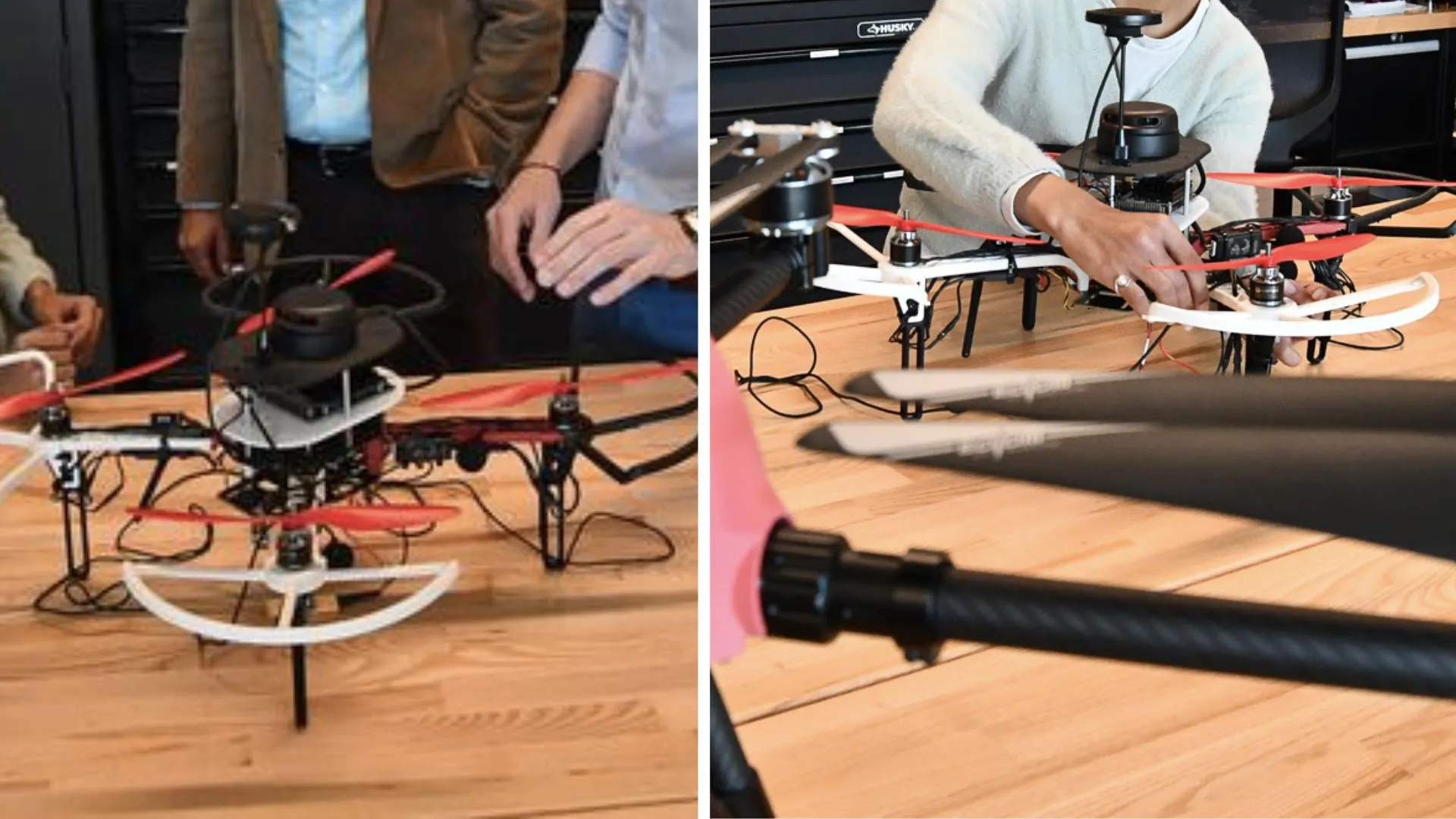
Engineers in the United States are using sound to detect potential catastrophic failures of drones. The University of Cincinnati team is using sound to help NASA detect whether a drone’s engines or propellers are damaged to prevent a crash.
Research partners recorded the various sounds drones make when their propellers chip or crack, or their engines become damaged or begin to fail. They converted the recordings into valuable data that computers at a ground station can use to alert operators before takeoff that a drone is unfit to fly.
Autonomous drone only uses sound to detect damage
“The project started in 2024 with NASA’s interest in detecting problems with engines before a drone took off,” said Prissha Chawla, a doctoral candidate in the UC College of Engineering and Applied Science. “Drones are being used more and more for public safety. You don’t want them to crash.”
Ultimately, students envision an autonomous drone that can use sound alone to detect damage to its own propellers and other mechanical systems in flight, allowing it to return to base before a catastrophic failure occurs, a press release said.
According to Chawla, in addition to chips or cracks in the propellers, sand and other foreign objects can also get into the engine bearings and block them.
A damage detection system could be a feature
“We are focusing on pre-flight testing that NASA is already doing,” she said.
UC student Luke Busse said the damage detection system could be a feature of fully autonomous “drone-in-a-box” systems. Drones are deployed from a weatherproof docking station that handles takeoff, landing, recharging, data uploading and mission planning without an operator on site.
“In this scenario, it would be great. You could have sensors in the box that allow for pre-flight checks,” said Busse.
Drone engines and propellers produce characteristic noises when in operation. If a component becomes damaged or fails, these noises may change and may be an early indication of a mechanical problem.
The approach is particularly valuable because not every mechanical problem can be easily identified through visual inspection. While a crack in a propeller may be visible, it may be more difficult to detect contamination inside an engine mount. According to the researchers, sand and other foreign objects can enter and block the engine mounts, potentially leading to a loss of propulsion.
Acoustic monitoring could therefore provide additional protection by detecting unusual mechanical behavior that would otherwise go unnoticed during routine inspections.
The technology could be particularly useful in situations where drones operate frequently or perform missions with limited time for detailed manual inspections. Detecting a fault before launch could prevent damage to equipment, reduce service interruptions and help protect people and property on the ground.
