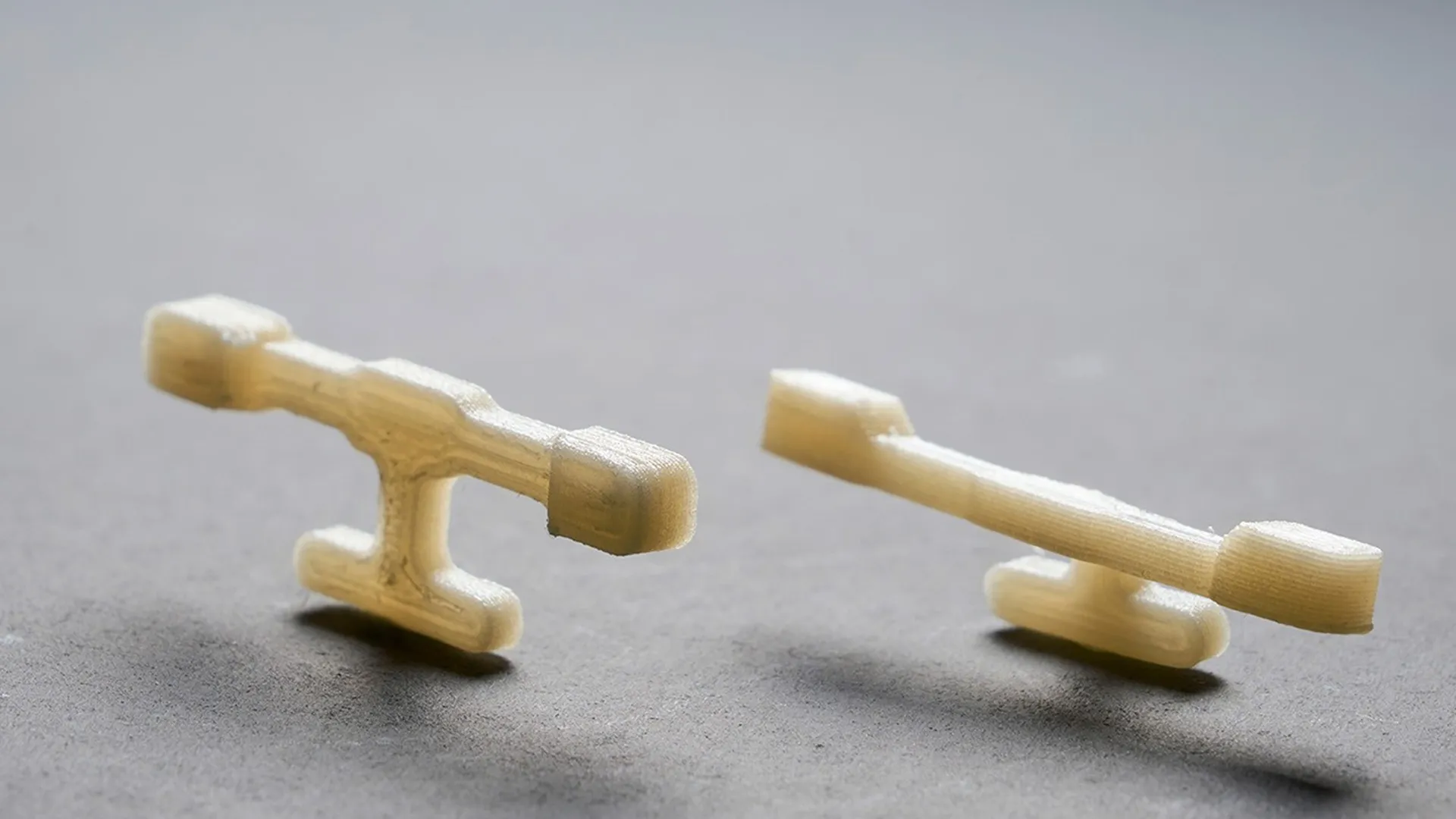
Researchers at Germany’s Fraunhofer Institute for Applied Polymer Research (IAP) have developed 3D-printed shape-memory polymer hinges that could help satellites deploy their solar panels while carrying significantly less mechanical hardware.
Each hinge weighs about 1.4 grams, making it about 93 percent lighter than conventional hinges currently used in satellite systems, the researchers said. The components use heat to trigger a programmed shape change, allowing folded solar panels to unfold after launch.
The development is part of the “Additive Manufacturing of Solar Modules for spACE Applications” (AM-SPACE) project, in which Fraunhofer IAP, German Orbital Systems (GOS), Orion Additive Manufacturing and the Fraunhofer Institute for Reliability and Microintegration IZM were involved.
Heat triggers the recovery of shape
The technology uses shape memory polymers (SMPs), materials that can be programmed into a temporary shape and return to their original shape when heated.
The researchers processed the polymers into filaments suitable for additive manufacturing and used them to create hinges and hold and release mechanisms (HDRMs). The latter secure the satellite components during launch before releasing them in a controlled manner once the spacecraft reaches orbit.
After the release mechanism is activated, the polymer hinges unfold the solar panels using heat. A heating element increases the hinge’s temperature from 73.4°F to 284°F, triggering its programmed shape recovery. Under controlled laboratory conditions, the hinge unfolds in approximately 60 seconds.
The approach could reduce the need for traditional mechanical actuation systems that increase the weight and complexity of satellite deployment structures.
Printing speeds up production
To simplify the production of the components, the researchers also used additive manufacturing. Printing a hinge or HDRM takes about 15 minutes, followed by another 30 minutes to program its temporary shape.
A separate 4D printing approach integrates the deformation reaction directly into the component during manufacturing. Using this method, the team created HDRMs in about five minutes.
The researchers say the approach could help launch satellites in a compact configuration before deploying their solar panels or antennas in orbit. It could also enable other activatable components for small spacecraft.
Unlike traditional 3D printing, 4D printing features a programmed response that allows a printed object to change shape or function when exposed to an external stimulus, such as heat.
The technology has undergone initial laboratory validation, including cleanroom testing, temperature cycling and preliminary vacuum chamber experiments. One of the polymers also passed outgassing tests carried out by the Spanish National Institute of Aerospace Engineering (INTA).
However, the components have not yet been tested in orbit and their long-term reliability in real space conditions remains to be determined.
German Orbital Systems has expressed interest in evaluating the components in space, while discussions are ongoing about a possible follow-up project aimed at an in-orbit demonstration.
The AM-SPACE project ran from October 2023 to September 2026 and was funded by regional innovation programs with support from the European Union.
