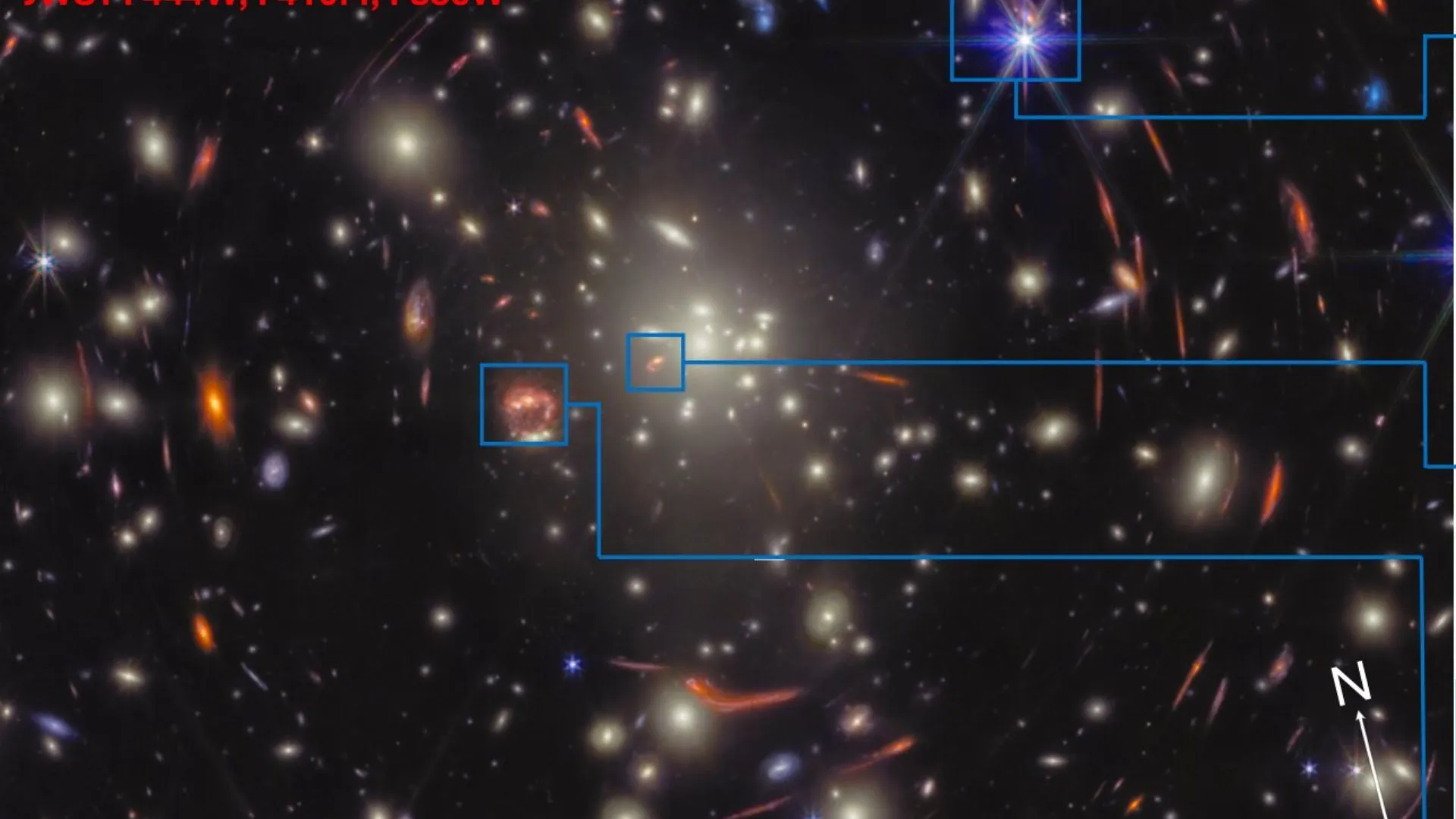
Astronomers at the Space Telescope Science Institute (STScI) have discovered an exploding star 8.8 billion years ago in high-resolution images from the James Webb Space Telescope (JWST). The images were taken in August 2025 and thanks to gravitational lensing, astronomers will have another chance to see them in about 70 years.
The JWST was launched in December 2021 as the successor to the Hubble Space Telescope. The project is a space-based infrared observatory and a joint collaboration between NASA, the European Space Agency (ESA) and the Canadian Space Agency (CSA). The telescope orbits about 930,000 miles (1.5 million km) around Earth and captures images of exoplanets, star formation and galaxy evolution that help us understand the early universe.
When it comes to discovering supernovae, JWST has an outstanding track record, capturing some of the earliest supernovae, dating back just 730 million years after the Big Bang. Scientists have combined data from Hubble and JWST to explain some “missing red supergiants,” while JWST has also discovered the “Brightest of All Time” (BOAT) supernova signature.
This time, thanks to gravitational lensing, astronomers will be able to detect the supernova called SN Ares in another 70 years.
What is gravitational lensing?
According to Einstein’s general theory of relativity, massive objects distort the fabric of space and time. Although light has no mass, the curvature of spacetime caused by gravity also bends light. This creates a cosmic magnifying glass or lens that can brighten the light from a background source, helping astronomers see faint or distant objects clearly. This is called gravitational lensing.
Some examples of this lensing include the Einstein Cross, where gravity splits the light from a distant quasar into four different images arranged in the shape of a cross. A molten ring magnifies the light of a background galaxy by twenty times, turning it into a glowing molten ring.
However, in some cases, the light refracted by gravitational lensing can arrive at different times. While in the case of SN Ares it may only last a few hours, the other light is expected to appear in around 73 and 76 years.
Light comes after decades
Astronomers discovered SN Ares in near-infrared images of the MACS J0308.9+2645 galaxy cluster taken by JWST in August 2025. They classified it as a Type IIb supernova after spectroscopy results showed helium and hydrogen features, suggesting the star lost its outer hydrogen layer due to an explosion.
Their analysis using a three-lens model shows that two more images of the supernova have yet to reach us. Their expected arrival after seven decades represents a rare cross-generational viewing opportunity. We don’t know exactly how astronomy will evolve over the next 70 years, but it will also give the next generation a glimpse into the past.
Another reason this event is significant is that the arrival time of the next set of images depends on the geometry of the room. Since the universe is also expanding, measuring the delay in the arrival of images helps astronomers calculate the Hubble constant, the expansion rate of the universe.
Researchers will conduct further spectroscopic measurements in 2027 to understand the properties of the lens and accurately predict the delay.
The research results were published on a preprint server arXiv.
