Eight years ago, chipmaker Marvell Technology Inc. decided to take a leap of faith with nanometers, and things have been going uphill ever since.
In semiconductor manufacturing, nanometer designations denote generations of chip-making technology, called process nodes, rather than the precise physical dimensions of transistors. Advanced process nodes generally enable higher transistor density as well as improvements in performance and energy efficiency.
Chipmakers typically followed a set downward progression in nanometer sizes, and skipping a step posed a significant risk. Marvell decided to make that bet.
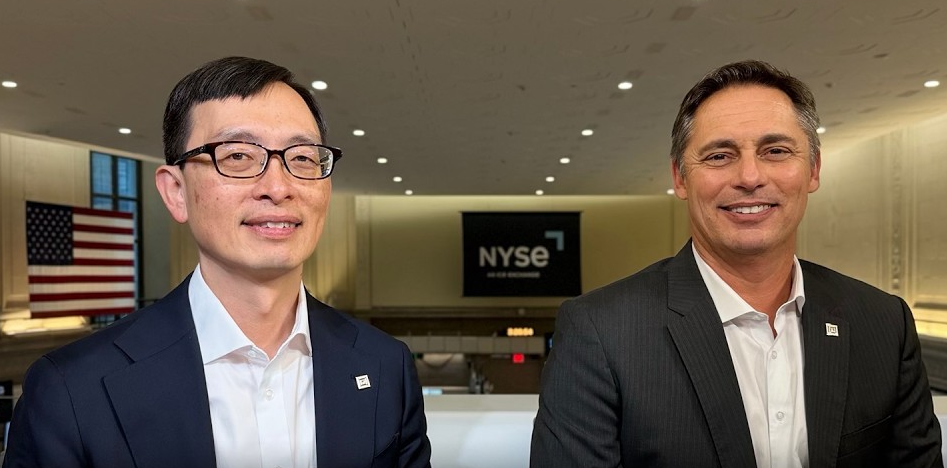
“Around 2018 and 2019, we made the decision that if we wanted to build a data infrastructure, we needed to be a leader, not a follower, and that meant jumping to the newest process node with the best technology,” said Will Chu (pictured left), executive vice president and general manager of the Custom Cloud Solutions Business Unit at Marvell. “So we jumped 7 nanometers. We had products like 12 and 16 nanometers and the next logical thing would have been 7. We jumped all the way to 5…we kept going – 3 nanometers, 2 nanometers, 14 angstroms. We followed that playbook, and it really served as the foundation for our growth to become a leader in the cloud.”
Chu spoke with theCUBE’s John Furrier for theCUBE + NYSE Wired interview series: AI Factories – Data Centers of the Future during an exclusive broadcast on theCUBE, SiliconANGLE Media’s livestreaming studio. He was joined by David Lazovsky (right), executive vice president and general manager of the Data Center Networking Business Group at Marvell, and they discussed how the company has built its business around improving efficiencies for enterprise AI architectures. (*Disclosure below.)
Optical solutions for AI architectures
A cornerstone of the Marvell platform is Serializer/Deserializer technology (SerDes), which enables high-speed, multi-gigabit data transfer for AI clusters, cloud data centers and enterprise networks. Scaling AI infrastructure is a critical challenge in today’s data centers, and Marvell is leveraging SerDes to improve energy efficiency.
In September, the company unveiled 2-nanometer optical interconnect technologies designed to support AI scale-up architectures that tightly connect multiple computing and storage resources to function as a larger system.
“Interconnectivity in copper-to-optical scale-up is so important because processor-to-processor data transfer, about 85% of the total data transfer, occurs within these scale-up networks and only 15% in the scale-out network,” Lazovsky told theCUBE. “If you can positively impact energy efficiency, you can move the needle significantly. We are developing technologies that leverage optics and SerDes…that significantly reduce overall power consumption.”
Marvell’s focus on efficient architecture has also led to advances in high-bandwidth storage. In August, the company announced a Photonic Fabric Memory Module designed to enable a shared memory layer across AI infrastructure. The technology combines DDR5 memory, high-bandwidth memory caching and optical connectivity to enable sharing of memory resources between AI systems.
“For the first time ever, Marvell has developed high-capacity, high-bandwidth optically connected storage,” Lazovsky said. “There are two stacks of high-bandwidth storage, and this supports a module with up to eight stacks of Double Data Rate 5. It gives you the ability to decouple storage capacity from computing power for the first time.”
Marvell’s advances in storage and optical networking have strengthened its position in the AI infrastructure market. Nvidia Corp. announced a $2 billion investment in the company earlier this year, and Marvell recently announced an agreement that would see the company develop custom AI chips for Google LLC.
“This is the largest investment expansion in human history,” Chu said. “In terms of our connectivity business, our networking business and our custom business, we are connected to the fastest growing part of these markets. We have the leading technology, we have the credibility of our customers and a track record of execution.”
Here is the full video interview, part of SiliconANGLE and theCUBE’s coverage of theCUBE + NYSE Wired interview series: AI Factories – Data Centers of the Future:
(*Disclosure: TheCUBE is a paid media partner for theCUBE + NYSE Wired interview series: AI Factories – Data Centers of the Future. Neither Marvell, the sponsor of theCUBE’s event coverage, nor other sponsors has editorial control over theCUBE or SiliconANGLE content.)
Photo: SiliconANGLE
Support our mission to keep content open and free by interacting with theCUBE community. Join theCUBE Alumni Trust Networkwhere technology leaders connect, share information and create opportunities.
- Over 15 million viewers of theCUBE videosto spark conversations about AI, cloud, cybersecurity and more
- Over 11.4k theCUBE alumni — Connect with more than 11,400 technology and business leaders shaping the future through a unique, trusted network
Founded by tech visionaries John Furrier and Dave Vellante, SiliconANGLE Media has built a dynamic ecosystem of industry-leading digital media brands, reaching over 15 million elite tech professionals. Our new proprietary theCUBE AI Video Cloud is a game-changer in audience engagement, leveraging the theCUBEai.com neural network to help technology companies make data-driven decisions and stay at the forefront of the industry conversation.
