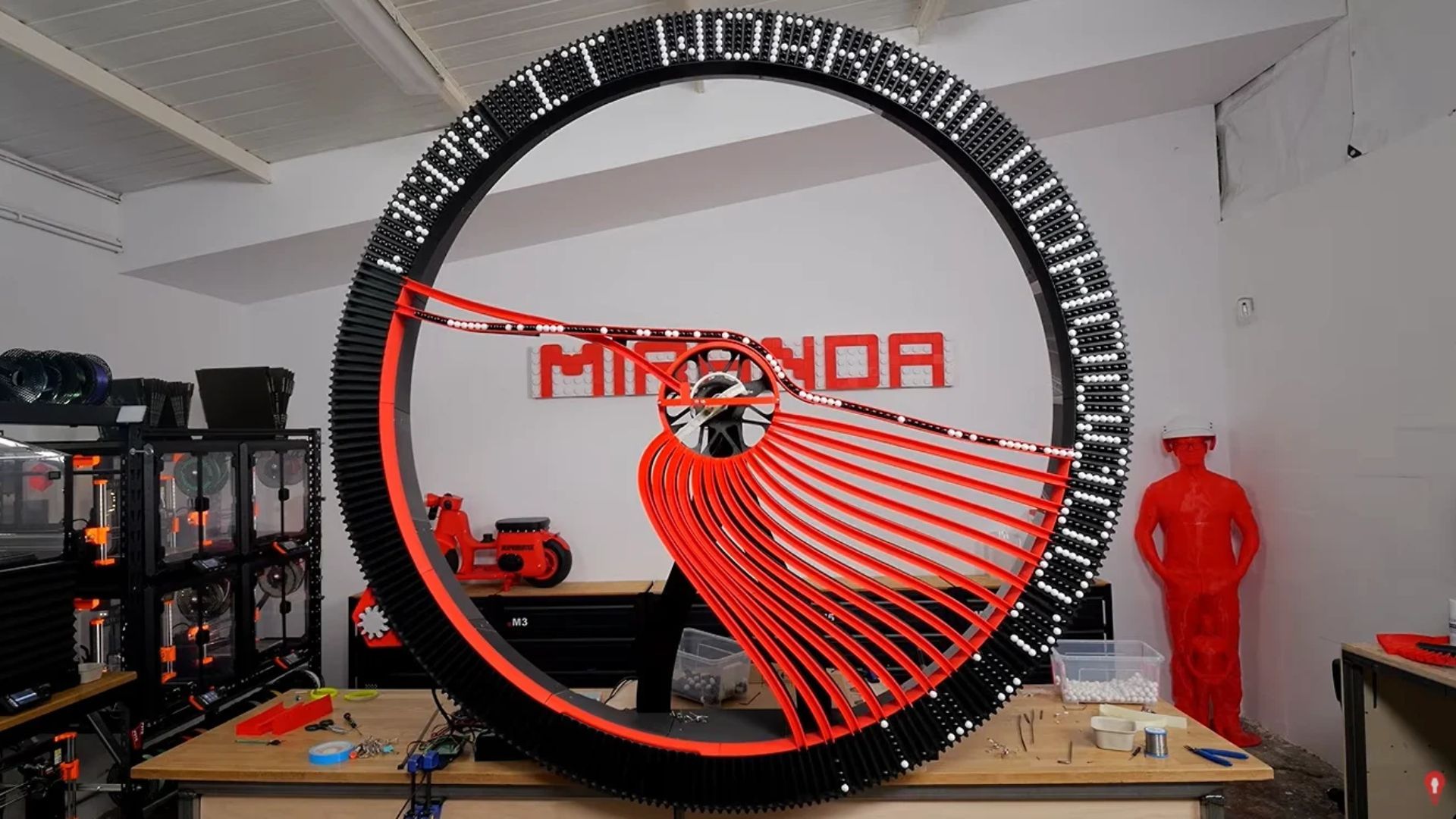
Engineer Ivan Miranda has done it again. As a 3D printing fan, he has given us some wild creations in the past. Its latest model is the Scroller, which uses black and white marbles to display text. By making it huge and round, Miranda ensured that it could display endless text. Whether it’s a text message or a long letter, the scroller can display everything.
If you and I had unlimited access to a 3D printer, what would we print? An action figure? A musical instrument perhaps? Maybe even a scale model of a bicycle, car, plane or rocket. But here YouTubers are different.
They don’t think about what you can do in an afternoon or a weekend. The vision spans weeks and months, and the final video you see is just a snippet of the work that was done behind the scenes.
Interesting technology previously reported on Miranda’s builds, which included a motorcycle, a go-kart and even a treadmill. Needless to say, these were not scale models but working models. While these are impressive, Miranda has a reputation online for building display clocks out of marbles, and this time he’s surpassed his previous achievements.
For his latest work, Miranda replaced the numbers on his digital clocks with text. Theoretically, if you can handle numbers, you can also handle text. However, the main difference is where and how these letters are displayed. While the digital clock and its variants struggled with changing numbers, it all happened in a relatively small space.
For the scroller, Miranda chose a huge circular design, which, while giving him a large canvas to present the text, also greatly increases the complexity of the process. For someone like Miranda, who has been creating digital content for over five years, the complexity only begins when things get interesting.
The solution to solving the complexity challenge is multiple iterations with more 3D printed parts than we can even imagine and the ease with which they fit into the grand plan of making the device work.
How does it work?
The scroller consists of a huge surrounding ring assembled from 3D printed parts in which the letters are displayed. A few things that aren’t 3D printed in the structure are steel ball bearings and a stepper motor that makes the wheel move.
The crucial component of the entire assembly is the selection arm, which decides whether a black or white marble must be sent in a particular direction to produce a letter. This arm is also powered by a stepper motor, while an infrared sensor helps distinguish the marble colors. The setup also features a marble collector that sends marbles that fall from the floor back into the system.
Although the entire structure is made entirely of 3D printed parts, it is huge and fills Miranda’s workshop. Like any other engineering project, sometimes something goes wrong and the letters appear a little askew. But with a little help from its human creator, the system returns to displaying large blocks of text endlessly.
