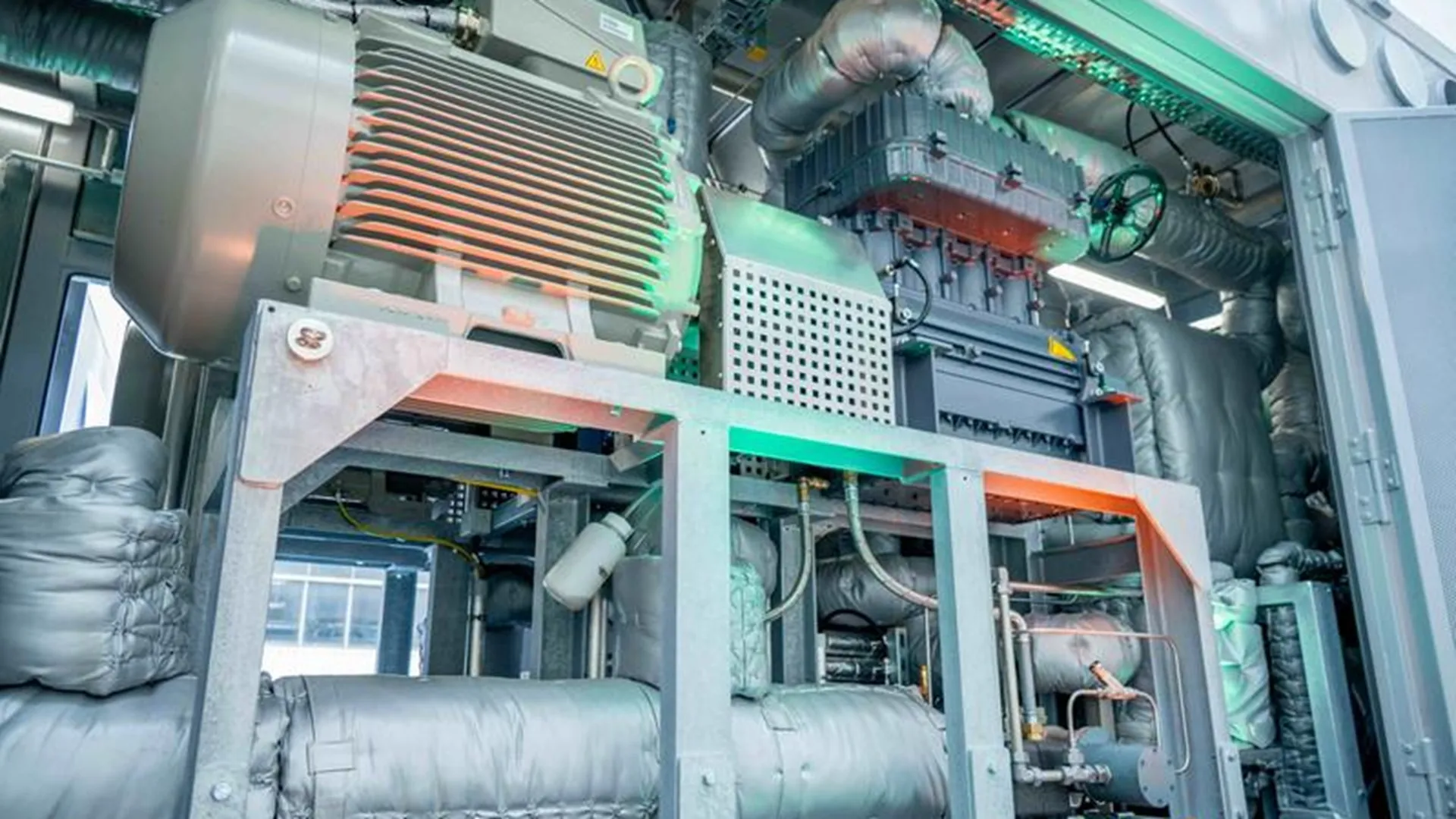
Engineers have just unveiled a powerful 1.2-megawatt heat pump that can convert waste heat from paper production into industrial steam at temperatures of around 120 degrees Celsius.
The heat pump was manufactured by a research team with participation from the Fraunhofer Institute for Energy Infrastructures and Geotechnologies (IEG) in Germany. It was tested in a Felix Schoeller GmbH & Co. KG paper factory in Weißenborn, Hesse. The experiment was carried out as part of the EU-funded PUSH2HEAT project.
The system uses otherwise wasted heat to generate steam for industrial processes. According to the institute, this could reduce carbon dioxide (CO2) emissions by up to 600 tons annually. This means that it could also reduce dependence on natural gas.
“Industrial companies need solutions that combine climate protection, energy security and competitiveness,” said Reuven Paitazoglou, the head of the project. “High-temperature heat pumps make it possible to make previously unused energy sources economically usable for production.”
From waste heat to steam
In industrial processes, steam systems operate well above atmospheric pressure at temperatures exceeding 212 degrees Fahrenheit (100 degrees Celsius). In most cases, producing this steam requires burning fossil fuels, particularly natural gas.
On the other hand, burning fossil fuels releases CO2 and other greenhouse gases that drive climate change and air pollution. To address this challenge, the team developed a two-stage heat pump that can convert low-temperature waste heat into usable industrial steam.
The system captures excess heat from paper production at temperatures between 30 and 70 degrees Celsius. The temperature then rises to about 248 degrees Fahrenheit.
During its first approximately 300 hours of operation in 2026, the pump achieved an average steam output of around 700 kilowatts (kW). It also produced about 1.2 tons of steam per hour at a pressure of about 2.3 bar.
The researchers reported a power factor of 2.30. To put it simply, the system delivered more than twice as much useful heat as the electrical energy required to operate it. With an operating time of 4,000 to 5,000 hours, the system could avoid up to 600 tons of CO2 emissions annually. This could reduce CO2 emissions by around 100 kilograms per megawatt hour (MWh) of heat compared to natural gas steam generation.
Greater industrial potential
The demonstration was part of the EU-funded PUSH2HEAT project, which is investigating ways to reuse industrial waste heat. Although the focus is primarily on paper and chemical production, the technology could also find application in the pharmaceutical and food industries.
Fraunhofer IEG coordinated the scientific aspects of the tests and developed a monitoring system to evaluate performance. The team investigated how the pump could be integrated into existing production processes and steam networks.
Paitazoglou emphasized the importance of expanding the use of the technology. “The demonstration plant in Weißenborn lays an important foundation for the future use of this technology in other industrial applications,” says a press release.
Full load testing began in September 2026. The team plans to evaluate the system in real industrial conditions for a year. Further improvements are expected by the end of the project in 2027.
