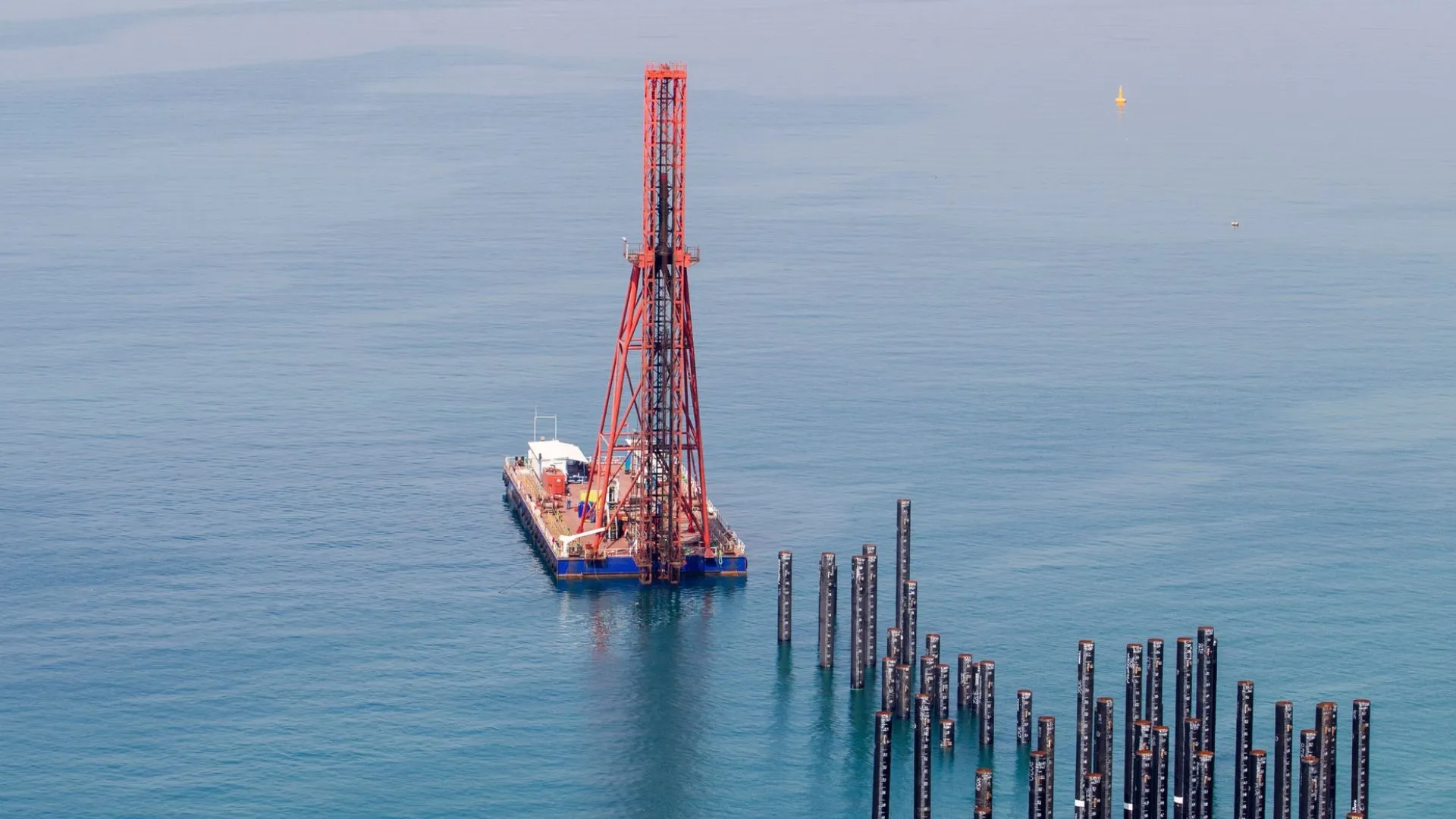
Conventional construction equipment has no chance in the turbulent, deep waters of the Bay of All Saints.
Recently, the world’s “largest” purpose-built piling ship left Lyusi Port in Nantong, Jiangsu Province, and is headed to All Saints Bay in Brazil. It embarked on an ambitious 45-day journey across two oceans.
It will contribute to the construction of the largest cable-stayed bridge in Latin America: the Salvador Itaparica Bridge. Specifically, the bridge will span the largest bay in the country and will require pile foundation work in waters up to 64 meters (nearly 210 feet) deep.
Piling ships are specialized shipbuilding vessels that hammer or push large vertical foundation piles deep into the sea or river floor. These foundation piles act as underwater stilts that anchor and support heavy offshore infrastructure. Typical applications include supporting overseas bridges, wind turbines, oil platforms and harbor docks.
Built for the extremes
The technical challenge is huge. Building a 12.4-kilometer-long sea span over deep water and chaotic seafloor geology requires unprecedented muscle power. To accomplish this task, the China Railway Construction Bridge Engineering Bureau Group (CRBG) built a vessel designed to push the absolute limits of shipbuilding.
“Complex marine geology, strong currents and changing wave conditions have long made the site a major engineering challenge,” said Song Jian, ship construction manager at CRBG China Daily.
The piling vessel reportedly features a 156-meter (511-foot) pile frame, making it the tallest in the world. It delivers a world record lifting capacity of up to 700 tons (approximately 771 US tons) of steel and concrete in a single maneuver. The ship also holds the world record for operating depth and is capable of driving foundations into the seabed to a depth of 70 meters (approximately 230 feet).
Keeping a ship steady while driving massive pillars into a moving seabed is a brutal operational hurdle. To overcome this problem, the vessel combines anchor mooring with state-of-the-art dynamic positioning. Onboard sensors continuously track wind, waves, currents and the ship’s orientation in real time, automatically firing thrusters to fine-tune and keep the giant in place.
Expansion of regional transport
This vessel is also an important milestone in shipbuilding technology as it is the first piling rig equipped with a closed-circuit master cylinder hydraulic system.
According to Song, this system captures naturally generated energy as the massive pile frame sinks or tilts and converts this potential energy into recyclable electricity.
Through this innovative mechanism, the vessel achieves an energy recovery rate of 40 percent, significantly improving operational efficiency while reducing waste during demanding offshore operations.
His route is equally daunting. The ship will navigate south through the narrow Strait of Malacca, round the turbulent waters of the Cape of Good Hope and traverse the open expanses of the South Atlantic before anchoring off the coast of Bahia.
When the bridge finally opens, daily life in the region will change overnight.
Commuters traveling between Bahia’s capital Salvador and Vera Cruz on the island of Itaparica currently face a one-hour ferry ride. The new road connection shortens this journey to a short 15 minute journey. For producers in western Bahia, the connection promises faster and cheaper transit for vital agricultural goods, opening up a new economic artery for northeastern Brazil.