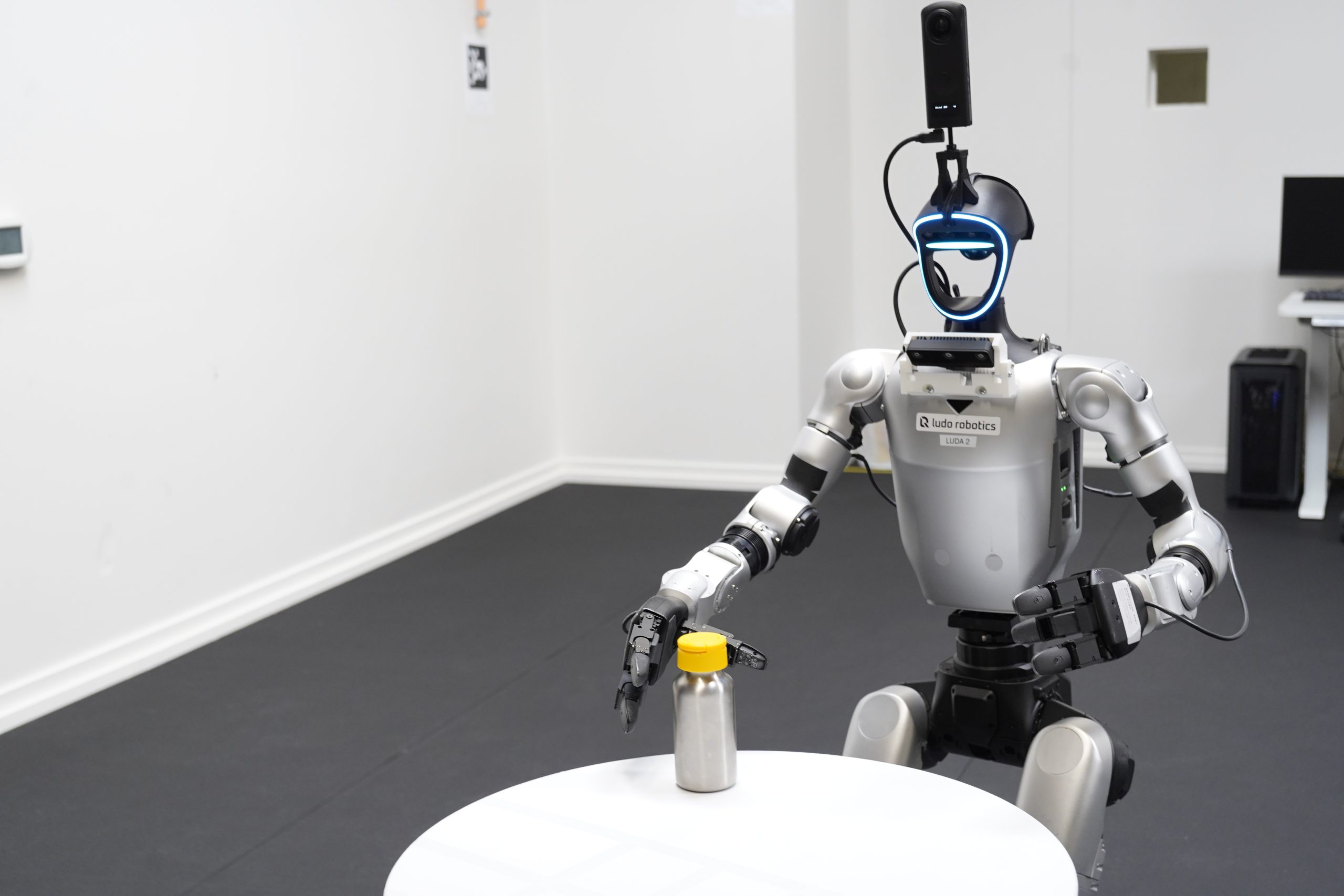
Ludo Robotics Inc., a subsidiary of major South Korean video game maker Krafton Inc., today introduced Ludi 0.2, an artificial intelligence robotic system designed to understand and interact with people in the physical world.
Headquartered in Palo Alto, Ludo grew out of Krafton, a company that primarily publishes video games and is best known for the wildly popular PUBG: Battlegrounds. Ludo also has a research and development laboratory in Seoul that combines the efforts of researchers and engineers in robotics, machine learning and AI.
Krafton CEO CH Kim also leads Ludo as CEO, with Krafton Chief AI Officer Kangwook Lee serving as Chief Technology Officer.
Why did a video game company create and support an AI robotics company? Krafton believes AI makes games more responsive and replayable. It also has strong roots in simulation, interaction and real-time systems, which have immediate applications at the bridge between the digital and the physical, where interaction between humans and robots takes place.
“Robots are becoming increasingly capable of performing physical tasks, but understanding and responding to humans remains a major challenge,” Lee said. “Ludi 0.2 represents another step toward our goal of bringing together conversation, reasoning and physical action to enable robots to better understand human intentions, respond to feedback and adapt to changing situations.”
The company introduced the first version of Ludi 0.1 in August 2026. It combines a vision-language model for argumentation and dialogue with special navigation and manipulation functions. Today’s next-generation model has expanded its capabilities and created more natural human-robot interaction, including social intelligence, memory and reasoning, tool coordination, gesture interpretation and physical movement.
The company said it is working on a final version of Ludi that integrates perception, dialogue and physical action.
The goal is to integrate communication, thinking and physical action into one “brain”. The model would observe what is happening, listen to commands and speech, interpret these commands along with human gestures and physical movements, and make considerations about the environment. This would happen in real time and be coordinated in a similar way to how another human decides actions based on the actions of another person in their workspace.
This is the “Holy Grail” of physical AI, where intelligent robots can perform actions not only in industrial environments and warehouses, but also in retail and residential spaces such as restaurants, living rooms and kitchens.
Krafton has said a lot about this The work includes proprietary base models and co-playable characters created in collaboration with Nvidia Corp. were developed. AI teammates designed to understand players in real time. Ludo builds on this foundation to develop the same kind of intelligence into real-world robots.
Startups are bringing the physical world to robots so that they can see objects and grasp and move them with ever greater efficiency. However, interpreting human intentions and responding to social cues from people around the robot remain elusive. Simulation makes it easy for physical AI to prepare robots to work with objects and around people, but it doesn’t always prepare them to model human behavior.
Photo: Ludo Robotics
Support our mission to keep content open and free by interacting with theCUBE community. Join theCUBE Alumni Trust Networkwhere technology leaders connect, share information and create opportunities.
- Over 15 million viewers of theCUBE videosto spark conversations about AI, cloud, cybersecurity and more
- Over 11.4k theCUBE alumni — Connect with more than 11,400 technology and business leaders shaping the future through a unique, trusted network
Founded by tech visionaries John Furrier and Dave Vellante, SiliconANGLE Media has built a dynamic ecosystem of industry-leading digital media brands, reaching over 15 million elite tech professionals. Our new proprietary theCUBE AI Video Cloud is a game-changer in audience engagement, leveraging the theCUBEai.com neural network to help technology companies make data-driven decisions and stay at the forefront of the industry conversation.
