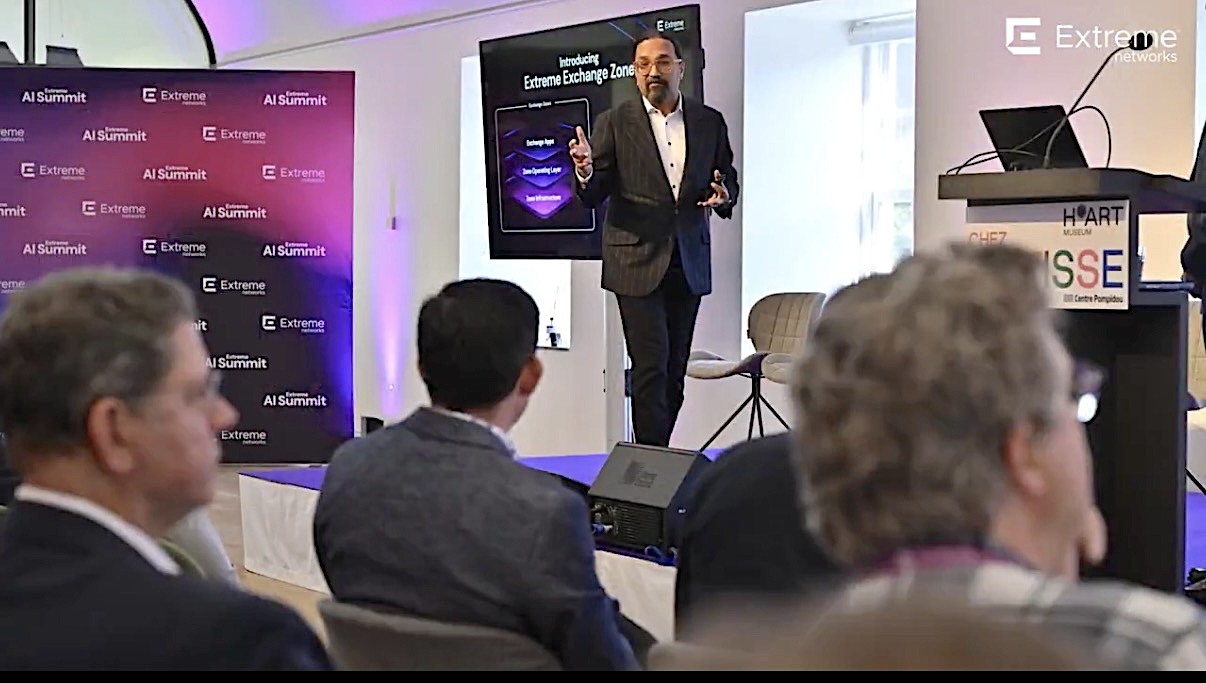
Last AI Summit in Amsterdam, Extreme Networks Inc. shared early Agent ONE Coworker results and previewed Exchange Zones that leverage free access points and switch machines as on-premises artificial intelligence infrastructure. Here’s what it means and what IT professionals should do about it.
Most conversations about AI and networks went one way. AI comes into play, examines the network and helps the network team run it better. This is useful, but it treats the network as a patient rather than a resource.
At the summit, the company argued that there was a better way. The network should be managed by AI and serve as a place where AI runs, using data that most companies currently throw away. This would allow network teams to go from just maintaining Wi-Fi to the AI project to hosting it.
The news
Extreme made two announcements. The first was a progress report on Extreme Agent ONE Coworker, the ambient AI agent integrated into Extreme Platform ONE. According to Extreme, customers saved about 1,000 hours troubleshooting in the first month, 41% of Platform ONE customers used it for daily tasks, and users responded to 98% of critical “nudges,” the proactive alerts the agent issues after conducting its own preliminary investigation. Engagement was approximately 10 times that of Extreme’s first-generation conversational assistant.
The second was a preview of Extreme Exchange zones planned for the first half of 2027. A zone combines an Extreme Universal Compute Platform or customer-owned server with spare capacity from Extreme access points and switches already installed at a site. AI applications from the Extreme Exchange marketplace run on-premises on open-weight models by default, using cloud inference only when policies allow it and logging every time. Agent ONE Operator mode, the autonomous tier, is also coming in the first half of 2027.
Ambient beats conversation
The first wave of AI in networking was not a complete success because it was based on a chatbot built on fragmented data. During his talk, Nabil Bukhari (pictured), Extreme’s chief technology officer and president of AI platforms, called it a design flaw. “Conversational AI requires the user to know the question and the context, and you’d be surprised how difficult that is when it comes to technology domains,” he said.
In Extreme’s focus groups, many administrators asked a powerful AI assistant how many devices they had, even though the number was already on the dashboard. The colleague turns that around. “We have entered a world where AI, not you, stimulates you,” Bukhari said.
The best evidence came from a customer. Kevin Rocha, Chief Information Officer at Hill Collegedescribed a Wi-Fi outage in a building that housed human resources, finance and enrollment departments. “The agent at Agent ONE told me exactly where to look: one access point needed checking and several others needed firmware upgrades. We solved the problem in about 20 minutes, not a whole morning,” he said. Platform ONE, he added, “is like having two or three more network engineers on the team.”
This is the value of AI for networking in most companies. It does not replace the network team. It gives a small team the reach of a larger one. Bukhari also admitted that there is still a lot to be done. He explained that 58% of support cases opened by Agent ONE are received with all the necessary evidence. “Fifty-eight is pretty good, but 58 is still 58, not 100.”
Governance must live outside the agent
Andrew Grill, the opening speaker and author of “Digitally Curious,” discussed the risks. “If a chatbot does something wrong, you might have a bad sales. If an agent does something wrong, you might have a bad Tuesday,” he said. His test for every assignment: “If your agent does something wrong at 2 a.m., whose phone will ring?”
Extreme’s Operator demo has limitations. Each of the 268 tools can be configured to be automatically authorized, ask first, or never used. Four basic rules apply to everything: do not harm the network, never reveal credentials, never act outside of your role, and never act in another tenant. Every task has a full audit trace.
An important design criterion is that governance resides within Extreme Exchange and not Platform ONE. “You can’t govern something from within,” Bukhari said. “That’s how you get rogue agents.” If the system running the agent also controls its permissions, you don’t have a control plane. They have an honor system.
Transition zones are the bigger bet
Networks produce dense, real-time telemetry data about location, movement and behavior that far exceeds operational requirements, and cloud platforms forego most of it because it is expensive to transmit. Bukhari said the valuable uses typically involve four walls: sovereignty, localization, survivability and economics.
The innovation lies in where the computing power comes from. High-end access points have four to eight cores and typically only use one, meaning companies already have to pay for idle computing power hanging from the ceiling. In a healthcare demo, a fall detection app that combined camera feeds, Wi-Fi location and paging to find the closest responder ran entirely on access points. Used a second demo Seattle Seahawks Game data to predict gate congestion and showed some fans had a seven- to eight-minute walk to the nearest pro shop.
“This is not a network management use case,” Bukhari said. “These use cases are not possible without this comprehensive, real-time telemetry.” That is the strategic point. The return flows into operations, facilities and fan experience, giving network executives something they’ve rarely had: a revenue story.
Zones will ship in 2027 and the demo apps were built in collaboration with design partners. The model requires a real application catalog, so Extreme combines it with a free, forward-deployed, invitation-only engineering program. Pricing is based on consumption and measured in “agent actions”. As Grill noted, most companies today have not priced the cost of their tasks and will therefore have difficulty estimating value.
Sovereignty is about permission
As expected, the most valuable insights came from the customer panel. Jonathan Monk, CIO of Institute for Cancer Research in LondonHe manages about 9 petabytes of data, but performance is not his main reason for building confident AI. “When we ask people in our organization what is most preventing them from using AI, I’m not sure I’m allowed to,” he said.
Andrew Beynon, Chief Enterprise Architect at Extreme Partner AROlinked that to the shadow AI. The goal is to “make the path to the legitimate introduction of AI easier than the transition to illegal introduction.” Monk called it the construction of “paved streets.” The industry views sovereignty as a compliance cost, but these customers see it as an accelerator for adoption.
David O’Neill, Head of IT Operations at Liverpool Football Cluboffered a balanced view of AI. “Although AI is an answer, it is not necessarily the answer.” Bukhari highlighted the next challenge: “Adoption is no longer the problem. It’s about optimizing adoption.” After the AI-generated product specifications grew to 200 pages, Extreme limited them to three pages.
Advice for IT professionals
Include the network team in the AI plan. If it’s not involved, decisions about traffic, inference location, and data storage location will be made without the people who understand them.
Separate governance and execution. Verify that agent permissions, audit logs, and the kill switch are located outside of the system where the agent is running.
Inventory the data your network discards. Identify the location and occupancy telemetry you are already generating and which business units would pay to use it.
Test edge computing math under pressure. Ask how workloads are prioritized during RF demand peaks and what model sizes can realistically fit on an access point.
Evaluate your tasks first. Without the base cost of today’s work, it is impossible to evaluate consumption-based AI pricing.
Final thoughts
Extreme cannot outperform its larger competitors and therefore, as a pure network company, relies on speed and focus. Agent ONE’s numbers suggest this is paying off on the operational side.
Exchange zones are the bolder idea. Transforming installed access points and switches into a distributed, centrally controlled inference fabric is more ambitious than anything I’ve seen from Extreme’s larger competitors. It is also unproven and 2027 is still a long way away in the AI era. As Beynon put it, “Today’s knowledge has an expiration date.”
The direction in which Extreme is heading is the right one. For 30 years, the network was the most important infrastructure, but no one wanted to talk about it until it broke. AI makes the network the system that connects data, computing power and people, and possibly also the system that runs the AI. Network professionals who recognize this early will play a much larger role in the next direction of their organizations.
Zeus Kerravala is a Principal Analyst at ZK Research, a division of Kerravala Consulting. He wrote this article for SiliconANGLE.
Photo: Zeus Kerravala
Support our mission to keep content open and free by interacting with theCUBE community. Join theCUBE Alumni Trust Networkwhere technology leaders connect, share information and create opportunities.
- Over 15 million viewers of theCUBE videosto spark conversations about AI, cloud, cybersecurity and more
- Over 11.4k theCUBE alumni — Connect with more than 11,400 technology and business leaders shaping the future through a unique, trusted network
Founded by tech visionaries John Furrier and Dave Vellante, SiliconANGLE Media has built a dynamic ecosystem of industry-leading digital media brands, reaching more than 15 million elite tech professionals. Our new proprietary theCUBE AI Video Cloud is a game-changer in audience engagement, leveraging the theCUBEai.com neural network to help technology companies make data-driven decisions and stay at the forefront of the industry conversation.
