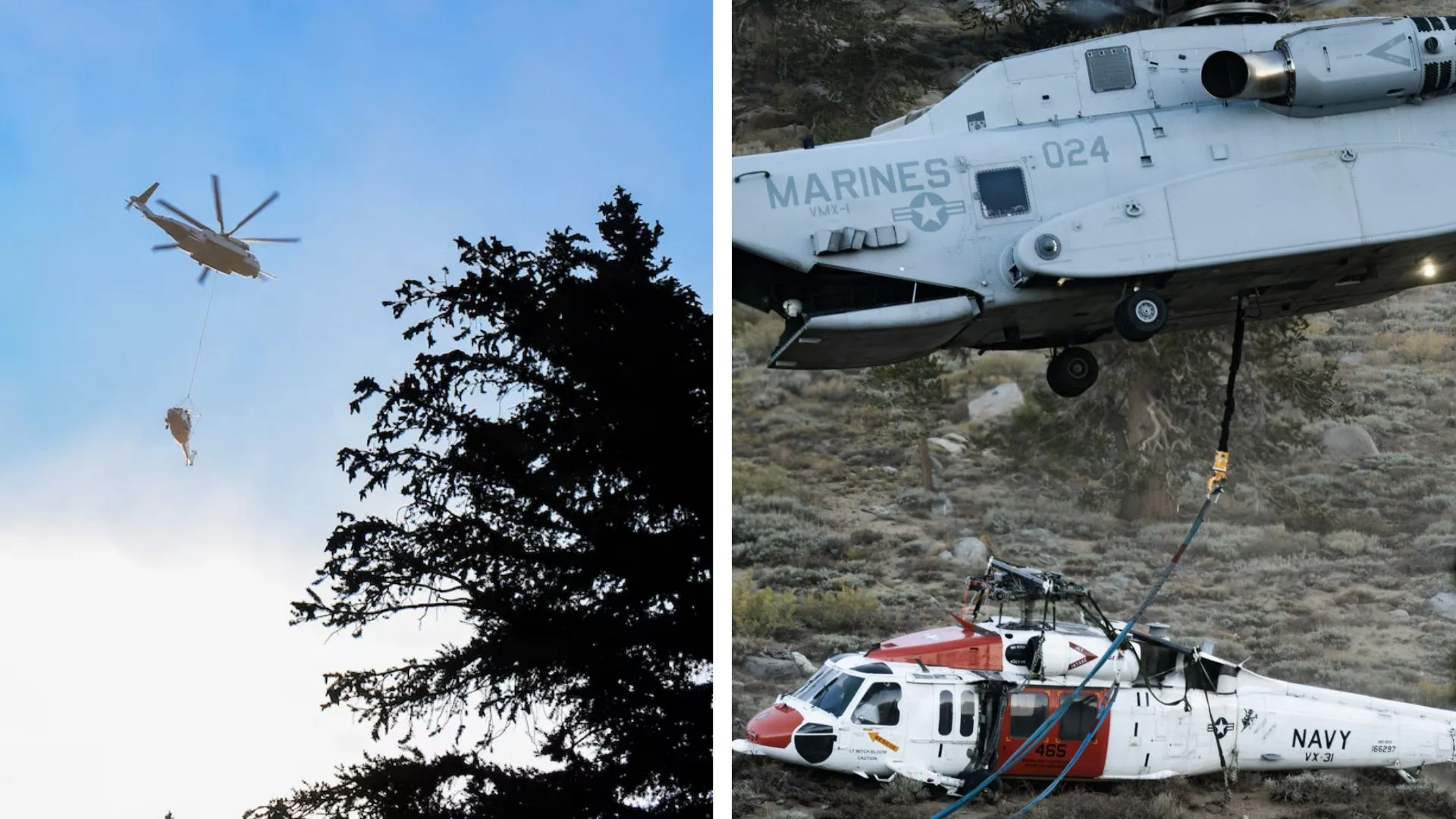
A powerful US Navy helicopter was recently recovered using the CH-53K King Stallion helicopter. The US Marine Corps CH-53K King Stallion recovered a crashed MH-60S Seahawk from the Sierra Nevada mountains.
The nearly 16,000-pound aircraft was recovered by a Marine Operational Test and Evaluation Squadron (VMX) 1 CH-53K using a U.S. Marine Corps helicopter sling-load rigged “long line” and delivered to an airfield at the Naval Air Weapons Station in China Lake, California. Because the MH-60S was recovered without incident or damage, it can fly again without extensive maintenance.
A special rigging configuration was used to recover the helicopter
The US Navy announced that the recovery used a special rigging configuration developed jointly with the Naval Air Warfare Center Aircraft Division (NAWCAD) Cargo Lab and the Maritime Industrial Base and the NAWCAD Structures Lab.
“The most difficult part of this recovery wasn’t necessarily lifting the H-60. It was figuring out how to do it safely without causing additional damage,” said Maj. Lee Henderson, VMX-1 pilot and lead planner.
“We incorporated proven lifting procedures for the MH-60S crane and lifting sling with a 70-foot line to ensure proper load distribution and obstacle clearance.”
Because the longline used in the recovery is longer than a standard U.S. Marine Corps slingline used by the military in slingload operations, the recovery operation provided an opportunity to certify the CH-53K for use.
MH-60S could not take off due to the slope of the terrain
The MH-60S, belonging to Air Test and Evaluation Squadron (VX) 31, landed hard at an altitude of 10,000 feet but suffered no damage. Due to the slope of the terrain, a start was not possible. The remote location and altitude made it more difficult to get personnel and equipment to the scene – meaning it would be extremely difficult to defuel the helicopter to save weight, a news release said.
Due to power requirements and limited terrain, the King Stallion is the only aircraft capable of performing the MH-60S recovery. The goal of the recovery operation was to keep the MH-60S in as “holistic” a condition as possible to avoid damage to any part of it. Experts from the Cargo and Structures Lab were brought in to develop the rigging procedures; Coordinate longline testing and certification. Perform long-term testing and data processing for final report. and be on site during recovery, according to the news release.
The H-60 Fleet Support Team at Marine Corps Air Station Cherry Point, North Carolina, was also consulted to provide guidance on how to properly configure the MH-60S for lifting and make weight reduction recommendations.
Henderson also emphasized that the CH-53K’s available power, precise flight control system and ability to calculate instantaneous available power based on engine performance and environmental conditions in real time significantly reduced risk during this complex recovery and enabled precise, efficient execution.
The mission demonstrated the effectiveness of an integrated Navy and Marine Corps in a austere environment.
