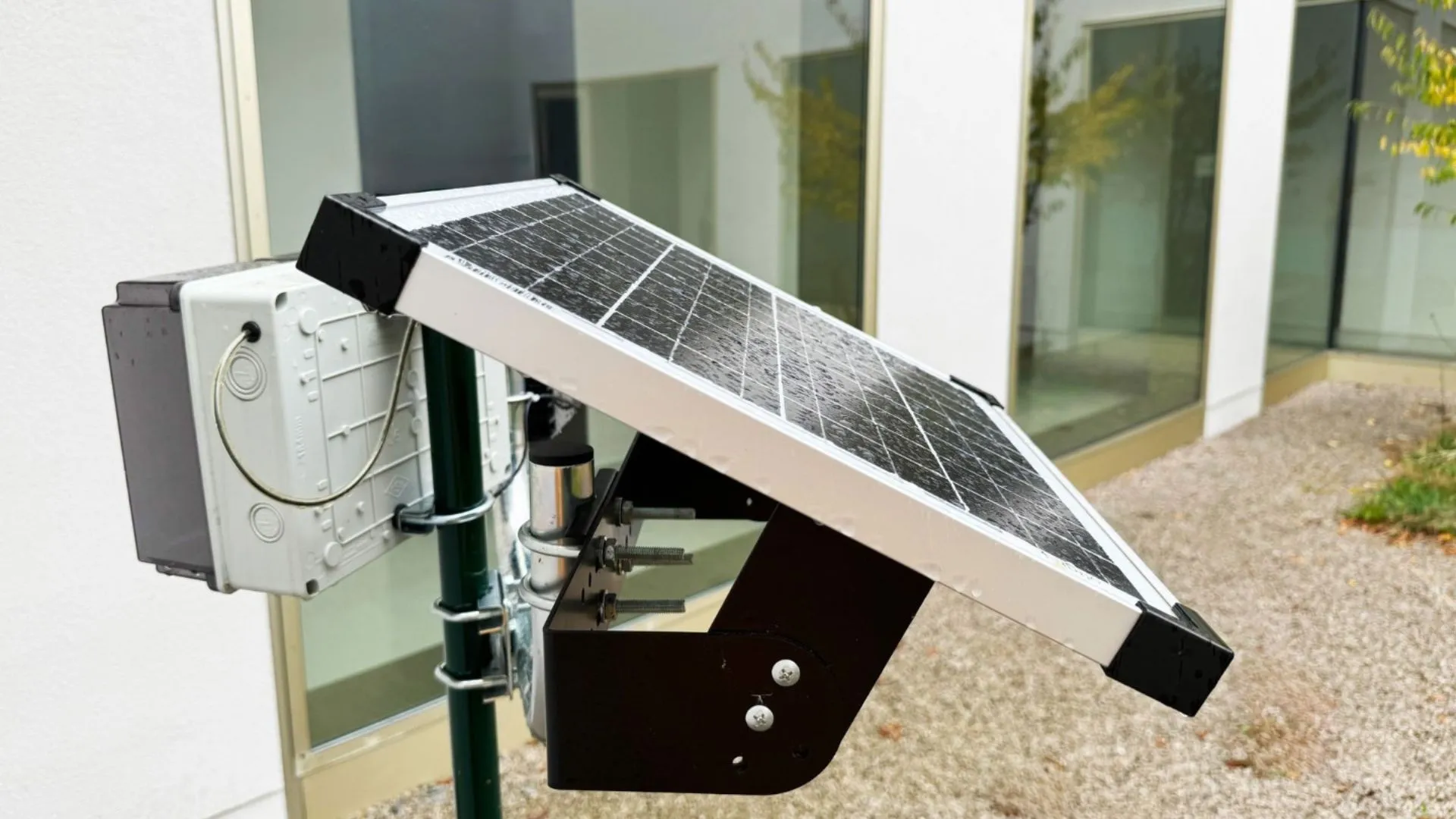
Scientists have developed a system that uses structure-borne sound sensors and machine learning to measure precipitation without moving parts.
The technology could complement traditional rain gauges. The system achieved an average error of 1.88 millimeters per hour.
Scientists have developed a new artificial intelligence (AI)-based rainfall monitoring system that can estimate light rainfall with an average error of just 1.88 millimeters (mm) per hour.
The new method, developed by researchers at Germany’s Fraunhofer Institute for Digital Media Technology (IDMT) and Pan Acoustics GmbH, analyzes the tiny vibrations created when raindrops hit solar panels. It offers a low-maintenance alternative for expanding weather monitoring networks.
The system uses structure-borne sound sensors and machine learning to measure precipitation without moving parts. The technology could complement traditional rain gauges by creating dense networks of low-cost measurement points that capture highly localized rainfall.
The researchers demonstrated the approach in the recently completed LokalRAIN project and tested the system in both laboratory experiments and outdoor installations. They are now looking for industry partners for further pilot deployments to evaluate the technology under a wider range of operating conditions.
“We have proven the feasibility of our approach for light rain,” said Jakob Bergner, scientific leader of the project at Fraunhofer IDMT. “Now we want to collect more data for the rarer heavy rain events and optimize the process for different operating conditions.”
Turning solar panels into precipitation sensors
The system attaches structure-borne noise sensors to photovoltaic (PV) modules. Each raindrop that hits the panel creates microscopic vibrations, creating unique acoustic signatures that vary depending on the intensity of the rainfall.
Instead of sending raw sensor data to remote servers, an AI model running on an energy-efficient microcontroller processes the information directly at the measurement site. Only the calculated precipitation values are transmitted, which significantly reduces power consumption and the need for WiFi bandwidth.
Pan Acoustics developed the hardware and software for the wireless communications network. In field tests, the system achieved transmission ranges of about 2.5 miles (4 kilometers) in urban environments and more than 22 miles (35 kilometers) in rural areas with clear line of sight, the statement said.
The data collected from multiple sensor nodes was then combined into a central data infrastructure to create localized precipitation maps.
Closing gaps in existing weather networks
Traditional rainfall monitoring relies on weather stations equipped with specialized rain gauges, which can be costly to install and maintain. As a result, many regions have relatively sparse monitoring networks, making it difficult to detect localized storms where rainfall can vary dramatically over short distances.
To validate the new approach, the researchers first conducted experiments in a rain simulator and tested different droplet sizes, precipitation intensities, photovoltaic modules and sensor placements.
They later used three external measurement systems at Fraunhofer IDMT in Ilmenau, at Pan Acoustics in Wolfenbüttel and in the weather garden at the Technical University of Ilmenau. The collected data was compared to reference rainfall measurements to train and validate the machine learning models.
At rainfall rates between 2 and 5 millimeters per hour, the system achieved an average error of 1.88 millimeters per hour, meeting the World Meteorological Organization (WMO) Class C accuracy requirement for low-intensity rainfall measurements.
From weather forecasts to risk management
The researchers emphasize that the technology is intended to complement rather than replace high-precision rain gauges.
A denser network of precipitation sensors could improve real-time monitoring of local rainfall and provide valuable data for urban digital twins, allowing municipalities and infrastructure managers to respond more quickly to flood risks. The information could also support drainage planning, insurance risk assessments and weather forecast models.
In addition, Fraunhofer IDMT is researching agricultural applications in another project that integrates the sensor network into agri-PV systems, enabling farmers to make more targeted irrigation decisions based on site-specific rainfall data.
Before commercial deployment, researchers plan additional pilot installations to collect more data during heavy rain events and to further refine the sensor housing, electronics and quality assurance processes required for production-ready systems.
