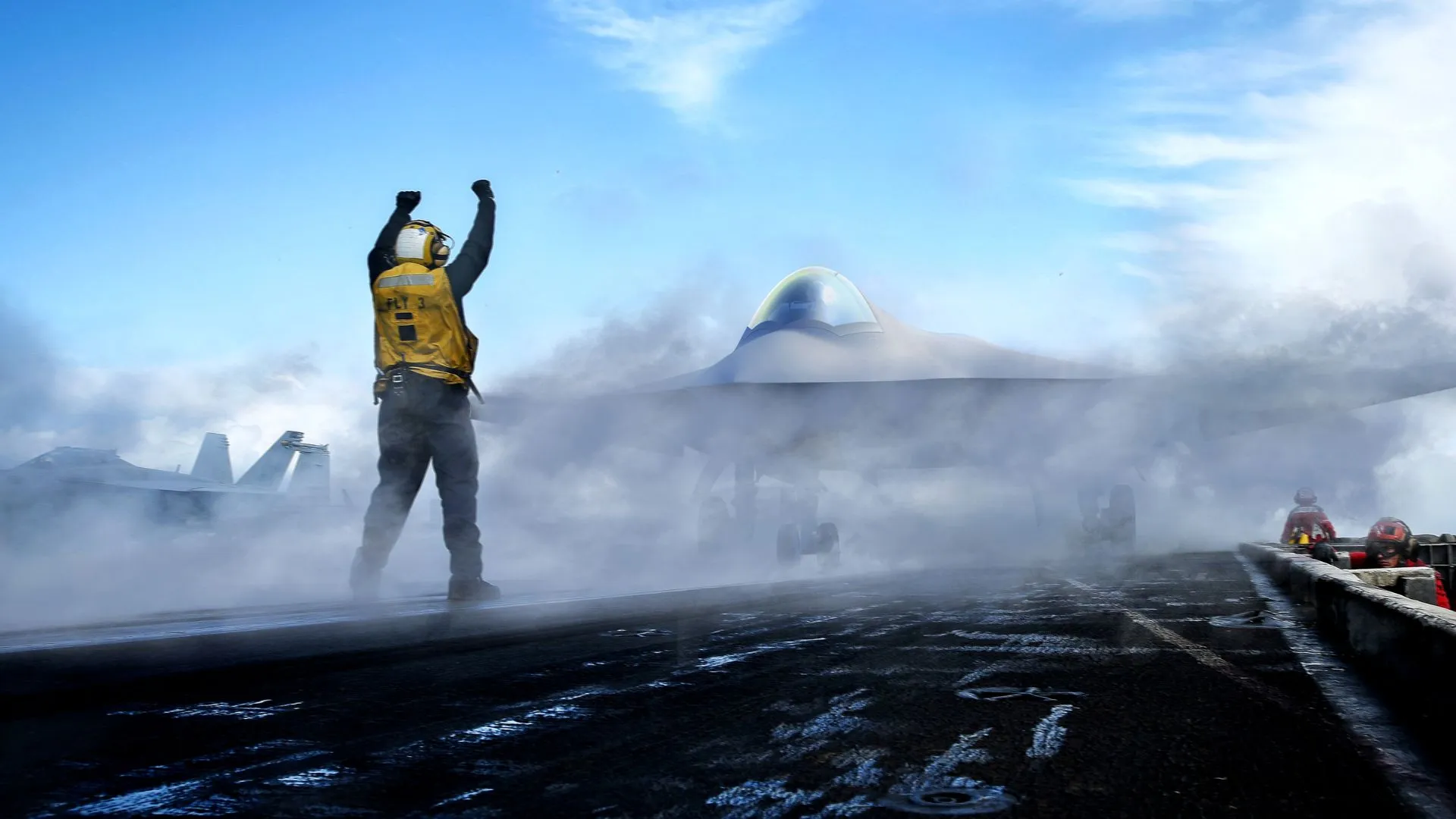
The Pentagon has awarded Boeing a $20 billion contract to build the U.S. Navy’s next-generation F/A-XX fighter, officials announced Tuesday. The sixth-generation aircraft will replace the Navy’s F/A-18 Super Hornet fleet beginning in the 2030s as part of the Next Generation Air Dominance program.
The carrier-based fighter is being developed to increase the range and survivability of U.S. naval aviation. It is also expected to operate alongside unmanned systems as the Navy develops a new generation of carrier-based aircraft.
The contract gives Boeing its second major U.S. sixth-generation fighter jet program after the company was tasked with developing the Air Force’s F-47 in 2025.
Boeing wins Navy fighter jet competition
Boeing competed with Northrop Grumman for the F/A-XX contract. The Navy said the new aircraft will include open mission systems architecture, advanced mission systems and greater operational range and capacity.
The approach is intended to give the fighter more flexibility as mission requirements and supporting technologies evolve.
“It is an honor to be selected to produce the Navy’s first sixth-generation platform. Supported by decades of work, underpinned by breakthrough innovations and bolstered by the investments we have made in new facilities uniquely suited to building multiple products with next-generation capabilities, our dedicated and talented team is ready to deliver this important program,” said Steve Parker, President and Chief Executive Officer of Boeing Defense, Space & Security.
Northrop Grumman confirmed Boeing’s selection after applying for the program.
“For the F/A-XX, Northrop Grumman has offered the U.S. Navy a highly survivable, digitally advanced, sixth-generation fighter,” Northrop said Tuesday. “We look forward to hearing more information about your selection.”
Super Hornet replacement is taking shape
The F/A-XX is expected to succeed the Navy’s F/A-18 Super Hornets in the 2030s. Its development is linked to the future of carrier aviation, in which manned combat aircraft will work together with unmanned aircraft.
At a hearing in May 2026, Chief of Naval Operations Admiral Daryl Caudle told a U.S. Senate panel that the next-generation system must “expand range, survivability and lethality” and is expected to be a system that can work with unmanned systems.
“Failure to deploy next-generation aviation capabilities on schedule poses risks to air superiority, strike range and the long-term viability of carrier-based operations in contested environments,” Caudle said.
The Navy has provided limited information about the aircraft as its technical and program details remain classified.
Boeing is preparing production facilities
Boeing said construction will continue at its secure manufacturing facility in St. Louis, Missouri. The company describes the site as the largest of its kind in the United States and plans to use it as part of a fully digital aerospace design and manufacturing system.
“Investing in facilities is only part of the story; we are also investing in technology and people so we can serve our customers,” Parker added.
The company says its investment is intended to support the production of future fighter jets, including the F/A-XX.
The classified fighter enters the next phase
The Navy’s contract kicks off an important phase in the development of a fighter whose design remains largely unknown. Boeing said the F/A-XX’s technical and programmatic details remain subject to U.S. national security and export laws.
“It was always our plan to deliver two advanced fighter aircraft in parallel and we have invested accordingly. We are ready and able to build multiple future fighter aircraft franchise programs simultaneously,” noted Parker.
Department of Defense Undersecretary of Defense for Acquisition and Sustainability Michael Duffey described the program as a long-term investment in U.S. air combat capabilities.
“The F/A-XX platform represents a critical, non-negotiable investment in America’s national security and long-term air combat capabilities,” he said. “We are joining forces with Boeing to leverage these capabilities.”