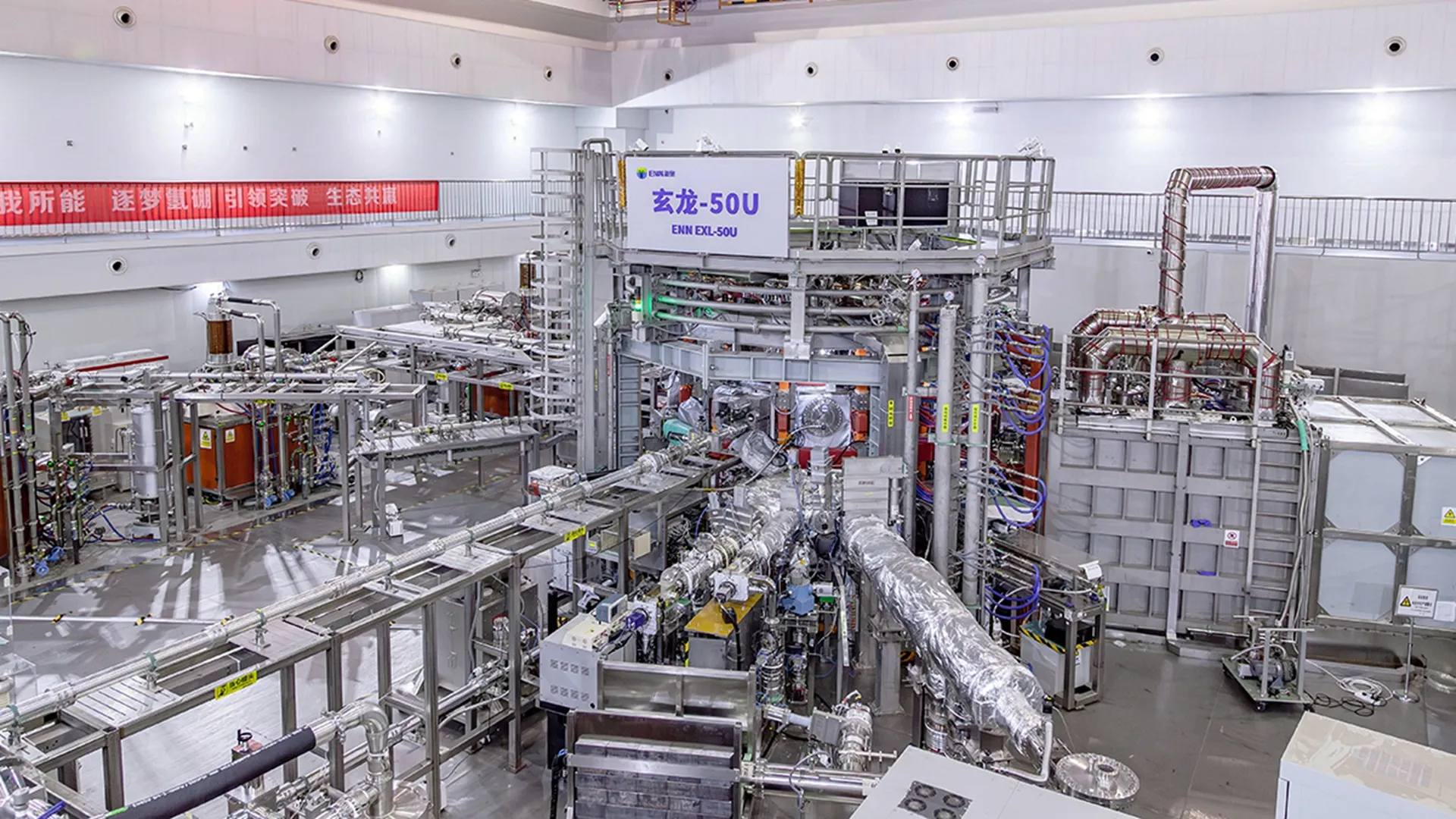
A clean energy company in China has just carried out hydrogen-boron fusion reactions at a rate of over 100 million per second in the EXL-50U spherical tokamak, the country’s first medium-sized spherical torus experimental device.
Hebei-based ENN Group said the experiment resulted in more than 100 million fusion reactions per second. It is the first hydrogen-boron fusion reaction performed by a commercial fusion company using its own device.
Unlike deuterium-tritium (DT) fuel, the primary fuel used in mainstream fusion research, hydrogen-boron fusion does not produce high-energy neutrons as a primary product. Instead, a hydrogen proton fuses with a boron-11 nucleus. The reaction releases energy and produces alpha particles or helium nuclei.
The company announced the success on Monday, September 28th. According to the researchers, it could provide new insights into hydrogen-boron fusion.
Milestone of the fusion reaction
Most fusion projects, including the International Thermonuclear Experimental Reactor (ITER) in France, focus on DT fusion because it can be carried out under less demanding conditions than alternative fuel cycles. It combines a deuterium nucleus with a tritium nucleus and produces helium-4, a high-energy neutron and an energy of 17.6 megaelectron volts (MeV).
However, tritium is radioactive, rare in nature and expensive. DT fusion also releases high-energy neutrons that can damage reactor materials and induce radioactivity in surrounding components. In contrast, hydrogen-boron fusion relies on comparatively abundant fuels and produces primarily charged alpha particles rather than high-energy neutrons.
Photo credit: ENN Group
However, hydrogen-boron fusion is much more difficult to achieve because it requires much higher temperatures and strict confinement conditions. So instead of trying to increase the temperature of the entire plasma, the team combined the injection of a high-energy neutral beam with radiofrequency waves.
This excited particles in an energy range in which hydrogen-boron reactions are more likely, the so-called first resonance peak. The process created large numbers of high-energy or fast protons in the plasma. These then collided with boron nuclei, helping to increase the fusion reaction speed to over 100 million reactions per second.
A race for fusion power
The company said more than 10 experts from international research institutes and universities reviewed the results. Meanwhile, repeatable measurements of the alpha particles produced during the experiment provided evidence that the hydrogen-boron fusion reactions had indeed occurred.
Yang Yuanming, an ENN engineer who led the fusion project, said hydrogen-boron fusion has attracted interest from private fusion developers including TAE Technologies of the United States and Marvel Fusion of Germany. He emphasized that hydrogen and boron fuels are abundant and easily accessible.
The approach could also offer another advantage. Hydrogen-boron fusion produces high-energy charged particles. Future systems may be able to convert their energy directly into electricity without using heat to generate steam and drive a turbine.
However, technical hurdles still need to be overcome before the reaction can be used in a practical power plant. The team is now working on bringing the plasma to more extreme conditions. “[We will] “Strive to get the plasma to 100 million degrees Celsius (180 million degrees Fahrenheit) as quickly as possible,” Yang said.
SCMP reported that the company is also moving forward with its next experimental platform. The groundbreaking ceremony for Helong-2, its third-generation fusion device, took place earlier this month.