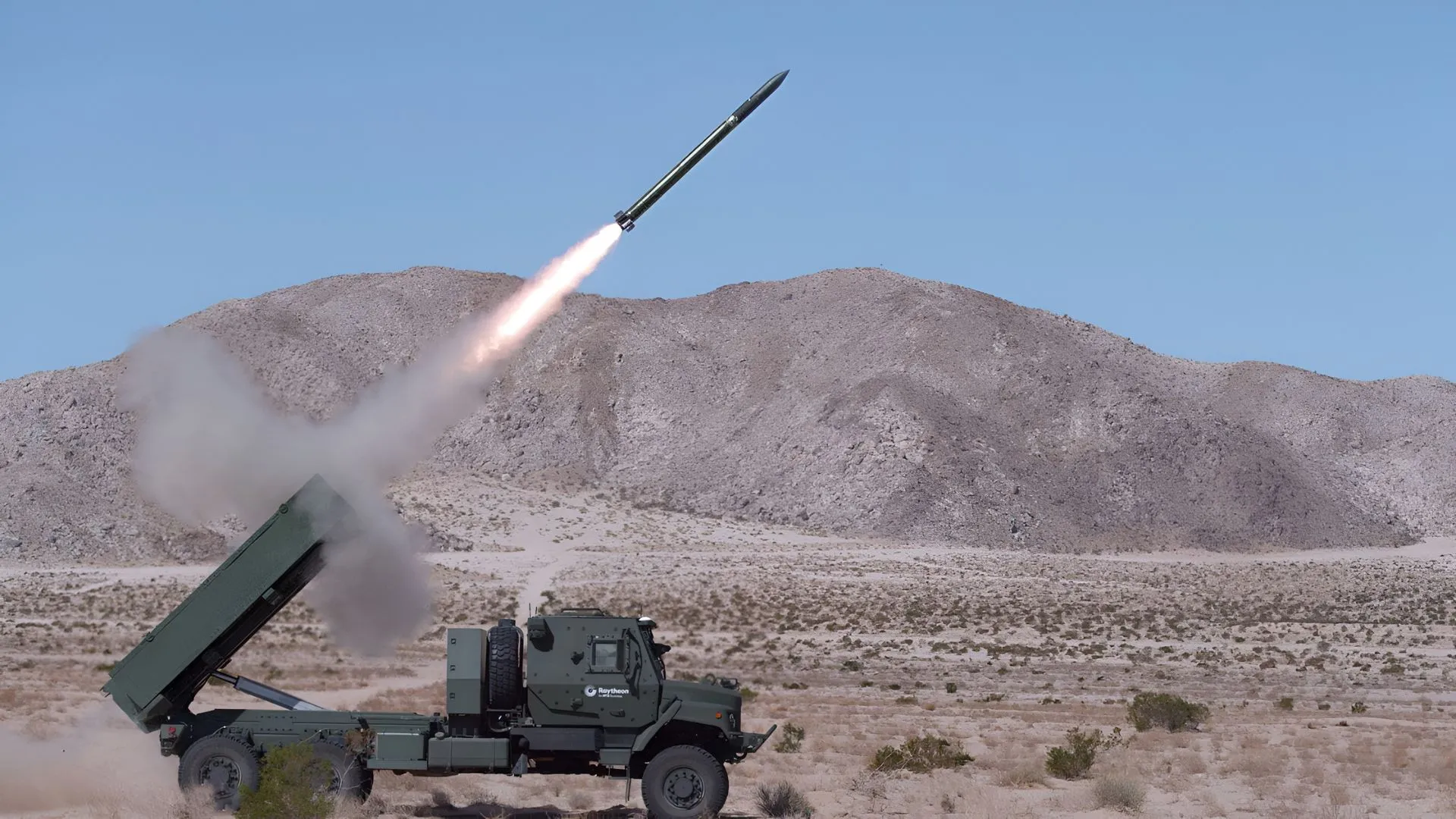
Raytheon has completed the third successful flight test of a new reduced-range missile system designed to make U.S. Army training more affordable. The DeepStrike JR3 system could replace the Army’s existing reduced-range training missile, providing a reusable launch container and a lower-cost missile for repeated exercises.
The test took place at the Yuma Proving Ground in Arizona. Raytheon fired multiple missiles in rapid succession, demonstrating several capabilities designed to meet the Army’s growing training needs. The results also bring the system closer to a formal qualification process, although further flight testing is still pending.
Reusable pods reduce costs
One of the central features of the system is the reusable starting container container. Rather than treating the entire launcher as disposable equipment, the design allows crews to reuse and maintain the container across multiple training exercises.
Raytheon also demonstrated the pod’s maintainability during Yuma testing. This approach could help the Army manage training costs by reducing the need to replace launch hardware after each exercise.
The JR3 rocket fits into the MFOM (Multiple Launch Rocket System Family of Munitions) capsule. Each pod can accommodate 24 missiles, making the system compatible with an established launch architecture.
This capacity could make the DeepStrike JR3 useful in various Army training missions. It also gives the service the opportunity to practice rocket artillery procedures without relying solely on more expensive operational munitions.
The test evaluated more than just the physical design of the launch system. Raytheon examined the missile’s range, trajectory and accuracy during the demonstration. Engineers also evaluated the visibility of the marking solution, which helps personnel see where training rounds land.
Commercial suppliers support production
Raytheon developed the JR3 rocket as part of a rapid prototyping initiative. The program also brings together established defense companies, smaller technology suppliers and government manufacturing facilities.
Its industry partners include Combined Systems Inc., Corvid Technologies, L3Harris Technologies and Northrop Grumman. The Letterkenny Munitions Center also contributes to the production effort.
This agreement is based on existing manufacturing capabilities and commercially available technologies. Raytheon wants to use this approach to reduce production time while controlling manufacturing costs.
The company’s strategy also addresses a practical challenge for military training programs. A replacement training missile must provide reliable performance without incurring the costs associated with operational weapons.
Brian Burton, Raytheon’s vice president of Precision Fires & Maneuver, said the JR3 combines expected training performance with lower cost and reduced complexity. He also noted that the reusable pod was an important part of the system design.
Further flight tests are imminent
The third successful demonstration gives Raytheon another opportunity to test the rocket before qualification. The company plans further flight tests to provide further evidence of the maturity of the design.
These trials will help determine whether the JR3 can meet the Army’s technical and operational needs. Its ability to support repeated launches, maintain consistent accuracy and simplify training logistics will continue to be key evaluation points.
The Army’s existing reduced-range training rocket provides a training alternative to operational rocket ammunition. A replacement could help preserve valuable live-fire training opportunities without requiring the service to use up its full-capacity ammunition.
DeepStrike JR3 is not yet a qualified replacement. However, the latest flight demonstration represents another milestone toward that goal, with affordability and reusable launch hardware at the heart of its development.
