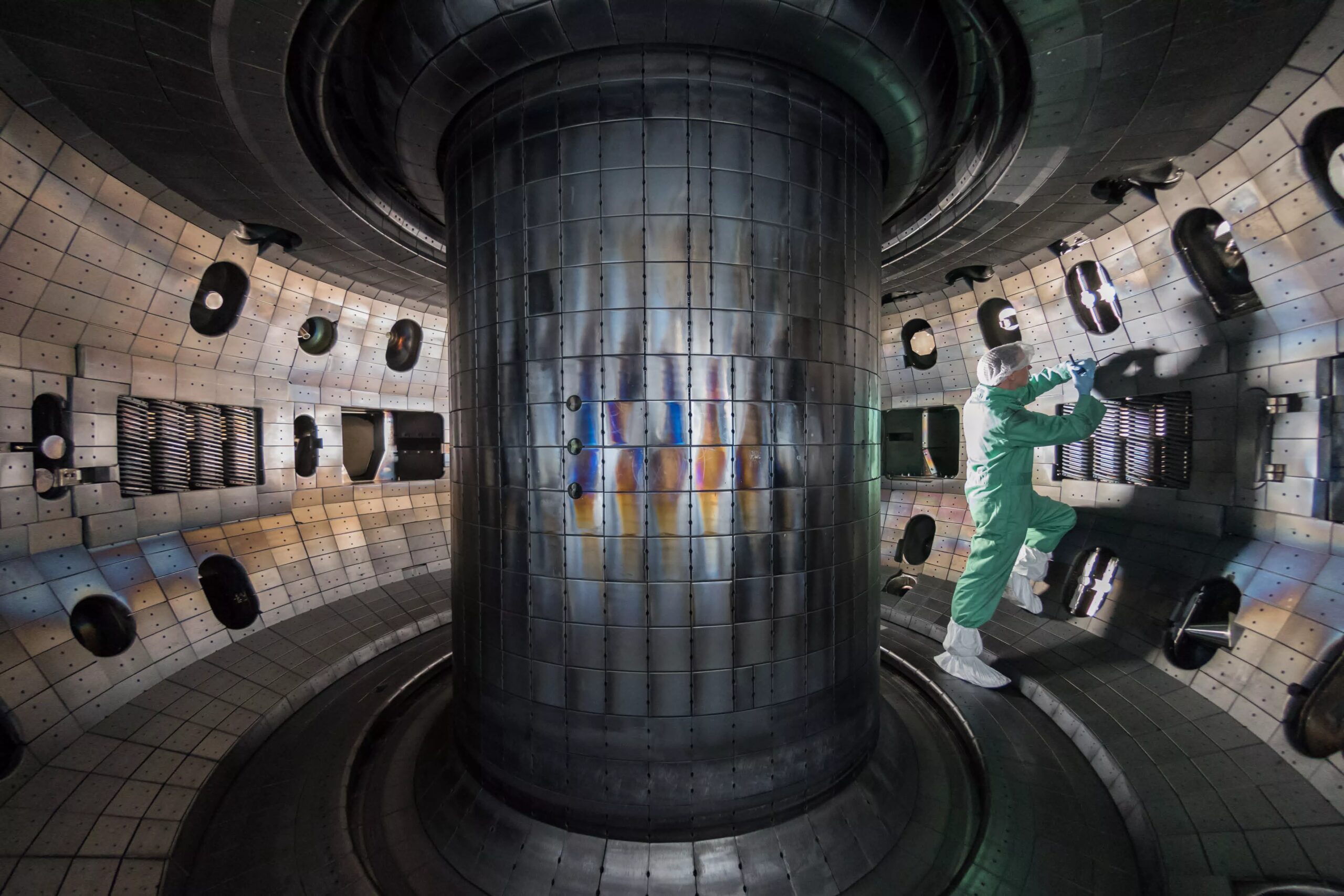
Why it matters: A fusion power plant only makes sense if it can run for days, similar to the coal and gas power plants it would replace. However, most tokamaks still operate intermittently because the giant magnetic coil that drives their plasma stream must eventually stop and restart. Physicists in San Diego have now shown that radio waves can carry some of that load instead, using a trick that no experiment in the 1980s managed to achieve.
The coil in question, a central magnet, functions largely like a transformer. It constantly increases its own current to induce a current in the plasma, but eventually it runs out of room to ramp up. These stop-start cycles also wear on the machine over time, so engineers would prefer to operate a reactor in a steady state.
The new method, called Helicon Current Drive, gets around this problem by beaming 476 MHz radio waves into the plasma, where they drive electrons and keep current flowing without the help of the coil. Bob Pinsker, a General Atomics physicist involved in the new work, was among those who tried it at the time. He told the American Nuclear Society that the theory predicted a very weak effect in plasmas from the 1980s, so researchers were “kind of hoping for a miracle.”
This miracle never materialized, so the idea lay on hold for decades. Today, however, DIII-D can produce plasmas that are quite close to reactor conditions. In addition, General Atomics built a “comb-line” antenna with 30 radiating elements, more than twice as many as previous tokamak antennas, to radiate the waves more efficiently.
The team has now published the results in Physical Review Letters. During each test, the antenna coupled approximately 370 kW into the plasma for a full second. This was enough to drive about 20 kA of current near the core. Comparative images using microwave heating of similar intensity showed no such effect, so heat alone cannot explain it.
Still, the plasmas in these tests carried a total of about 1 mA of current, so the helicons only provided about 2% of that. So realistically, Helicons won’t allow anyone to retire the coil anytime soon. Instead, they could become one of several current propulsion tools that a future reactor uses simultaneously. This is important because every watt a system uses to maintain its power is a watt it cannot sell to the grid.
Meanwhile, China’s EAST, which held a plasma for a record 1,066 seconds last year, and France’s WEST are already bypassing the coil over long distances with lower hybrid waves. But these waves have trouble in dense plasma, so they would be useful in a power plant mostly near the edge. Helicon waves are not expected to hit this density wall at all.
