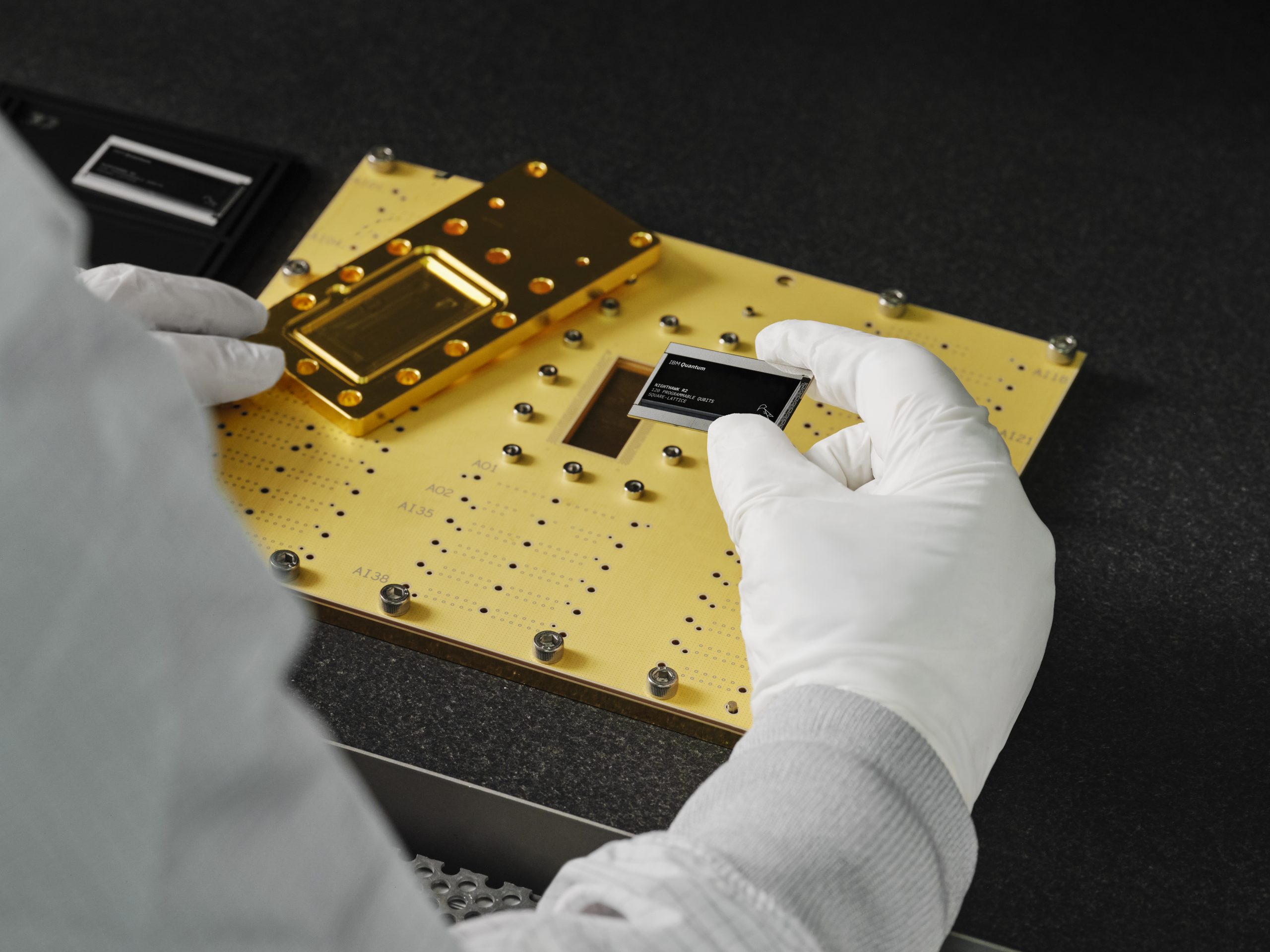
IBM Corp. today announced the Quantum Nighthawk r3, its next-generation processor designed to handle larger, more complex calculations at high speed while maintaining quality.
The company also announced that in 2027, IBM plans to combine two r3 quantum processors into a single system capable of performing up to 10,000 quantum operations, scaling between them to more than 1,000 qubits.
“Useful quantum computing depends on being able to deliver results with accuracy and speed, both of which are fundamental,” said Jay Gambetta, director of IBM Research. “IBM Nighthawk is already showing us what that looks like.”
The new r3 chip follows the launch of the Nighthawk r2 in September, which supports more than 7,500 quantum operations on 120 qubits.
Qubits are the fundamental unit of logical information in a quantum computer, similar to the bit in a classical computer. Unlike classical bits, which can be 0 or 1, qubits can be 0, 1, or a “superposition” of both at the same time. This property allows quantum processors like IBM’s Nighthawk to perform fast, complex parallel calculations.
The R2 chip introduced a breakthrough high-speed qubit reset architecture, allowing developers and researchers to quickly prepare qubits after measurements. Under normal circumstances, after executing a quantum circuit and measuring the result, the qubits must return to the ground state before the next program can be executed. This process can take hundreds of milliseconds, leaving the chip idle during this time. With the new technology, this waiting time can be reduced from about 200 milliseconds to about 25 nanoseconds without disturbing neighboring qubits.
Scaling to more than 1,000 qubits
Building on the lessons learned from Nighthawk r2 and the technology it integrates, IBM said r3 will extend the same high-speed architecture to larger quantum systems to support 10,000 operations on 520 programmable qubits with 2,034 physical quantum components.
A physical qubit is the actual hardware-level quantum device that stores the quantum information. In Nighthawk, the qubits are superconducting and arranged in a square lattice. The programmable qubits are the measurable, active quantum data units that are supported by other quantum components such as couplers and reset elements.
IBM said it had already demonstrated two key technologies that would enable the combination of two R3 chips. This year, the company connected two Nighthawk r1 processors using four L-couplers, or “long-range” quantum interconnects. These act as a physical bridge between separate processors to create a larger machine.
During the demonstration, the couplers achieved a transmission fidelity of 99.4% and thus approached the goal of a transmission fidelity of 99.9%. The company has also connected cryogenic modules into a single system.
In 2027, IBM intends to use these modularity advances to scale Nighthawk into a larger quantum system. By combining two Nighthawk r3 processors into a single 1,040 system, IBM extends this high-performance architecture to handle larger and more complex calculations.
“As we scale this architecture to larger and more powerful quantum computers, quantum computing capabilities will reach new levels as we connect more closely with classical resources and advance toward fault tolerance,” Gambetta added.
A bridge between quantum technology and classical on a single platform
IBM also announced that its cloud-based service for researchers and developers, IBM Quantum Platform, will bring together powerful classical and quantum computing in a single managed environment.
Users can now integrate quantum workflows directly with HPC and classical resources on the platform, or with classical computing power on their laptop or one of the world’s most powerful supercomputers.
By integrating quantum and classical computing, traditional computers can orchestrate algorithms and calculations on dedicated central processing units and graphics processors while the quantum computer performs parallel calculations. Users are already seeing promising results, including the Cleveland Clinic, which is using the platform to process 2.6 million samples up to three times faster to model biological structures.
Direct integration of quantum and classical systems will also help drive breakthroughs in quantum error correction. Error correction is fundamental to dealing with the noise that can destabilize individual qubits, making the probability of errors in calculations high. Quantum Platform introduces pulse-level access to give researchers precise control over how they can detect, understand and correct errors in quantum and classical architectures.
IBM, in collaboration with Advanced Micro Devices Inc. and the Quantum Science Center at Oak Ridge National Laboratory, recently launched a new quantum error correction platform that addresses this problem. The build physically combines Nighthawk processors with next-generation AMD GPUs and CPUs.
Image: IBM
Support our mission to keep content open and free by interacting with theCUBE community. Join theCUBE Alumni Trust Networkwhere technology leaders connect, share information and create opportunities.
- Over 15 million viewers of theCUBE videosto spark conversations about AI, cloud, cybersecurity and more
- Over 11.4k theCUBE alumni — Connect with more than 11,400 technology and business leaders shaping the future through a unique, trusted network
Founded by tech visionaries John Furrier and Dave Vellante, SiliconANGLE Media has built a dynamic ecosystem of industry-leading digital media brands, reaching over 15 million elite tech professionals. Our new proprietary theCUBE AI Video Cloud is a game-changer in audience engagement, leveraging the theCUBEai.com neural network to help technology companies make data-driven decisions and stay at the forefront of the industry conversation.
