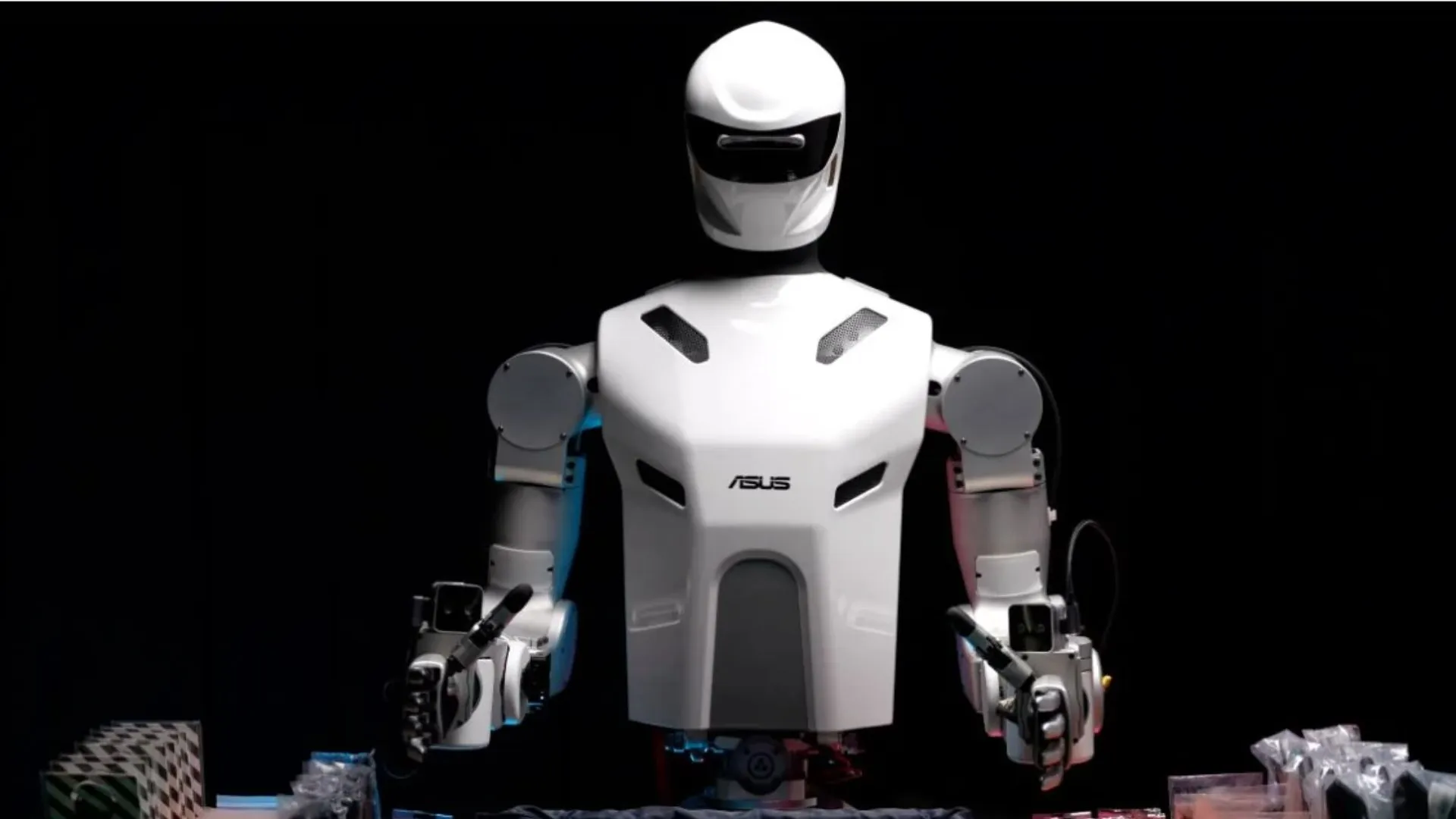
Taiwanese technology company ASUS is developing a humanoid robot called Gallop to automate repetitive tasks in electronics manufacturing. The robot’s customer pilot programs are planned for 2027 and commercial availability is targeted for the second half of 2028.
The robot is currently being tested at an ASUS Group electronics manufacturing services (EMS) factory, where it is learning to package motherboard accessories in a workplace designed for human workers.
According to ASUS, Gallop is being developed to demonstrate that humanoid robots can consistently perform real-world factory operations rather than just staged demonstrations.
Humanoid learns factory
Gallop’s first task is to pack 15 different motherboard accessories, many of which are small, thin and packaged in clear plastic bags. For conventional robot grippers, the task is a challenge due to the different shapes and flexible materials.
ASUS said it selected the workstation to test whether Gallop could take responsibility for the majority of an operation without having to have a human worker remain at the side throughout the process.
The company has developed a training process that combines human demonstrations, simulation and practical exercises. With their permission, experienced factory workers wear small, head-mounted cameras to record how they perform certain operations. Gallop uses this information to learn the movements and handling techniques required for the job. The simulation software then generates variations of the demonstrations to help the robot deal with subtle differences in working conditions.
The training process also includes virtual reality (VR), where an operator wearing a headset and gloves guides Gallop through tasks using the same components and cameras found in the actual workplace. After use, the robot’s recorded experiences are also incorporated into its training process.
The company aims to achieve 99.5 percent task completion within 20 seconds, which is the same time it takes a human worker to complete the same task.
Gallop is getting smarter
ASUS has divided Gallop’s AI architecture into four levels: planning, monitoring, capabilities and control. The planning level interprets the environment and divides a process into individual steps. A separate monitoring AI monitors these actions and can revise the plan if something goes wrong. The capability layer manages movements such as grasping, grasping, and placing objects, while the control layer operates the robot’s arms and hands.
The architecture uses fixed interfaces between the different layers, allowing ASUS to replace AI models as improved versions become available without having to redesign the entire robot. The system runs on a single NVIDIA Jetson AGX Thor computer installed in Gallop, along with standard robotics software.
ASUS develops the robot’s body and dexterous hands in-house. The hands are particularly important because they must manipulate small components while using tactile sensations to understand physical contact. Other components, including engines, are sourced from established industry partners.
Gallop currently operates from a fixed base equipped with two arms. ASUS plans to introduce a wheeled version next year and integrate its in-house skilled hand. The company also plans to demonstrate the robot to customers ahead of planned pilot deployments at Computex 2027.
Electronics manufacturing will be its first target market, although ASUS sees potential applications in hospitals and other service environments. The company believes that skills learned in one workplace could be transferred to other operations involving similar pick-and-place activities.
According to ASUS, Gallop is intended to handle repetitive and physically demanding tasks and not to replace factory workers. Employees involved in training the robot could instead take on roles that involve setting up, monitoring, and improving the robot’s performance.
The Gallop program began in early 2026. ASUS is targeting customer pilots in 2027 and market availability in the second half of 2028. However, the robot’s ability to achieve its factory performance targets remains an important part of its development.
