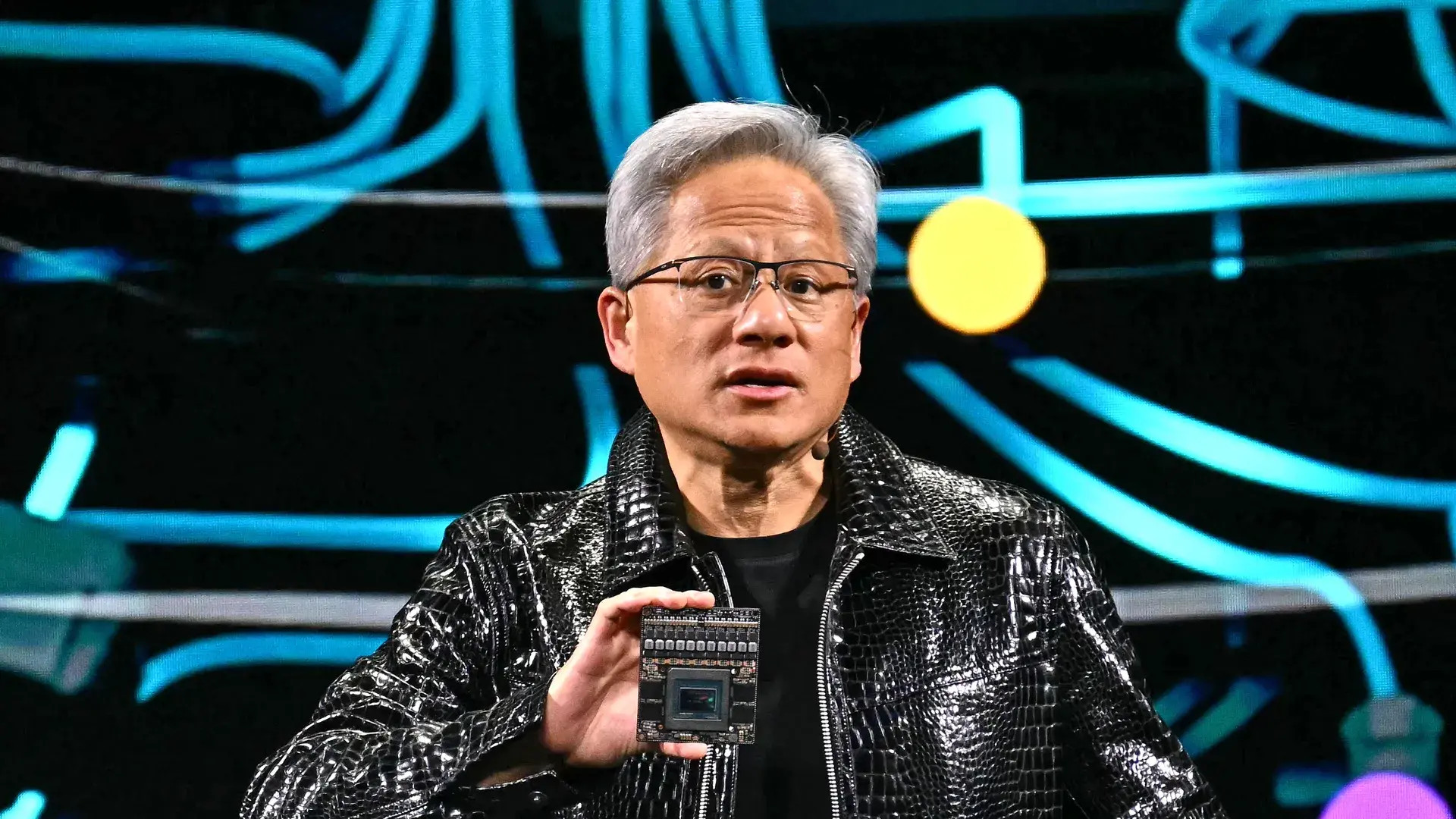
THE AFTERMATH: Jensen Huang’s resignation this morning ends Nvidia’s 33-year founding era, but not its history. There’s a search for a successor with no apparent candidate, an espionage case currently involving four administrations, a congressional hearing and a growing list of people offering their own suggestions to run the world’s top AI chipmaker.
Nvidia quickly moved to project continuity. In an internal memo, longtime director Harvey Jones told employees he would become the company’s first chief executive. Jones, a former CEO of Synopsys, has served on Nvidia’s board since its founding in 1993. The fact that Nvidia has never had a separate chairman to date says a lot about how much authority one person had.
CFO Colette Kress, who has been with Nvidia since 2013, will lead the company on an interim basis while retaining her finance role. CNBC reports that she is gathering the leadership team at headquarters in Santa Clara to talk about leadership and continuity. Your first real test: Nvidia will present its quarterly results in a few days, on November 17th.
Meanwhile, investors aren’t waiting and the immediate reaction was Nvidia shares initially falling more than 13%, briefly taking the company below its $4 trillion market cap before partially recovering by midday. Nvidia remains on track to post six consecutive weekly losses, its longest losing streak since 2012. Apple has reclaimed the title of the world’s most valuable company. Wall Street and everyone else is divided about what comes next.
No succession plan
Bloomberg reports that Nvidia has hired an outside firm to find candidates, but replacing Huang won’t be easy. For three decades, Huang combined extensive technical knowledge with tight operational control, running the company with a notoriously flat structure and dozens of direct reports.
Kress has emerged as the obvious choice for continuity, with the expectation that she will hold the seat for about a year before an outsider takes over. The name most often mentioned among insiders is Ian Buck, who leads Nvidia’s hyperscale and HPC business and is closely linked to the origins of CUDA.
Ben Bajarin called him the most logical choice, although Bloomberg noted that he lacks the operational experience typically expected of a CEO. Analysts also listed chief scientist Bill Dally, CTO Michael Kagan and 32-year veteran Jeff Fisher. Huang’s children, Madison and Spencer, both hold senior positions at the company, but even observers who mention them question whether either of them is ready.
The outside list is a who’s who of chip leadership: Arm CEO and former Nvidia executive Rene Haas, Intel’s Lip-Bu Tan, Apple’s hardware chief Johny Srouji, and AMD’s Lisa Su, who happens to be Huang’s first cousin after being ousted to head Nvidia’s most credible rival. Some analysts have even suggested a co-CEO configuration, where a technical lead works alongside an operator.
President Trump also has a favorite. He stated that only Tim Cook could follow in Huang’s footsteps, adding: “A legend replaces a legend!”
Meanwhile, Elon Musk is recruiting. Hours before the resignation, as reports of a possible ouster circulated, a user on X asked Musk to hire Huang. Musk replied: “That would be an honor.” He also endorsed a post arguing that Nvidia’s board should wait for its investigation to be completed before acting.
Is this game over for GeForce too?
This list should worry anyone buying graphics cards. If you look closely, you’ll see that most of these names have built their careers in data centers, finance, mobile chips or CPUs. Neither of them co-founded a company producing 3D graphics for PC games in 1993.
Huang did, and even though Nvidia was committed to AI, he never completely gave up on it. Even after Nvidia rebranded as an AI infrastructure company, he continued to remind the audience that it was GeForce that brought CUDA to the world and that the AI boom would not have happened without them. At GTC in March, he called modern Nvidia “the house that GeForce created.”
Nvidia’s gaming business reached a record $16 billion in the company’s last fiscal year, but the data center was still a rounding error. Then this year, Nvidia stopped reporting games separately and bundled them into a new “edge computing” section along with workstations, consoles, robotics, cars and telecommunications devices. Last quarter, the entire group brought in $7.2 billion, versus $89 billion from the data center. That’s just 7.5% of revenue for everything Nvidia sells outside of a data center, and there wasn’t a single mention of GeForce or gaming in the earnings release.
Under Huang, GeForce probably survived in part because of the spirit, the founder’s attachment to the company that built the company.
Gamers have been feeling the change for several years. As AI gobbles up the world’s memory supply, Nvidia reportedly reduced GeForce production by up to 40% in the first half of the year. Kress himself (now interim CEO) warned investors that supply bottlenecks would weigh on gambling in the future. It was widely known that no new gaming GPUs would be released this year, which would be the first such gap in about three decades.
Under Huang, GeForce probably survived in part because of the spirit, the founder’s attachment to the company that built the company. A successor without this history will look at the same table and see a comparatively unattractive consumer data center chip business competing for the same scarce memory and TSMC wafers. From there, options range from benign neglect to a spinoff or outright sale.
On the other hand, GeForce is still the entry point to CUDA for many developers and students. Consumer and data center GPUs share the same architecture, so much of the research and development is transferred.
Nvidia also supplies the chip inside Nintendo’s Switch 2. Untangling it all would be messy. A more realistic risk is not a sale, but a slow decline: fewer launches, longer gaps between generations, and graphics card prices being driven by how much memory remains after the data center business takes its share. (If the AI bubble bursts, that’s a whole different discussion.)
Whoever takes the job, it remains to be seen how much attention Nvidia will pay to GeForce in the next few years.
The spy story is getting stranger and stranger
The Wall Street Journal reports one of the most surreal details of the entire spy saga: Huang was introduced to Alice Huang by Kang Wei, a Chinese businessman and former star fund manager whom he had known for about a decade. According to people who know the couple, Kang was also Alice Huang’s husband.
Huang and Kang reportedly first crossed paths in the 2010s, when Kang’s company Shanghai Hexi was investing in video game companies and Nvidia was primarily a gaming chip company. For about two years, Kang appeared to accept his wife’s relationship with the Nvidia CEO, at times joking to employees that she worked as Huang’s assistant.
The Journal describes the pair as serial dealmakers who moved from gaming to pharmaceuticals to cloud computing. In 2023, they renamed a Singaporean company Megaspeed International, with Alice Huang as director. With Alibaba as a promised anchor customer, Megaspeed secured access to chips as an Nvidia partner.
According to the WSJ’s sources, Alice Huang and Kang Wei have been wooing investors for new data center projects, promising to triple their money in three years and expressing confidence that they could bring Nvidia chips to China.
People familiar with the matter say most of the servers went to Malaysian data centers for Alibaba, but some were also shipped to China. Megaspeed says it has complied with all export control rules, but the WSJ has sources saying the pair have been courting investors for new data center projects, promising them they would triple their money in three years and expressing confidence they could bring Nvidia chips to China.
The New York Times also reports today that the Singapore government has just announced that it has confiscated Alice Huang’s passport from June 2025 to February due to possible false statements related to Megaspeed. Due to lack of evidence, she was eventually released, given a stern warning and banned from re-entering the country.
What happens now to the “Central Bank of AI”?
Beyond Nvidia’s own shares, the GPU maker has become more than just a chip supplier under Jensen: It is an investor, financier and loan guarantor for much of the AI industry, with commitments that CNBC estimates at around $400 billion.
To name just a few of these data points: Shares of Nvidia-backed Neoclouds fell today, with CoreWeave down about 8%. Big commitments include the $12.9 billion acquisition of Hugging Face, which is currently under review, and a $10 billion stock purchase tied to Anthropic’s IPO next week.
However, this does not change Nvidia’s product roadmap. Vera Rubin is shipping, demand remains strong, and even though AMD stock is up about 30% in the last few days, there’s no way AMD could magically absorb Nvidia customers even if they all switched tomorrow.
AMD is not the only alternative either. Google now sells its TPUs to external customers like Anthropic and Meta instead of just renting them through its cloud, and Amazon has signed up Anthropic and OpenAI for gigawatts of Trainium chips. Intel remains the question mark. After a $5 billion investment last year, Nvidia is even involved, and its CEO is on some analysts’ list to lead Nvidia.
For 33 years, Nvidia’s succession plan was essentially Jensen Huang. It needs a real one now.
