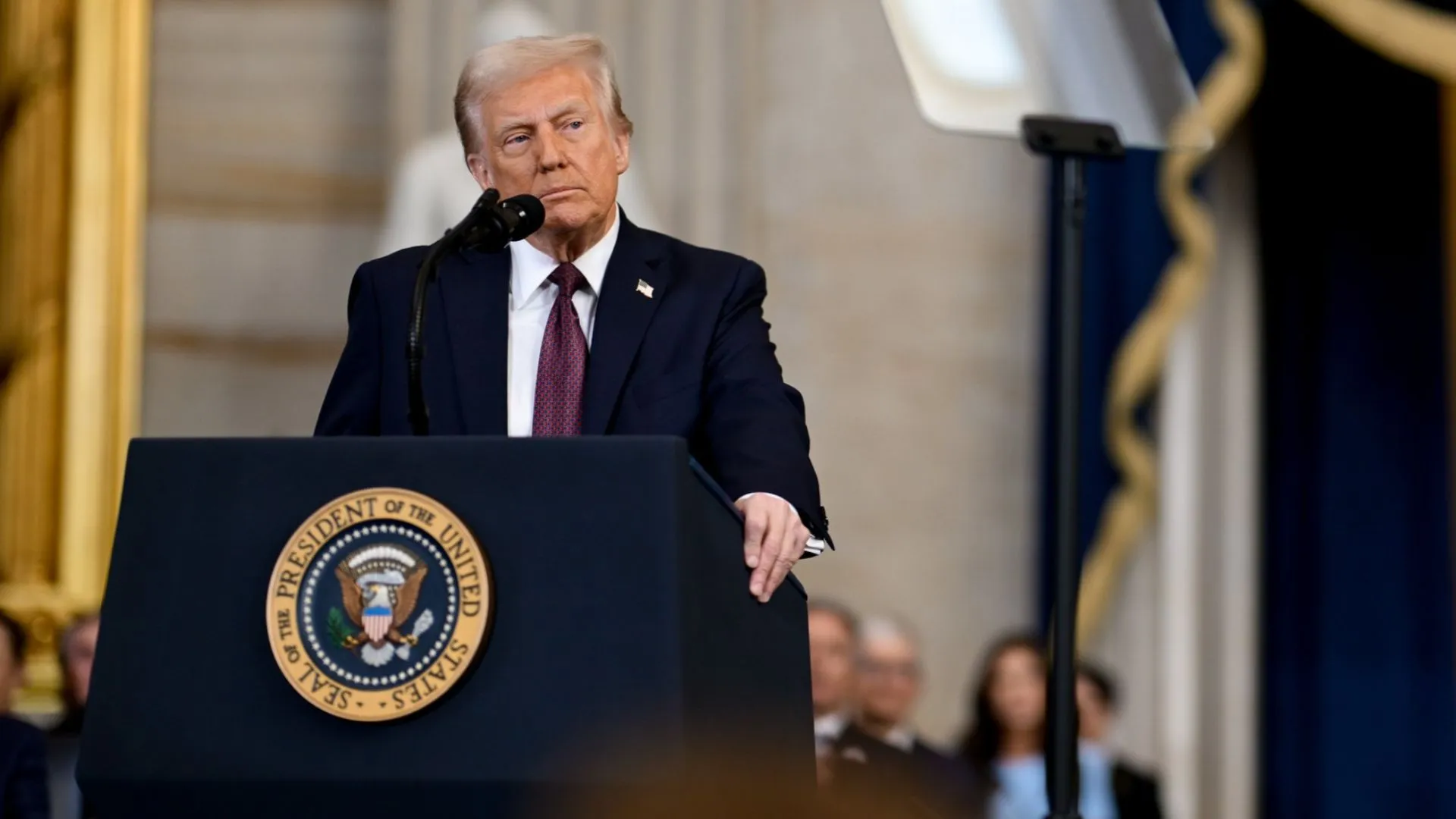
US technology companies could face steep financial penalties if they build artificial intelligence data centers outside the country. President Donald Trump announced the threat on Friday, arguing that overseas construction could give China greater access to critical computer infrastructure.
During a press conference at the White House, Trump said his administration would impose significant penalties on companies that pursue such projects. He did not outline a specific tax structure or explain how officials would enforce the proposed restrictions. Trump also admitted that he had not discussed the plan with his administration.
The warning adds another dimension to Washington’s efforts to maintain America’s technological edge over China. It also raises questions about how U.S. tech companies will approach their increasingly international infrastructure investments.
Trump wants infrastructure in his own country
Trump argued that American companies should prioritize construction at home rather than expanding their data center operations abroad. He suggested that communities should embrace these facilities while negotiating financial benefits with developers.
“They should use the data centers,” Trump said. He encouraged local authorities to ensure payments for their communities rather than blocking construction projects.
His comments reflect a government that wants to speed up domestic computing infrastructure. However, resistance from American communities has made this goal difficult.
Large data centers require a lot of power and supporting infrastructure. Their construction can also put additional strain on local power grids. Residents are increasingly asking themselves whether the economic benefits justify these demands.
The growing resistance has forced tech companies to rethink their approach to potential host communities. Several industry leaders are now promising more transparency and stronger financial commitments.
Tech giants face local resistance
Google and Meta have recognized the growing distrust of data center construction. Executives at both companies told the Associated Press that they are working to improve communications with communities.
Tech companies have also offered financial incentives to secure local support. Some developers are promising fewer tax subsidies and greater contributions to municipal infrastructure.
Environmental commitments have become another important part of these negotiations. Companies are trying to address concerns about resource consumption while defending the economic importance of data centers.
The political consequences extend beyond individual construction projects. Opposition to large establishments became a major issue in the midterm election campaign. Rising electricity prices also led to criticism of the industry’s growing infrastructure needs.
Democratic candidates capitalized on these concerns by promising greater oversight of energy-intensive developments. Local resistance has also led to obstacles to approval for companies applying for building permits.
Congress targets energy infrastructure
At the same time, Washington is pursuing legislation that could accelerate the expansion of domestic infrastructure. The Republican-led Senate passed bipartisan legislation on Thursday authorizing reforms. The proposal will now go to the House of Representatives.
The law’s goal is to shorten inspections for power plants, transmission lines and other large energy projects. These changes could help developers meet the power needs of growing data center networks.
Importantly, the proposal also aims to ensure that data center operators cover their electricity consumption. The developers would also contribute to improvements to the wider transmission network.
Trump praised the Senate legislation and predicted significant construction if it becomes law. His administration has also tightened restrictions on remote access to modern American computer chips and servers.
These restrictions target China’s ability to obtain American technology for training advanced artificial intelligence models. Taken together, these policies reflect Washington’s broader efforts to strengthen domestic computing capacity.
