Amazon Web Services Inc. is trying to solve two big problems for developers of artificial intelligence agents with a major update to Strands Agents, its open-source toolkit for building autonomous workers.
Today, the cloud infrastructure giant introduced a new family of open “decision models” called Strands Decider v2, along with the debut of Box CLI, which provides native sandbox support for popular coding agents such as Claude Code, Codex and Kiro CLI.
AWS launched Strands Agents back in May 2025, and recently the project has become the core of the company’s agent development strategy. Strands Agents is a software development kit that provides developers with a flexible, model-driven foundation for connecting large language models to enterprise data and tools.
After introducing Strands Harness, which enables Strands agents to be deployed in any computing environment, AWS followed suit a month later with Strands Decider. Unlike regular LLMs that focus on text output, Strands Decider is a category of decision models designed to evaluate scenarios and assign probability values to a given list of choices. At the time, AWS said decision models can help improve the efficiency of AI agent workflows, such as routing support tickets or choosing which software tool to invoke to complete a particular task.
More determined agents
With Strands Decider v2, AWS expands its offering with five even more powerful decision models. The open-weight models are based on Google LLC’s Gemma 4 architecture and are available in a range of sizes, from a lightweight edge version to a beefy variant with 31 billion parameters for complex decisions. In a blog post, AWS explained that the new models provide greater accuracy across text, image and video tasks and provide more optimal trust scores, allowing agents to better determine when it is OK to take an action or escalate to a human decision maker.
The Strands Decider v2 models also have the ability to handle longer inputs, including multi-stage agent execution protocols, allowing them to collaborate with other agents.
To date, AWS has only used the Strands Decider v2 agents internally, but has achieved impressive results. For example, engineers were able to replace Claude Sonnet 4.6 with Strands Decider v2 in the company’s largest internal ticketing system, reducing labeling costs by 98%.
They also reduced ticket response times by 78%. But that’s not all they can do – in its experiments, AWS said the new decision models demonstrated the ability to control robotic arms, evaluate other AI agents, and route routine queries to cheaper models when a more computationally intensive frontier model might be overkill.
The Strands Decider v2 models are now available to everyone under an Apache 2.0 license and can be found on Hugging Face and in the Strands Decider repository on AWS.
Security without sacrifice
Strands Decider is all about improving agent speed and performance while reducing costs. Meanwhile, Box CLI is all about securing them.
In a second blog post, AWS explained that many developers have moved to running their coding agents in what it calls “YOLO mode.” There they disable permissions and configuration prompts, allowing these agents to use their discretion to run terminal commands, edit files, and invoke third-party tools to complete a task. The name goes back to the colloquial saying “You only live once”.
Agents running in YOLO mode perform their work much faster, but do so at the expense of human oversight. And that is dangerous. An agent without limitations can accidentally delete files it shouldn’t, or reveal sensitive keys, or it can be manipulated by a malicious request to do something else that is extremely harmful.
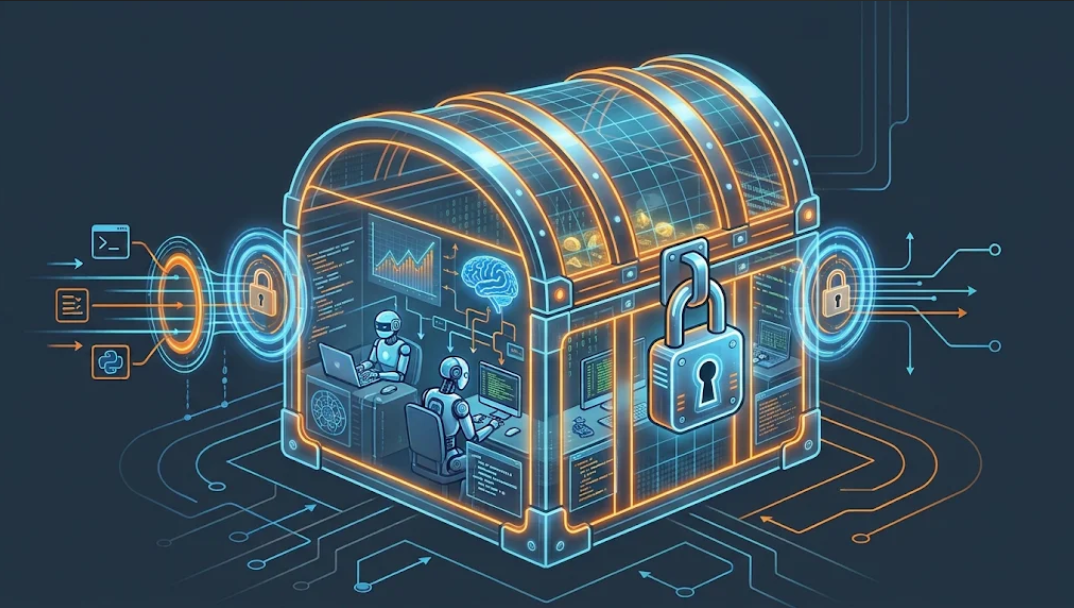
AWS’ solution to this is Strands Box, an open source operating system sandbox that enforces strict security policies with every agent action. Launched last month, with today’s update it gets a new Box CLI that provides support for encoding agents including Anthropic PBC’s Claude Code, OpenAI Group PBC’s Codex, and the company’s own Kiro CLI.
The idea is that developers can run their entire workflow in an isolated sandbox to prevent accidents. Within the sandbox, agents can work without restrictions, so they don’t have to constantly stop to ask a human developer for permission to do something important.
Instead, the developer simply applies security policies to protect the agent’s actions. These policies govern which files, commands and network hosts an agent can access, AWS explained.
The agent’s credentials reside outside of the sandbox, with application programming interface keys and AWS tokens only inserted when a policy-approved request leaves the sandbox environment. This way, the agent itself never has access to these sensitive keys.
According to AWS, developers also have the flexibility to switch between task-specific profiles, for example by granting a coding agent access to a repository and restricting a troubleshooting agent to read-only diagnostic access.
Like the new Decider models, Box CLI is introduced in Strands Box today. It’s a big step forward for autonomous agents, ensuring they can work without constant interruptions while remaining on a short leash.
Image: SiliconANGLE/Gemini
Support our mission to keep content open and free by interacting with theCUBE community. Join theCUBE Alumni Trust Networkwhere technology leaders connect, share information and create opportunities.
- Over 15 million viewers of theCUBE videosto spark conversations about AI, cloud, cybersecurity and more
- Over 11.4k theCUBE alumni — Connect with more than 11,400 technology and business leaders shaping the future through a unique, trusted network
Founded by tech visionaries John Furrier and Dave Vellante, SiliconANGLE Media has built a dynamic ecosystem of industry-leading digital media brands, reaching over 15 million elite tech professionals. Our new proprietary theCUBE AI Video Cloud is a game-changer in audience engagement, leveraging the theCUBEai.com neural network to help technology companies make data-driven decisions and stay at the forefront of the industry conversation.
