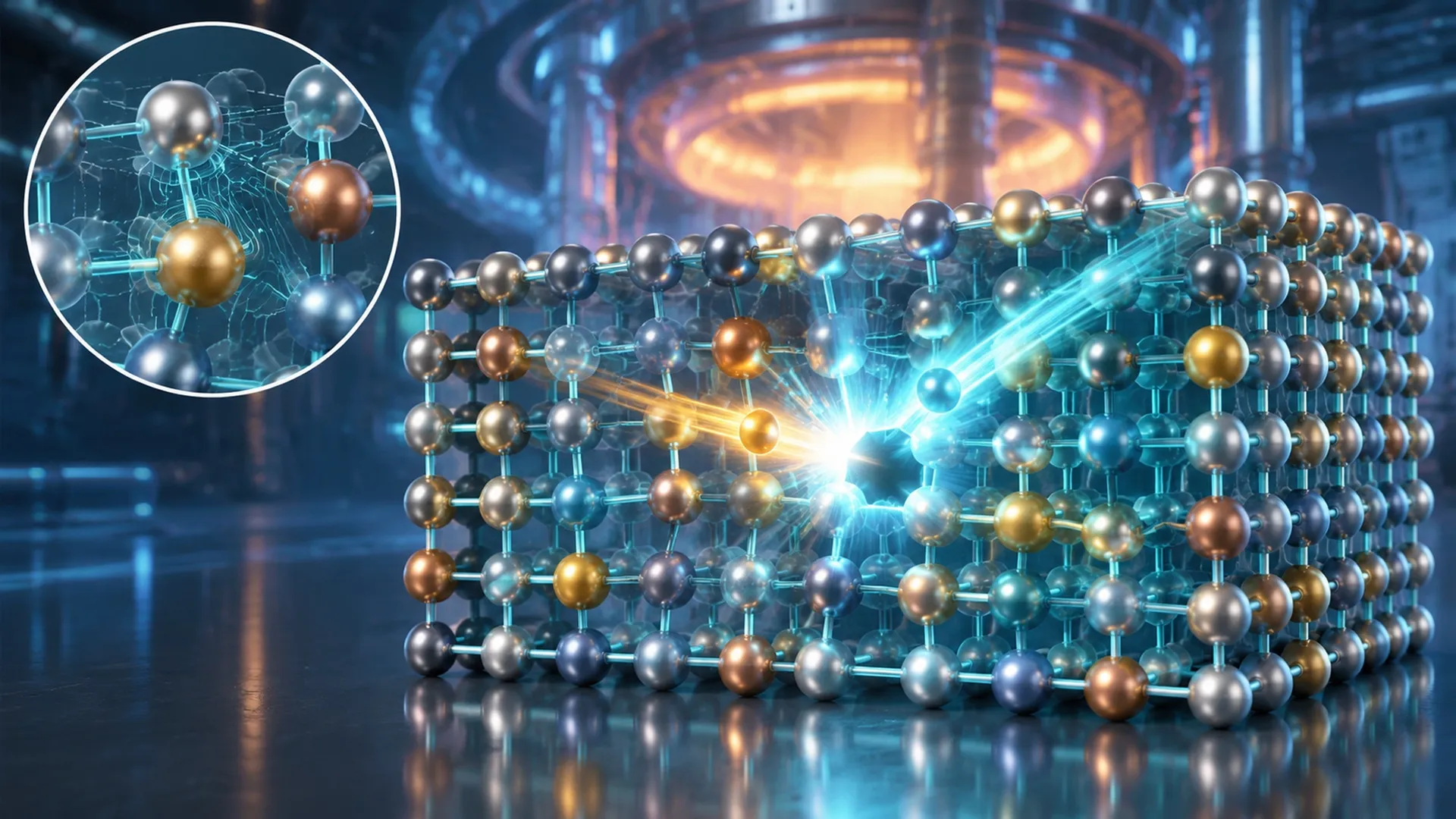
Researchers in China have reportedly found a new way to develop self-healing metal alloys that could withstand radiation damage in nuclear and fusion reactors.
The research was conducted by scientists from the Chinese Academy of Sciences (CAS) and Xi’an Jiaotong University in China’s Shaanxi Province. For the study, the team examined multi-principal element alloys (MPEAs), whose main components are several metals.
They found that tiny irregularities in the arrangement of atoms can influence how metals react to radiation damage. This finding could make it easier to develop alloys that can repair damage at the atomic level.
Guan Pengfei, PhD, a researcher at CAS’s Ningbo Institute of Materials Technology and Engineering (NIMTE) and lead author of the study, emphasized that the results could lead to stronger, longer-lasting materials for nuclear energy and aerospace. “This work provides a new avenue for developing radiation-resistant alloys for extreme environments,” Guan added.
Multi-principal element alloys (MPEAs) are materials made by combining multiple metals, typically three or more, in nearly equal or moderate proportions, rather than relying on one base metal. These include medium entropy alloys (MEAs), high entropy alloys (HEAs), and complex composition alloys (CCAs).
These alloys are typically characterized by strong mechanical properties, resistance to radiation damage, and flexibility in composition. Additionally, they hold promise for applications where traditional metals may not work well.
However, their development remains a challenge as scientists need to study how different combinations of elements behave when exposed to radiation. This may therefore require a lot of calculations.
Photo credit: NIMTE
According to the team, radiation can displace atoms from their normal position within a metal. This can lead to two types of defects, such as vacancies, where the atoms are missing from their usual positions, and interstitials, where the displaced atoms occupy spaces between other atoms.
As these defects move through the material and meet each other, they could reconnect and possibly even repair some of the damage. The team found that a property known as local lattice distortion (LLD) plays an important role in this process. LLD refers to small displacements of atoms from their ideal positions within a crystal structure.
Faster alloy discovery
To study the matter further, the researchers created a high-precision machine learning model that predicts interactions between atoms in alloys of zirconium (Zr), titanium (Ti), and niobium (Nb). It reproduced density functional theory (DFT) results and outperformed conventional interatomic potentials.
Simulations showed that larger local lattice distortion accelerates the movement of vacancies and slows the movement of interstitial sites. This reduces the difference in the speed of the two defects and facilitates their recombination.
The researchers also confirmed similar behavior with vanadium-cobalt-nickel and nickel-palladium alloys. This suggested that the effect is applicable to different metal combinations.
At the same time, the scientists developed compositional structures that show how the alloy composition affects the atomic structure. These could identify materials in which defects can more easily recombine and repair radiation damage. “We can now screen candidates for each composition without expensive calculations,” Guan concluded in a press release.
The study was published November 20 in the journal PNAS.
