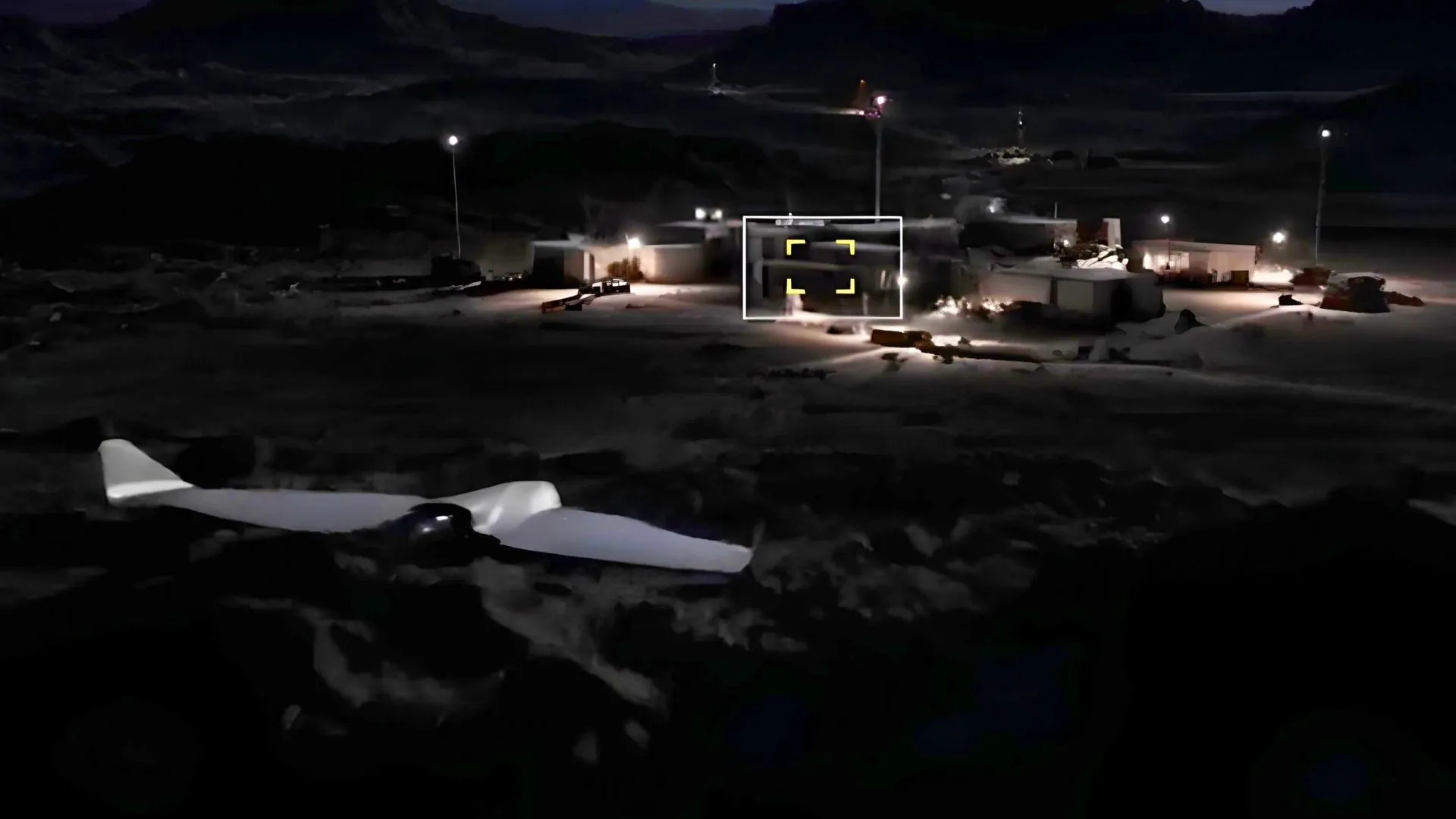
French defense startup Harmattan AI has unveiled IRIFI, an autonomous long-range attack system designed to operate at distances of up to 2,000 kilometers (1,240 miles). The system marks the company’s entry into the deep-attack market and is positioned as a lower-cost alternative to more traditional long-range missile systems.
IRIFI is designed to operate without satellite navigation and can be deployed from a mobile launch vehicle. According to Harmattan AI, the system is intended for rapid, large-scale deployment, potentially allowing multiple systems to be launched for coordinated attack missions.
Designed to operate without GNSS
According to the company, IRIFI uses onboard navigation that does not rely on GNSS. It is also designed for visual guidance in the final stages of a mission. According to Harmattan AI, the system can process information on board, fly at low altitudes to reduce the burden of radar detection, and achieve meter-level precision.
However, the company has not publicly disclosed IRIFI’s payload, speed, cost, testing history or customers, making it difficult to independently assess these performance claims. The system is intended for operations against targets such as logistics centers, airfields, command posts and other infrastructure.
Human authorization, autonomous execution
Harmattan AI describes IRIFI as autonomous rather than fully independent. Human commanders are expected to designate authorized targets and establish mission parameters before launch.
Once launched, the system is designed to execute the mission autonomously, with its navigation and terminal guidance occurring within these predefined parameters. The company summarizes the approach as “autonomy in mission execution, human authority over lethal actions.”
The startup also says artificial intelligence can process large amounts of satellite imagery to aid mission planning, allowing a single commander to launch dozens of systems.
Mouad M’Ghari, CEO and co-founder of Harmattan AI, contrasted the concept with existing systems such as the Shahed family of disposable attack drones and more expensive cruise missiles such as Tomahawk and Storm Shadow. He argued that AI-powered autonomy could combine the scalability of lower-cost systems with some of the capabilities associated with longer-range missiles.
The system is intended to close a gap between inexpensive disposable attack drones and significantly more expensive long-range missiles. The emphasis on canisterized launch and autonomous operation is also aimed at facilitating deployment of the system in larger numbers. The company describes this combination of range, autonomy and scalability as central to its approach to future deep strike missions.
Limited public details
Defense Blog reported that IRIFI is being developed as a long-range, one-sided attack system and noted that key specifications, including payload, speed, price, testing status and customers, remain secret. The publication also reported that Harmattan AI was founded in Paris in 2024 and raised a $200 million Series B round led by Dassault Aviation in January 2026, reportedly valuing the company at $1.4 billion.
IRIFI complements Harmattan AI’s existing portfolio, which includes the Gobi interceptor, the Sahara surveillance system and the Barkhan tactical attack platform. To assess how the system compares to established long-range weapons, we need details on testing, real-world range, payload and production plans.